Exploring the Meaning of Exallomai in Greek
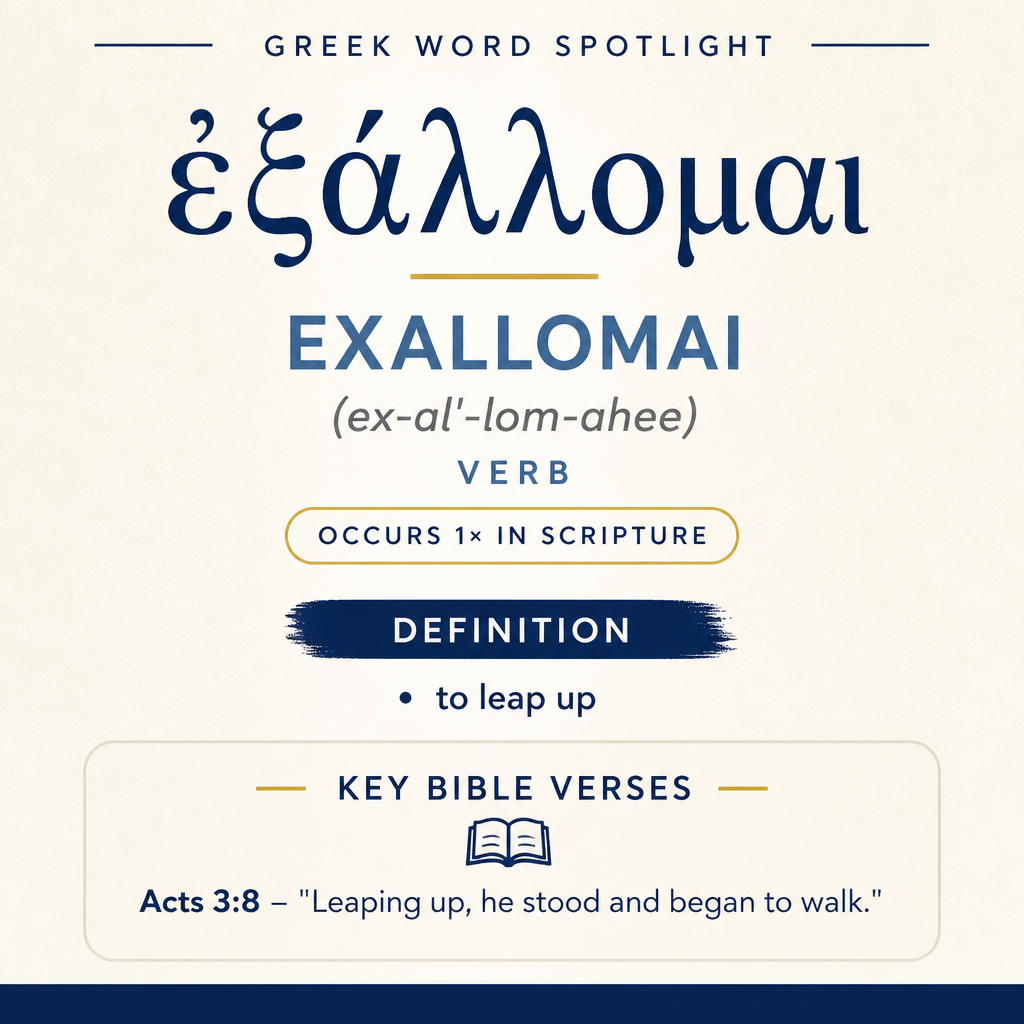
ἐξάλλομαι means “to leap up” and appears once in Scripture in Acts 3:8.
Core Meaning
ἐξάλλομαι is defined as “to leap up.” In Acts 3:8 it describes a sudden, upward leap.
Learn More →Biblical Usage
The verb occurs 1 time in Scripture. Its single occurrence is in Acts 3:8.
Learn More →Acts 3:8 Scene
Acts 3:8 says, “Leaping up, he stood and began to walk.” He entered the temple walking, leaping, and praising God.
Learn More →ἐξάλλομαι means “to leap up,” and it appears in the narrative of a healed man’s first movements in the temple precincts. The word captures a sudden, upward burst of motion that accompanies his transition from being unable to walk to active, public movement and praise.
Root and Related Words
ἐξάλλομαι is connected with the preposition ek (ἐκ), “out from” (Strong’s G1537), and with the verb hallomai (ἅλλομαι), “to spring” (Strong’s G242). Together these elements frame the verb as a springing motion marked by an “out-from” nuance: the movement is not merely a step forward but an energetic surge that breaks out into view.

Occurrences
“Leaping up, he stood and began to walk. He entered with them into the temple, walking, leaping, and praising God.” (Acts 3:8)
In Acts 3:8, ἐξάλλομαι occurs at the start of a compact sequence of actions: “Leaping up, he stood and began to walk.” The verb sets the initial bodily response to healing as immediate and vigorous. Before the text describes ordinary locomotion (“began to walk”), it places an upward spring (“Leaping up”) that signals sudden capacity and strength. The leap is the first visible evidence that something decisive has happened: he does not cautiously test his feet; he rises with a motion that is both quick and public.
The verse then widens from a single movement to a sustained pattern: “He entered with them into the temple, walking, leaping, and praising God.” The earlier leap becomes part of an ongoing rhythm of movement. The paired verbs “walking” and “leaping” show that his new ability expresses itself in more than one kind of motion. Walking is steady and continuous; leaping is intermittent and emphatic. By including both, the narrative portrays a whole-bodied response—stable movement alongside repeated bursts of exuberant motion. Within the same breath, “praising God” stands beside “walking” and “leaping,” so the leap functions as a physical counterpart to vocal worship: the body and the voice answer together.
Because the setting is the temple entrance and interior (“He entered with them into the temple”), the leap is also socially visible. The man’s movement is not private rehabilitation; it happens as he joins others (“with them”) and crosses into a place where people can see him. ἐξάλλομαι therefore contributes to the scene as an observable sign: the leap is a kind of kinetic announcement embedded within the narrative flow, drawing attention to the transformation without requiring explanatory speech.
Sense and Usage
The sense “to leap up” highlights a vertical, energetic motion, and Acts 3:8 uses it as a threshold action—what happens at the very moment a previously limited body enters full mobility. The sequence “Leaping up, he stood and began to walk” places the leap before standing and walking, giving it the character of an initiating surge. In ordinary experience, standing is often the prerequisite for walking; here, the leap is the first narrated response and thus carries the impression of suddenness and force. The verb’s contribution is not merely that the man moved, but that he moved in a way that breaks the expectations of slow recovery.
Within the same verse, the participial style (“walking, leaping, and praising God”) portrays ongoing activity rather than a single isolated jump. “Leaping” is coordinated with “walking,” suggesting that the leap is compatible with normal gait yet distinct from it. This coordination matters for the portrayal of healing: it is not simply that the man can now manage basic function; he expresses his new wholeness through repeated, vigorous motion. The usage presses the definition into a lived picture: leaping up is the kind of action that naturally draws eyes, communicates excitement, and refuses to be hidden.
The immediate context also anchors the verb to an affective and devotional response without changing its basic sense. “Praising God” stands alongside the physical verbs, but the leap itself remains a leap; it is simply placed in a frame where bodily motion and doxological speech are intertwined. The narrative does not treat leaping as random restlessness. It is the body’s fitting accompaniment to gratitude and astonishment, expressed in the same public space where he “entered with them into the temple.”
Because this is the sole attested occurrence in this set of texts, the word’s semantic profile here is shaped by narrative placement and collocation rather than by comparison across multiple passages. Acts 3:8 locates ἐξάλλομαι at the boundary between inability and ability, and it pairs the verb with standing, walking, entering, and praising. In that cluster, “to leap up” reads as a sign of immediacy (no delay), a sign of vitality (more than minimal movement), and a sign of visibility (performed while entering a public religious space). The verb thus functions as a vivid, concrete descriptor that helps the reader see the event rather than merely be told that it occurred.
Imagery
The imagery of ἐξάλλομαι in Acts 3:8 is intensely physical: a sudden upward spring that breaks into ordinary walking and then repeats as the man moves through the temple. The alternating cadence—walking, then leaping—sets a scene of motion that is hard to miss, and when joined to “praising God,” it presents a picture of worship expressed through the whole person in a crowded, sacred place.
Sources: Lexical data from Strong’s Exhaustive Concordance and the Translators Brief Lexicon of Extended Strongs for Greek (STEPBible, CC BY). Occurrence data from the Translators Amalgamated Greek New Testament (STEPBible, CC BY). Scripture quotations from the World English Bible (public domain).