Exploring the Meaning of Exagorazo in Greek
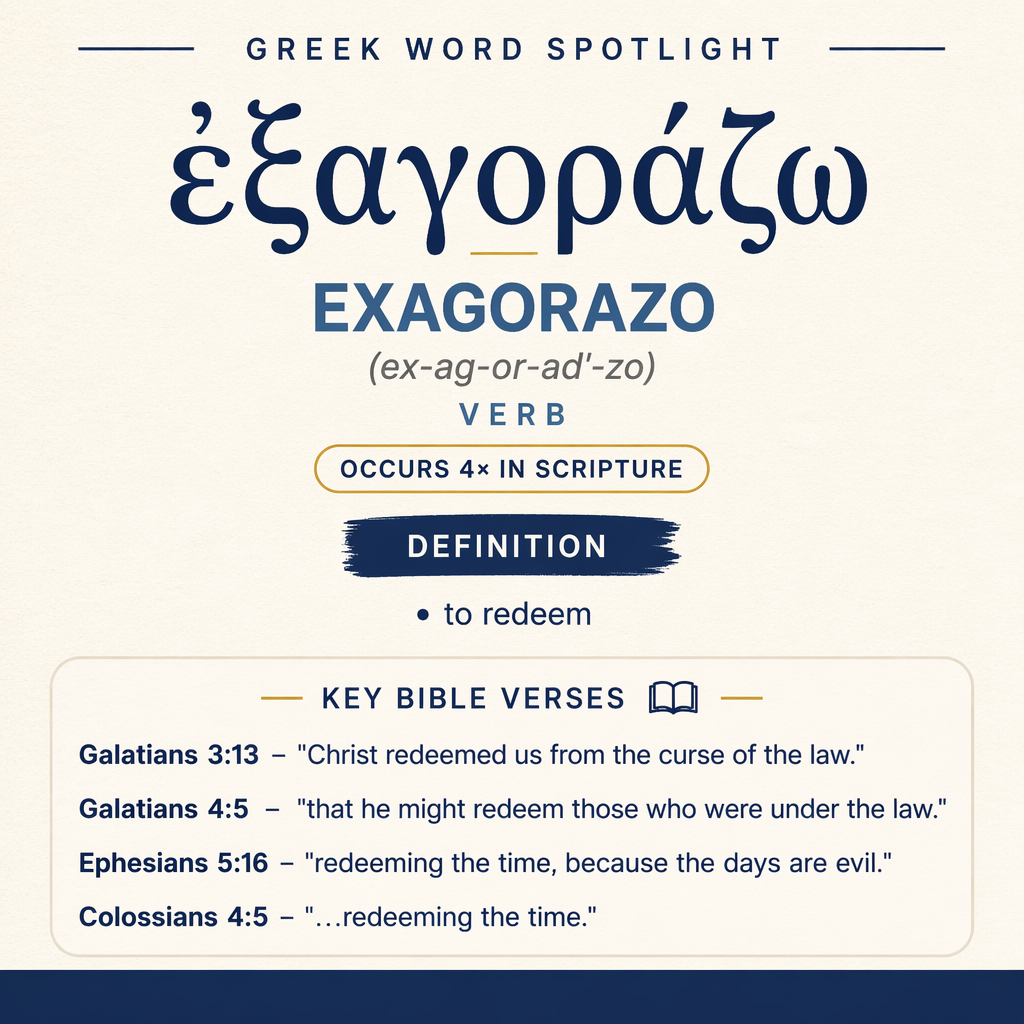
ἐξαγοράζω means “to redeem” and appears four times in Scripture: Galatians 3:13; Galatians 4:5; Ephesians 5:16; Colossians 4:5.
Pauline Occurrences
It occurs four times in Scripture: Galatians 3:13; Galatians 4:5; Ephesians 5:16; Colossians 4:5.
Learn More →Verse Contexts
In Galatians it is used of Christ redeeming from the curse of the law and redeeming those under the law. In Ephesians and Colossians it is used of redeeming the time.
Learn More →ἐξαγοράζω (Exagorazo) means “to redeem.” It appears in Galatians (twice), Ephesians, and Colossians, where it is applied both to Christ’s action toward people under the law and to a believer’s conduct in relation to time.
Root and Related Words
ἐξαγοράζω (Exagorazo) is connected with ἐκ (ek), “out from” (Strong’s G1537), and ἀγοράζω (agorazo), “to buy” (Strong’s G59). These related elements provide a natural way to hear the verb as a movement involving release “out from” a prior condition, expressed through the language of purchase.

Occurrences
Galatians 3:13: “Christ redeemed us from the curse of the law, having become a curse for us. For it is written, “Cursed is everyone who hangs on a tree,””
Here the verb stands at the head of a tightly framed statement about what Christ has done “for us.” The action of redeeming is directed “from the curse of the law,” so the redemption is described in terms of deliverance out of a defined plight named “the curse.” The verse itself explains the manner of this redeeming in relational and representative terms: it occurs as Christ “having become a curse for us.” The quotation at the end (“Cursed is everyone who hangs on a tree,”) gives the scene a stark public image: redemption is tied to Christ’s bearing of what is called “curse,” so that those addressed as “us” are freed from that condition.
Galatians 4:5: “that he might redeem those who were under the law, that we might receive the adoption of children.”
This occurrence places redemption within a purpose statement (“that he might…that we might…”). The direct object is specific: “those who were under the law.” Redemption is thus portrayed as an act aimed at people defined by their prior status “under the law.” The verse immediately attaches a resulting change in standing: “that we might receive the adoption of children.” In this setting, redeeming is not left as a bare transaction; it is depicted as a decisive intervention that transitions people from one condition (“under the law”) into a new received status described as “the adoption of children.”
Ephesians 5:16: “redeeming the time, because the days are evil.”
In Ephesians, the object of redeeming is not “us” or “those,” but “the time.” The phrase functions as an instruction about conduct, and the rationale is explicit: “because the days are evil.” Redemption language is therefore applied to the way time is handled under moral pressure. The verse sets a contrast between what is being redeemed (“the time”) and the character of the surrounding context (“the days are evil”), portraying redeeming as a purposeful response to an environment described as hostile or corrupted.
Colossians 4:5: “Walk in wisdom toward those who are outside, redeeming the time.”
Colossians combines the same object (“the time”) with a broader exhortation: “Walk in wisdom toward those who are outside.” Redeeming the time is presented as part of wise outward-facing conduct, not merely private discipline. The audience’s relationship to “those who are outside” shapes the scene: time is something to be redeemed as one’s life is observed and encountered by outsiders. The placement of the phrase after “Walk in wisdom” makes redeeming the time one concrete expression of wisdom in public posture and interaction.
Sense and Usage
Across these four texts, “to redeem” operates in two distinct but related domains. In Galatians, redeeming is Christ’s action toward persons: it is directed at people (“us,” “those who were under the law”) and names what they are redeemed from (“the curse of the law,” being “under the law”). The verbs in these statements are framed by “for us” language and purpose clauses, so redemption is cast as a deliberate act performed on behalf of others and resulting in a changed condition—freedom from “curse” and reception of “the adoption of children.” The word therefore carries the weight of decisive rescue expressed in covenantal terms (“law,” “curse”) and familial outcome (“adoption”).
In Ephesians and Colossians, “to redeem” is applied to “the time.” The focus shifts from what Christ does to what believers are to do, yet the verb remains urgent and purposeful. The object “time” is treated as something that can be handled in a redeeming way, which implies an active stance rather than passive drifting. The reasons and contexts supplied by the verses sharpen the moral shape of this instruction: “because the days are evil” (Ephesians) portrays time as passing through an evil season, while “Walk in wisdom toward those who are outside” (Colossians) places redeeming time in the social and missional space of outward conduct. Together these uses show that redeeming can describe both a redemptive act that changes a person’s standing and a disciplined practice that treats time as something to be claimed for wise and fitting ends amid evil days and public witness.
Imagery in Context
The word’s imagery varies with its object. In Galatians 3:13 the picture is sharpened by the mention of “a tree,” where the condition called “curse” is publicly borne and thus publicly answered; redemption is attached to that vivid setting as the means by which “us” are freed “from the curse of the law.” In Galatians 4:5 the imagery turns from curse to household: redeeming those “under the law” is immediately followed by “the adoption of children,” so redemption is pictured as a transition into a received family status. In Ephesians 5:16 and Colossians 4:5 the imagery becomes everyday and continuous: time itself is treated as something to redeem while one lives through “evil” days and walks wisely before “those who are outside.”
Sources: Lexical data from Strong’s Exhaustive Concordance and the Translators Brief Lexicon of Extended Strongs for Greek (STEPBible, CC BY). Occurrence data from the Translators Amalgamated Greek New Testament (STEPBible, CC BY). Scripture quotations from the World English Bible (public domain).