
Exploring the Meaning of Euthutes in Greek
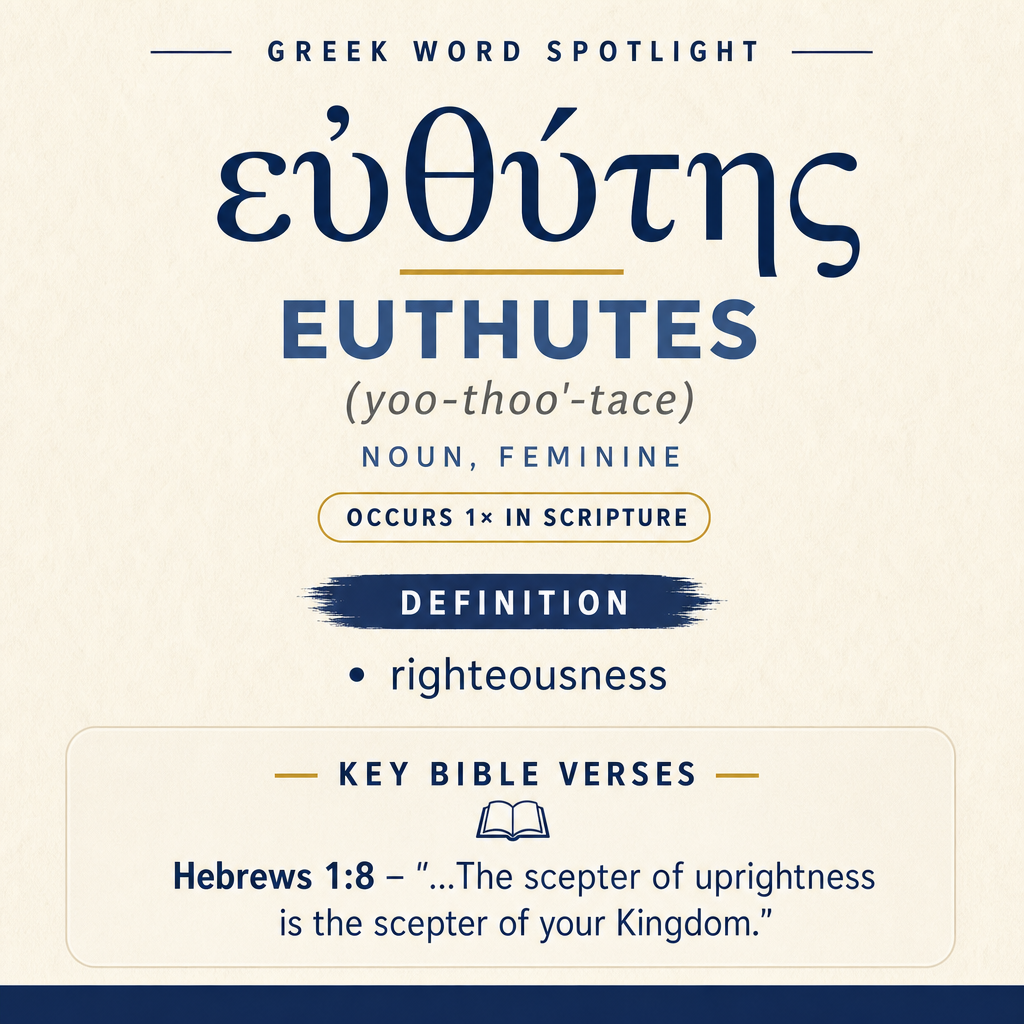
εὐθύτης means righteousness and appears once in Scripture, in Hebrews 1:8.
Biblical Occurrence
It occurs 1 time in Scripture. Its single occurrence is in Hebrews 1:8.
Learn More →Verse Context
In Hebrews 1:8 it appears in the phrase “the scepter of uprightness.” The verse addresses the Son and speaks of an everlasting throne.
Learn More →εὐθύτης means “righteousness” and appears once in the New Testament, in Hebrews 1:8. In that verse it is woven into royal imagery, describing the character of the Son’s reign through the figure of a scepter.
Root and Related Words
εὐθύτης derives from euthys (εὐθύς), “Straight.”

Occurrences
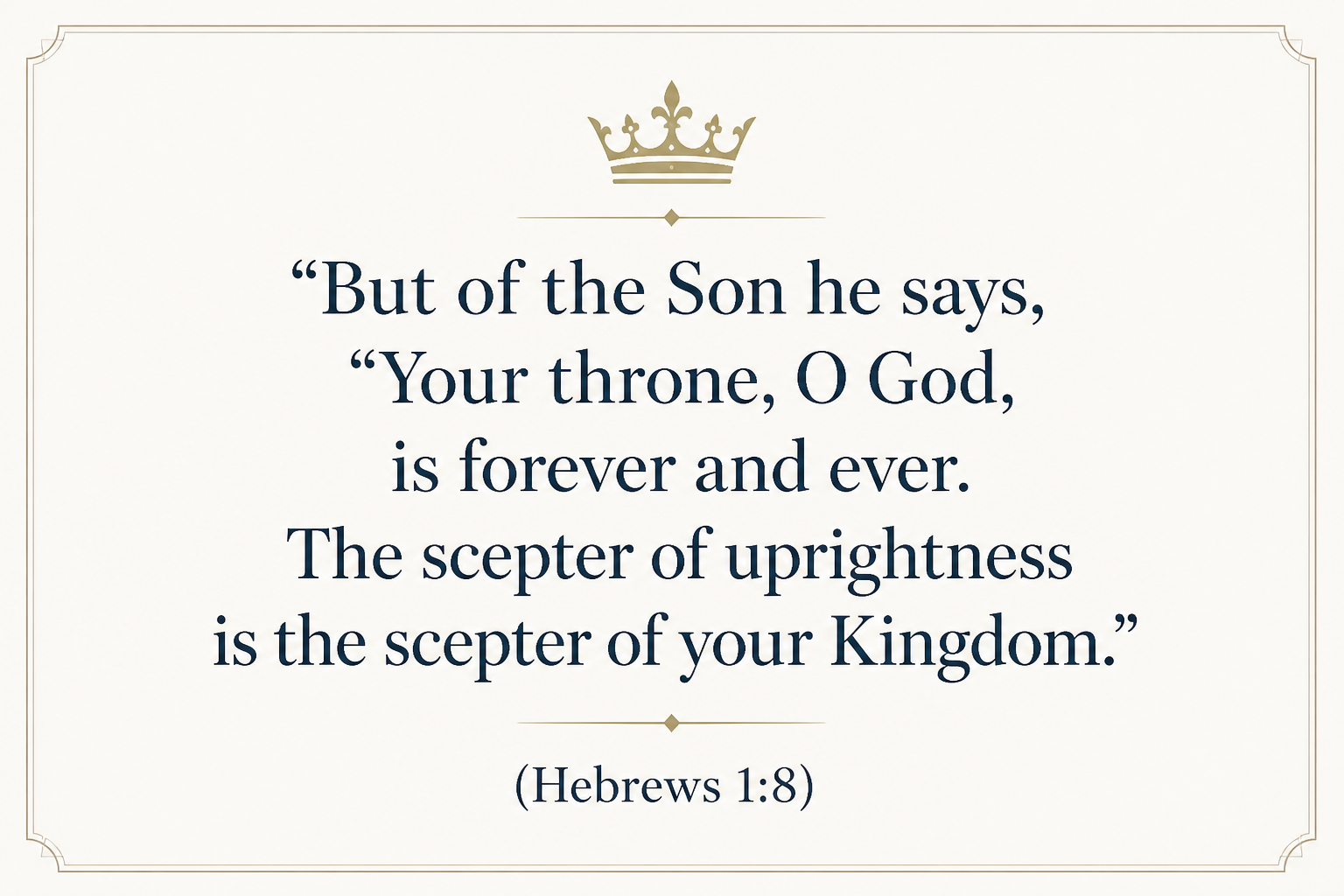
“But of the Son he says, “Your throne, O God, is forever and ever. The scepter of uprightness is the scepter of your Kingdom.” (Hebrews 1:8)
In Hebrews 1:8, εὐθύτης is placed inside a compact, elevated description of kingship: a throne that endures (“forever and ever”) and a kingdom marked by a particular kind of rule (“The scepter of uprightness is the scepter of your Kingdom.”). Within the verse’s own imagery, the scepter functions as a visible emblem of royal authority. By pairing “scepter” with εὐθύτης, the line does more than say that the Son possesses authority; it characterizes that authority as righteousness in its exercise and character. The term is not presented as a private quality hidden from view but as something publicly bound to the rule itself—so closely tied to the kingdom that the scepter is described twice, first with its moral quality (“of uprightness”) and then with its realm (“of your Kingdom”).
The repetition (“The scepter … is the scepter …”) gives εὐθύτης a defining role. The verse does not merely add righteousness as an additional ornament to royal power; it frames righteousness as what this scepter is, as if the rule can be named by this quality. In the immediate movement of the sentence, the proclamation begins with permanence (“Your throne … is forever and ever”) and then turns to the nature of that reign (“The scepter of uprightness…”). εὐθύτης thus sits at the hinge between unending rule and the kind of governance that rule embodies: not transient power, but a kingdom whose authority is stamped with righteousness.
Sense and Usage
The definition “righteousness” gains its specific color in Hebrews 1:8 through concrete royal imagery. εὐθύτης is not offered as an abstract ideal floating above the scene; it is attached to the “scepter,” a symbol of kingship and governance. In this single occurrence, righteousness is presented as a property of rule—something that can be predicated of the administration of a kingdom and of the authority that enacts its will.
Because εὐθύτης appears in the phrase “The scepter of uprightness,” righteousness is framed as measurable by the conduct and direction of reign. A scepter evokes judgments rendered, decisions made, and the ordering of a realm; by modifying that scepter, εὐθύτης portrays righteousness as integral to the way the kingdom is governed. The verse’s structure reinforces this: the scepter is not described as belonging to righteousness in a distant sense, but as characterized by it, and then immediately identified as the scepter proper to the kingdom itself. Righteousness, in other words, is made emblematic—something that can stand as the identifying mark of royal authority.
The verse also balances majesty with moral quality. “Your throne, O God, is forever and ever” speaks of durability and exaltation; εὐθύτης then specifies the kind of enduring dominion in view. Within the verse’s own lines, righteousness is not treated as a temporary policy or a momentary act; it is positioned alongside perpetuity (“forever and ever”) and kingdom identity (“your Kingdom”). That proximity paints righteousness as belonging to the settled character of the reign being addressed.
Finally, the link to euthys (εὐθύς), “Straight,” provides a lexical backdrop that supports the way the verse uses εὐθύτης within the “scepter” metaphor. A scepter that is “straight” in its quality of rule evokes the idea of authority that does not bend away from what is right. Hebrews 1:8 uses that moral straightness, expressed as righteousness, to describe not merely what the ruler possesses, but what the kingdom’s governing instrument itself represents.
Imagery
Hebrews 1:8 presents εὐθύτης through the vivid object of a scepter: righteousness depicted as the recognizable mark of royal power. The image is intentionally public and regal—throne, kingdom, scepter—so that righteousness is pictured not as a hidden virtue but as the defining quality of rule that endures “forever and ever.”
Sources: Lexical data from Strong’s Exhaustive Concordance and the Translators Brief Lexicon of Extended Strongs for Greek (STEPBible, CC BY). Occurrence data from the Translators Amalgamated Greek New Testament (STEPBible, CC BY). Scripture quotations from the World English Bible (public domain).





