
Exploring the Meaning of Euthumos in Greek
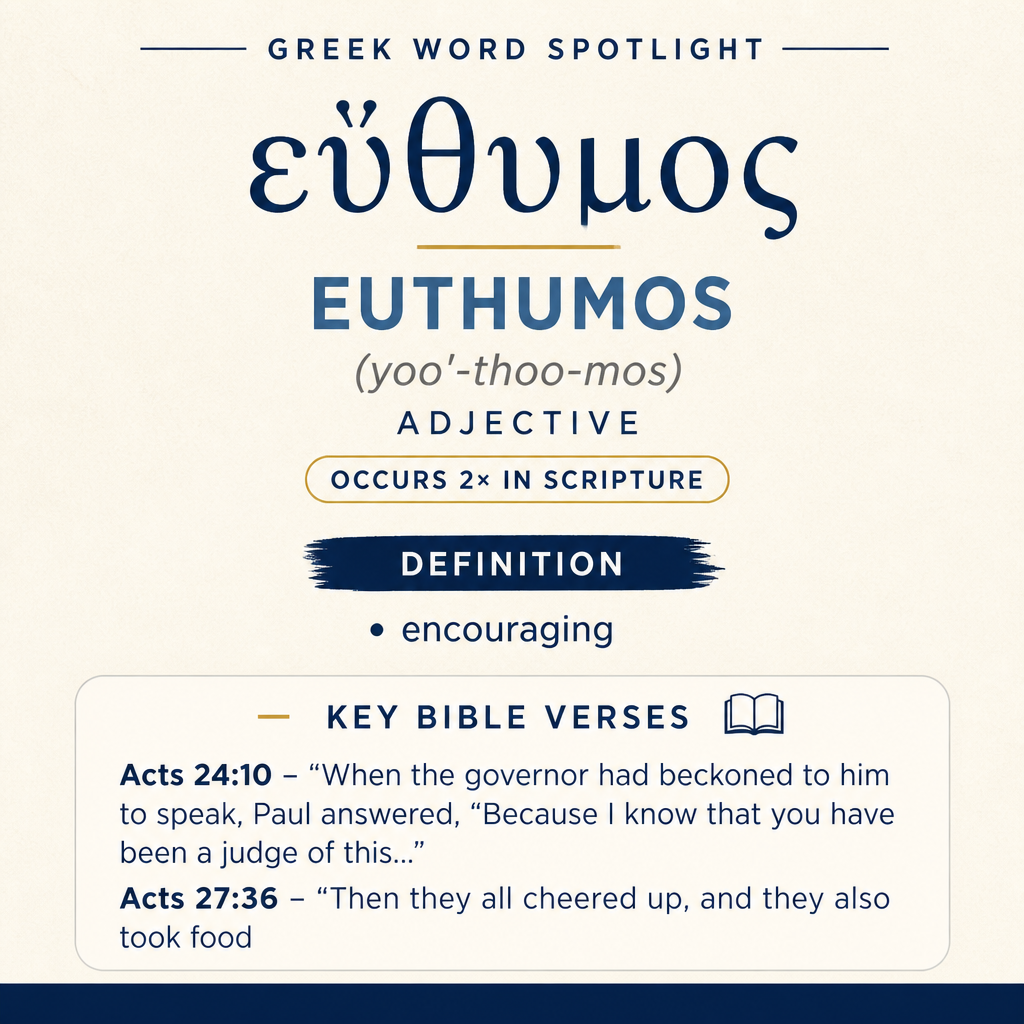
εὔθυμος means “encouraging” and occurs twice in Scripture, in Acts 24:10 and Acts 27:36.
Scripture Occurrences
It appears 2 times in Scripture. The references are Acts 24:10 and Acts 27:36.
Learn More →Context Snapshots
Acts 24:10 records Paul answering after the governor beckoned him to speak. Acts 27:36 describes everyone cheering up and taking food.
Learn More →εὔθυμος describes an encouraging disposition that affects speech and action. It appears in Acts in two different settings: a courtroom defense and a dangerous sea voyage where a group regains heart together.
Root and Related Words
εὔθυμος is connected with eu (εὖ), “well/well done!” (Strong’s G2095), and thymos (θυμός), “wrath” (Strong’s G2372).
Occurrences
Acts 24:10: “When the governor had beckoned to him to speak, Paul answered, “Because I know that you have been a judge of this nation for many years, I cheerfully make my defense,”
In this hearing, εὔθυμος characterizes the manner of Paul’s response as he begins his defense. The sentence ties his “cheerfully” delivered speech to his stated awareness of the governor’s long experience as a judge. The word therefore colors the whole act of speaking: Paul does not merely speak; he does so in an encouraging spirit, presenting his defense without the tone of collapse or panic that such proceedings could invite. The rhetorical effect is immediate: the opening is poised, and the encouraging stance serves the act of “make my defense” by setting the defense within a steady, forward-leaning posture.

Acts 27:36: “Then they all cheered up, and they also took food.”
Here εὔθυμος is not limited to one speaker but spreads across a group: “they all cheered up.” The word marks a shift in the shared morale of the people on board. The following action—“they also took food”—shows that this encouraging turn is not merely internal feeling but is strong enough to move them toward a practical, sustaining step. In this scene, εὔθυμος supplies the hinge between a pressured situation implied by the narrative context of the voyage and a concrete act of continued endurance: encouragement becomes the atmosphere in which they can eat, regroup, and act together.
Sense and Usage
Across these passages, εὔθυμος consistently points to an encouraging orientation that is visible in outward behavior. In Acts 24:10, it modifies a deliberate, verbal act—“make my defense”—and gives that act a constructive tone: the speaker’s posture toward the situation is not defiant or withdrawn but heartening in its manner. Even within a formal and potentially hostile setting, the word frames the opening of the defense as carried out with composure that can steady the exchange.
In Acts 27:36, εὔθυμος operates at the level of a community. The phrase “they all cheered up” depicts encouragement as contagious and collective, the kind of shared uplift that can reverse the group’s internal direction. The immediate sequel—“and they also took food”—shows encouragement functioning as a catalyst: it supports bodily action that keeps people going. The two uses therefore place the same quality in different spheres: the encouragement of a single voice in a judicial setting, and the encouragement of a whole company whose renewed heart leads to coordinated, life-supporting behavior.
The word’s placement in both verses is also instructive. It does not stand alone as a detached description; it attaches to key transitions: the beginning of a defense (a moment of public self-presentation) and the moment before eating (a moment of shared resolve). εὔθυμος thus marks encouragement as something that meets an immediate demand—speaking when summoned, eating when needed—and supplies the inner steadiness that makes those actions possible.
Imagery in Context
In Acts 24:10, the imagery is that of a courtroom moment where a man is beckoned to speak and answers with an encouraging demeanor; the word gives the scene a tone of calm readiness. In Acts 27:36, the image is communal: a whole group’s spirits lift, and the uplift shows itself in the simple, tangible act of taking food. In both, εὔθυμος is encouragement not as abstraction but as a visible atmosphere that shapes what people do next.
Sources: Lexical data from Strong’s Exhaustive Concordance and the Translators Brief Lexicon of Extended Strongs for Greek (STEPBible, CC BY). Occurrence data from the Translators Amalgamated Greek New Testament (STEPBible, CC BY). Scripture quotations from the World English Bible (public domain).





