
Exploring the Meaning of Euprepeia in Greek
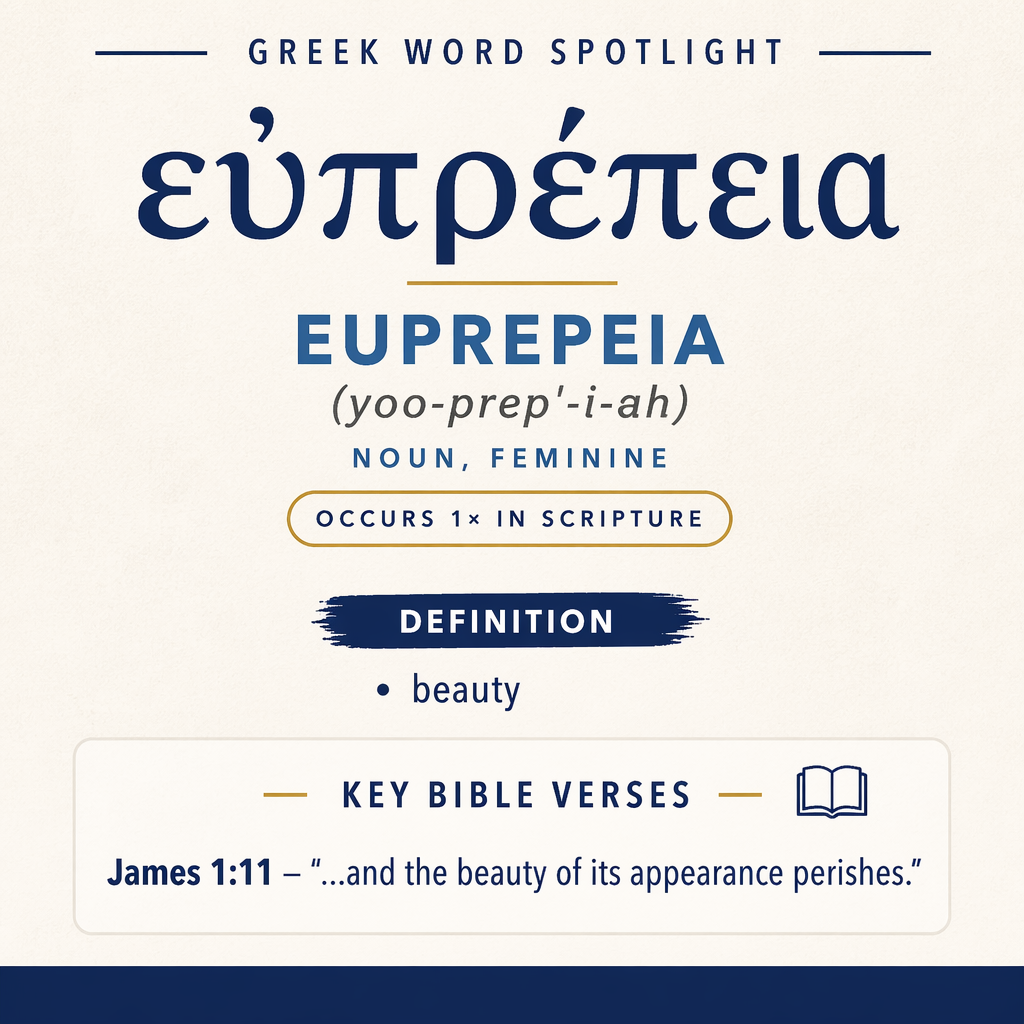
εὐπρέπεια means “beauty” and appears once in Scripture, in James 1:11.
Verse Context
In James 1:11, it refers to “the beauty” that falls as the flower withers.
Learn More →Euprepeia means “beauty” and appears in James to describe something visibly attractive that does not last. In its single New Testament use, the word is set inside a tightly observed picture of vegetation scorched by heat and losing what made it pleasing to look at.
Root and Related Words
Euprepeia is connected with eu (εὖ), “well/well done!”, and prepo (πρέπω), “be proper.” These related elements point to a conception of beauty as something that reads as fitting or proper in appearance—an outward quality that looks “as it should.”

Occurrences
“For the sun arises with the scorching wind and withers the grass, and the flower in it falls, and the beauty of its appearance perishes. So the rich man will also fade away in his pursuits.” (James 1:11)
Here euprepeia belongs to a sequence of actions narrated in quick, concrete verbs: the sun “arises,” the wind “scorch[es],” the grass “wither[s],” the flower “falls,” and then “the beauty of its appearance perishes.” Euprepeia is the term for what is lost when the flower collapses and the plant dries out. It is not introduced as an inner quality or a private judgment; it is tied to “appearance,” the visible look of the flower when it is fresh and upright. The clause places beauty alongside other fragile features of plant life—green grass, an intact flower—so that beauty is portrayed as something that can vanish as decisively as petals dropping.
The verse does more than note that the plant dies; it highlights the disappearance of what made the plant look attractive. Euprepeia is therefore the visible “good look” that makes a flower stand out before it falls. The imagery is also temporal: beauty is present for a moment in the life of the flower, but the heat-driven change is swift. By placing euprepeia right before “perishes,” the text emphasizes that beauty is not merely diminished but brought to an end under the harsh conditions described (“scorching wind”).
In the final sentence, “So the rich man will also fade away in his pursuits,” the fading of the rich man is set in parallel with the withering of grass and the perishing of a flower’s beauty. Euprepeia is not directly reassigned to the rich man in the sentence, but its function in the comparison is clear within the verse: just as the flower’s attractive appearance is undone by heat, so a person’s outwardly enviable state can pass away while life continues to move (“in his pursuits”). In this way, euprepeia supports the verse’s contrast between what appears impressive and what endures.
Sense and Usage
In James 1:11, “beauty” is specifically the attractiveness of something seen. The phrase “the beauty of its appearance” keeps the focus on what the observer can perceive in the flower before the weather turns. Euprepeia is not treated as a stable possession of the plant; it is described as contingent on conditions and vulnerable to forces outside the plant’s control. The verse chooses an everyday object—a flower in grass—and draws attention to how quickly its appealing look can vanish when the environment shifts.
The surrounding verbs shape the sense of euprepeia. Withering and falling are not primarily aesthetic terms, yet they produce an aesthetic outcome: the perishing of beauty. In this setting, beauty is closely linked to wholeness and vitality: when the grass is withered and the flower has fallen, the appearance no longer carries the same attraction. The text’s progression implies that beauty is bound up with a certain state of life and form, and when that state collapses, beauty collapses with it.
Because euprepeia occurs within an analogy applied to “the rich man,” the verse uses beauty as a representative feature of what people notice and admire. The image does not deny that beauty exists; it acknowledges it plainly and even lingers on it (“the beauty of its appearance”). Yet the verse frames beauty as something that can “perish,” which places it among realities that are temporary. Within the logic of the comparison, beauty becomes a vivid shorthand for the visible impressiveness that can accompany flourishing, and for the speed with which that impressiveness can disappear.
The pairing of euprepeia with “appearance” also helps define the word’s scope in this passage. Beauty is not described in abstract terms; it is anchored in the look of the flower and therefore in the realm of what can be observed, admired, and then watched as it declines. Euprepeia, as used here, belongs to the surface of things—not in the sense of being false, but in the sense of being the outward face that can change abruptly when circumstances change.
Imagery
The picture in James 1:11 is stark: a bright sun, a “scorching wind,” and a once-lovely flower losing what made it visually pleasing. Euprepeia carries the poignancy of watching beauty disappear in real time—the instant when an attractive appearance gives way to dryness and collapse, leaving behind the memory of what had been seen only moments before.
Sources: Lexical data from Strong’s Exhaustive Concordance and the Translators Brief Lexicon of Extended Strongs for Greek (STEPBible, CC BY). Occurrence data from the Translators Amalgamated Greek New Testament (STEPBible, CC BY). Scripture quotations from the World English Bible (public domain).




