
Exploring the Meaning of Erethizo in Greek
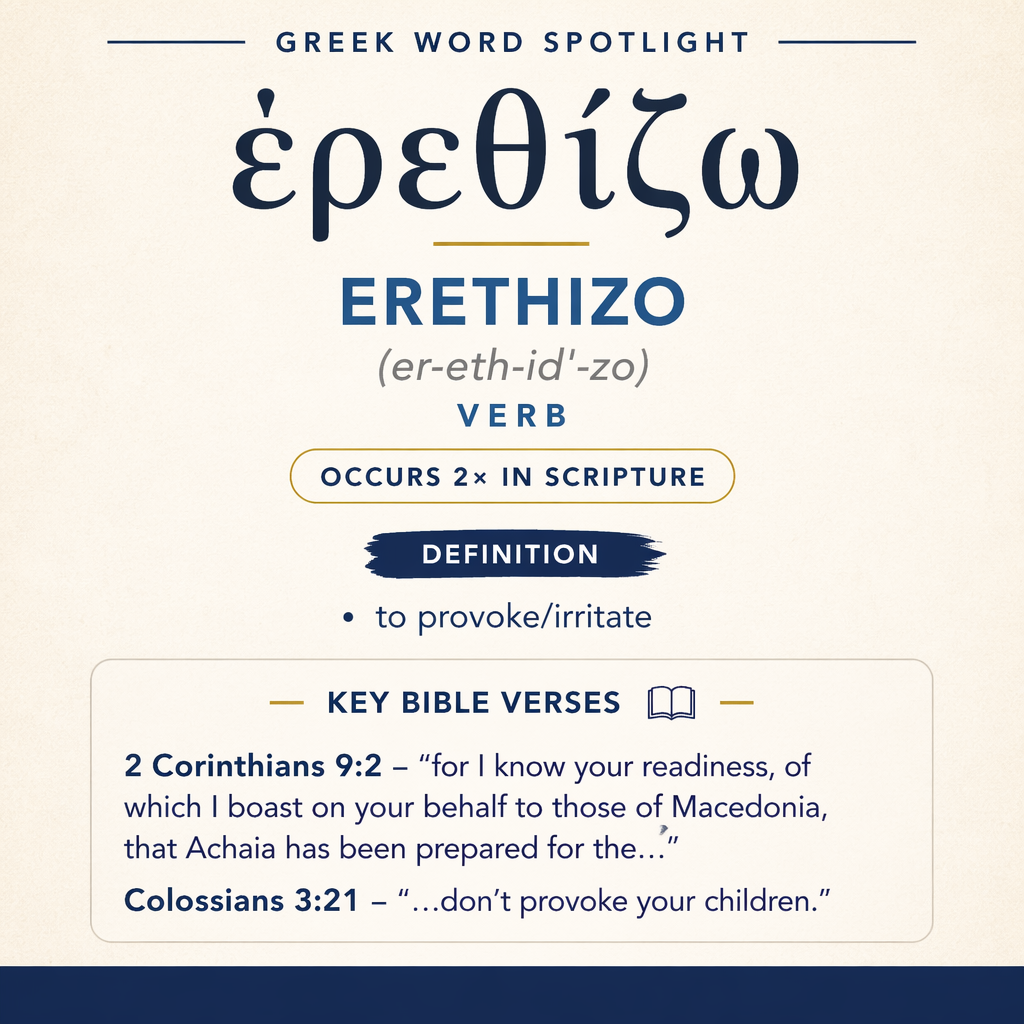
ἐρεθίζω means “to provoke/irritate” and occurs twice in Scripture: 2 Corinthians 9:2 and Colossians 3:21.
Scripture Occurrences
This verb appears 2 times in Scripture. The references are 2 Corinthians 9:2 and Colossians 3:21.
Learn More →Context Snapshot
In Colossians 3:21 it is used in the instruction, “Fathers, don’t provoke your children.” It also occurs in 2 Corinthians 9:2.
Learn More →ἐρεθίζω means “to provoke/irritate” and appears twice in the New Testament. In one setting it describes how zeal can be roused among a wider group; in the other it marks a damaging pattern to avoid within the household.
Root and Related Words
ἐρεθίζω is related to eris (ἔρις), “quarrel” (Strong’s G2054). The relationship points to a verbal family that can move in the orbit of conflict and friction, where interactions do not remain neutral but become charged in a way that strains relationships.

Occurrences
“for I know your readiness, of which I boast on your behalf to those of Macedonia, that Achaia has been prepared for the past year. Your zeal has stirred up very many of them.” (2 Corinthians 9:2)
Here ἐρεθίζω is used for a positive kind of provocation: the Corinthians’ “zeal” does not stay private or local but becomes a force that “has stirred up very many of them.” The immediate scene is Paul describing what he has been saying “to those of Macedonia” about Achaia’s readiness; the word fits the social spread of motivation, where one community’s forwardness becomes an irritant to complacency and a catalyst for action in others. The verb frames zeal as something that can be contagious: it presses against inertia, arousing response in “very many.” In context, the effect is communal and multiplying—Paul’s boasting circulates a report, and that report, paired with visible preparedness, provokes others into similar readiness.
The wording also suggests a dynamic of comparison without explicitly naming it: Macedonia hears of Achaia, and “very many” are stirred up. ἐρεθίζω thus contributes the idea that moral energy can be activated through the example of others. The provocation is not depicted as quarrelsome in this verse; rather, it is the kind of stirring that moves a group from passive awareness to active participation, matching the “readiness” already present in Achaia.
“Fathers, don’t provoke your children, so that they won’t be discouraged.” (Colossians 3:21)
In Colossians 3:21 the same verb is placed under a prohibition: “don’t provoke your children.” The immediate reason is stated in the purpose clause, “so that they won’t be discouraged.” ἐρεθίζω here names a parental behavior that needles, irritates, or presses a child in a way that yields an internal collapse of heart—discouragement—rather than growth. The command is addressed to “Fathers,” which locates the verb in the concrete sphere of family authority and daily interaction: the one with power can, by repeated irritation or harsh provocation, create conditions where a child loses courage.
The verse’s brief structure highlights cause and effect. The act of provoking is not treated as morally neutral; it is linked to a predictable outcome in the child. ἐρεθίζω therefore carries relational weight: it is not merely “making someone notice” but generating a pressure that can wear someone down. In this scene the verb functions as a warning about how authority can be exercised in a way that agitates and unsettles, producing not obedience but diminished spirit.
Sense and Usage
Across these two passages, “to provoke/irritate” operates on two distinct relational axes. In 2 Corinthians 9:2, provocation occurs between groups: the report of Achaia’s readiness and zeal exerts a stimulating pressure on “very many” in Macedonia, waking their willingness and moving them toward similar readiness. The irritation is constructive, because what is stirred up is “zeal”—the energy to act. ἐρεθίζω can therefore describe an arousing influence that disrupts apathy and sets good activity in motion.
In Colossians 3:21, provocation occurs within the household, from parent to child, and the pressure is destructive: it tends toward discouragement. The verb’s sense is sharpened by the stated consequence. This is not a momentary annoyance but a kind of ongoing irritation capable of shaping a child’s inner posture. The word marks a behavioral pattern—provoking—that is serious enough to be named and forbidden, precisely because the one provoked is vulnerable to being crushed rather than strengthened.
Read together, these uses show that ἐρεθίζω is less about the content of what is said or done and more about the effect produced in others: it is language for interpersonal friction that arouses a response. That response may be energetic (stirred-up zeal) or deflated (discouragement), depending on the setting and the moral direction of the influence. In both scenes the verb assumes that human communities are responsive: people do not simply remain unchanged under the touch of another’s example or authority. The word thus fits moments where one party’s stance creates an emotional or motivational reaction in another—either invigorating or wearing down.
Imagery
The passages picture provocation as a kind of contact that sets something in motion. In 2 Corinthians 9:2, zeal spreads outward like a force that jolts many people from stillness into readiness. In Colossians 3:21, the same kind of contact is dangerous when it comes from a father to a child, because repeated irritation can drain courage until the child becomes “discouraged.”
Sources: Lexical data from Strong’s Exhaustive Concordance and the Translators Brief Lexicon of Extended Strongs for Greek (STEPBible, CC BY). Occurrence data from the Translators Amalgamated Greek New Testament (STEPBible, CC BY). Scripture quotations from the World English Bible (public domain).




