
Exploring the Meaning of Epimeno in Greek
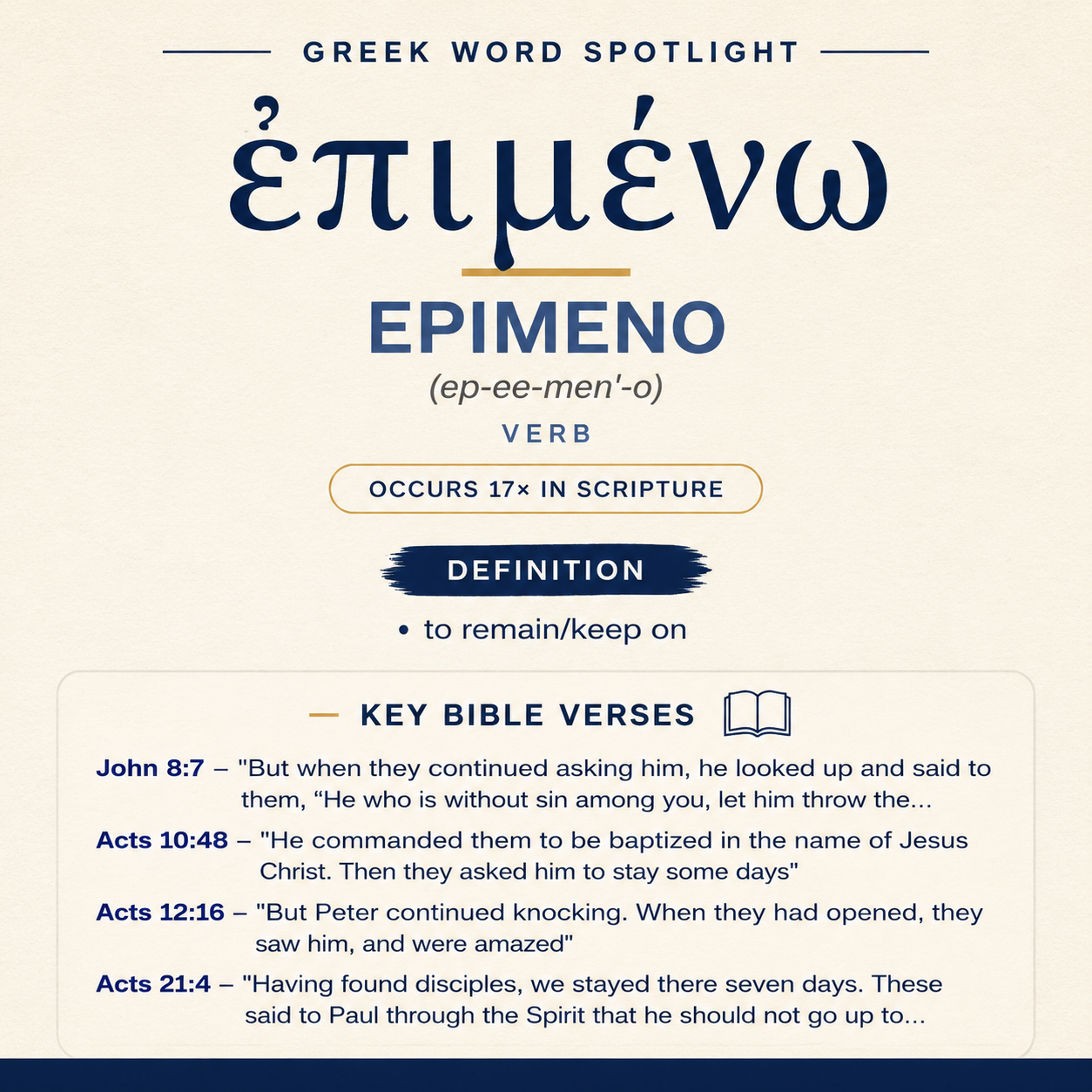
ἐπιμένω means “to remain/keep on” and occurs 17 times in Scripture, including John 8:7, several Acts passages, and Romans 6:1.
Core Meaning
ἐπιμένω means “to remain/keep on.” In context it can describe continuing an action or staying in a place.
Learn More →Acts Usage
Acts uses ἐπιμένω for staying or remaining: “stay some days” (Acts 10:48) and “stayed there seven days” (Acts 21:4).
Learn More →Continuing Action
John 8:7 uses it for continued questioning (“continued asking him”). Romans 6:1 uses it for continuing in sin (“continue in sin”).
Learn More →ἐπιμένω expresses remaining or keeping on, whether in a physical place for a span of days or in a course of action that persists. In the passages where it appears here, it can describe persistent pressure, continued activity, extended stays, and ongoing moral or spiritual continuance.
Occurrences
“But when they continued asking him, he looked up and said to them, “He who is without sin among you, let him throw the first stone at her.”” (John 8:7)
Here ἐπιμένω marks the crowd’s sustained questioning: their asking does not happen once but persists. That persistence sets the scene’s tension and frames Jesus’ response as addressing not a single inquiry but an ongoing, pressing demand.
“He commanded them to be baptized in the name of Jesus Christ. Then they asked him to stay some days.” (Acts 10:48)
In this setting ἐπιμένω describes a request for continued presence. After the command to baptize, the new situation leads to an appeal that he remain with them for “some days,” emphasizing duration and fellowship that extends beyond the immediate act.
“But Peter continued knocking. When they had opened, they saw him, and were amazed.” (Acts 12:16)
ἐπιμένω highlights Peter’s persistence at the door: he does not knock and stop, but keeps on until it is opened. The continued knocking drives the narrative forward to the moment of opening and the household’s amazement.
“Having found disciples, we stayed there seven days. These said to Paul through the Spirit that he should not go up to Jerusalem.” (Acts 21:4)
The verb situates the travelers in a settled interval—“seven days”—among disciples. The time spent remaining there provides the context for what follows: during that continued stay, warnings to Paul are voiced “through the Spirit.”
“As we stayed there some days, a certain prophet named Agabus came down from Judea.” (Acts 21:10)
Again ἐπιμένω is temporal and local: the group remains in place “some days.” The arrival of Agabus is anchored to that ongoing stay, so the prophet’s coming is not incidental but intersects with a period of waiting and continued presence.
“Touching at Syracuse, we stayed there three days.” (Acts 28:12)
In the travel narrative, ἐπιμένω marks a stopover that is more than a touch-and-go landing. The journey includes a defined three-day remaining at Syracuse, showing movement punctuated by deliberate pauses.
“where we found brothers, and were entreated to stay with them for seven days. So we came to Rome.” (Acts 28:14)
Here remaining is relational: they “found brothers” and are urged to stay “with them.” ἐπιμένω conveys not only a delay on the road but a sustained shared time that precedes the arrival in Rome.
“What shall we say then? Shall we continue in sin, that grace may abound?” (Romans 6:1)
ἐπιμένω shifts from geography to conduct. The question imagines a pattern of life that keeps on “in sin,” treating sin as an ongoing sphere in which one remains, and raising the moral issue of persistence for the sake of a supposed outcome (“that grace may abound”).
“See then the goodness and severity of God. Toward those who fell, severity; but toward you, goodness, if you continue in his goodness; otherwise you also will be cut off.” (Romans 11:22)
In this warning ἐπιμένω describes continued abiding “in his goodness.” Continuance is presented as conditional and consequential: remaining within that goodness stands in contrast to being “cut off,” so the verb bears the weight of perseverance within a stated condition.
“They also, if they don’t continue in their unbelief, will be grafted in, for God is able to graft them in again.” (Romans 11:23)
Here the same idea of persistence is applied negatively: not continuing “in their unbelief.” The verb frames unbelief as a state that can be persisted in or not; the prospect of being “grafted in” is tied to the cessation of remaining in that condition, while still stressing God’s power to restore.
“For I do not wish to see you now in passing, but I hope to stay a while with you, if the Lord permits.” (1 Corinthians 16:7)
ἐπιμένω functions in Paul’s travel planning to contrast a brief visit (“in passing”) with a sustained one (“stay a while”). The hoped-for remaining is not merely logistical; it indicates intentional time together, though framed with the contingency “if the Lord permits.”
“But I will stay at Ephesus until Pentecost,” (1 Corinthians 16:8)
The verb marks a settled decision about location and duration: remaining “at Ephesus” has a terminus (“until Pentecost”). The continuing presence provides a time frame for what Paul will do before moving on.
Sense and Usage
Across these passages ἐπιμένω consistently signals continuation—either continuing an action or remaining within a place or condition. In narrative scenes it often supplies the temporal pressure that shapes what happens next: continued asking (John 8:7) intensifies a confrontation; continued knocking (Acts 12:16) pushes the story from uncertainty to recognition; extended stays (Acts 21:4; Acts 21:10; Acts 28:12; Acts 28:14; 1 Corinthians 16:7–8) punctuate movement and make room for encounters, counsel, and fellowship.
In Acts, the verb repeatedly attaches to measured spans (“some days,” “three days,” “seven days,” “until Pentecost”), making remaining a concrete element of travel and ministry rather than a vague delay. The same basic notion then carries into Romans as a metaphor of moral and spiritual persistence: one can “continue in sin” (Romans 6:1), “continue in his goodness” (Romans 11:22), or “continue in their unbelief” (Romans 11:23). In these rhetorical contexts, continuation is not neutral; it is a sustained stance with outcomes implied by the surrounding language—grace invoked as a pretext, cutting off as a warning, grafting in as a possibility.
The breadth of usage here shows how a single idea—remaining/keeping on—can describe both outward duration (staying with people, staying in a city) and inward duration (remaining in a moral or spiritual condition). The surrounding phrases specify what the continuance consists of: a repeated activity (“asking,” “knocking”), a shared presence (“stay with them”), or an ongoing realm (“in sin,” “in his goodness,” “in their unbelief”). In each case ἐπιμένω contributes the same essential feature: the matter in view does not merely occur; it persists.
Imagery
The scenes attached to ἐπιμένω are rich in ordinary, embodied images: voices that keep pressing with questions, fists that keep knocking at a closed door, travelers who remain for numbered days, and communities that urge guests to stay. Romans then draws that same texture of persistence into ethical speech, treating sin, goodness, and unbelief as places one can remain in or refuse to remain in, and placing weight on what it means to keep on rather than to shift course.
Sources: Lexical data from Strong’s Exhaustive Concordance and the Translators Brief Lexicon of Extended Strongs for Greek (STEPBible, CC BY). Occurrence data from the Translators Amalgamated Greek New Testament (STEPBible, CC BY). Scripture quotations from the World English Bible (public domain).




