
Exploring the Meaning of Epimeleomai in Greek
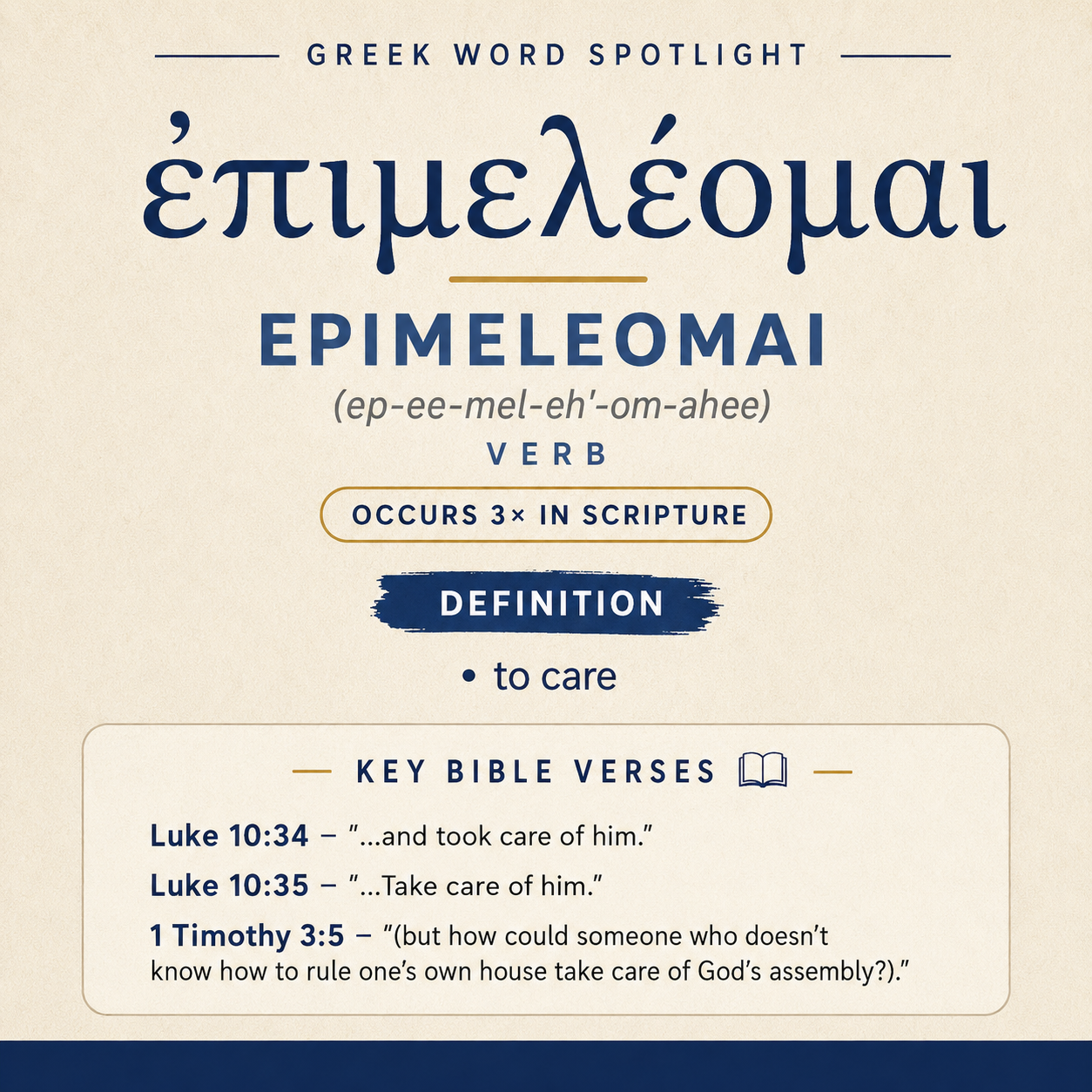
ἐπιμελέομαι means “to care” and occurs three times in Scripture: Luke 10:34–35 and 1 Timothy 3:5.
Luke Context
In Luke 10:34–35 it is used in the Good Samaritan’s care for the injured man, including arranging help at an inn.
Learn More →Church Leadership
In 1 Timothy 3:5 it describes taking care of God’s assembly in connection with ruling one’s own house.
Learn More →ἐπιμελέομαι expresses “to care,” appearing in the Good Samaritan narrative (Luke 10:34–35) and in a pastoral test of household leadership (1 Timothy 3:5). In both settings it speaks to sustained, responsible attention to the well-being of another.
Root and Related Words
ἐπιμελέομαι is connected with ἐπί (epi), “upon/to/against” (Strong’s G1909), and μέλω (melo), “to concern” (Strong’s G3199). Together these related words frame the verb as care that is directed toward someone as a matter of concern.

Occurrences
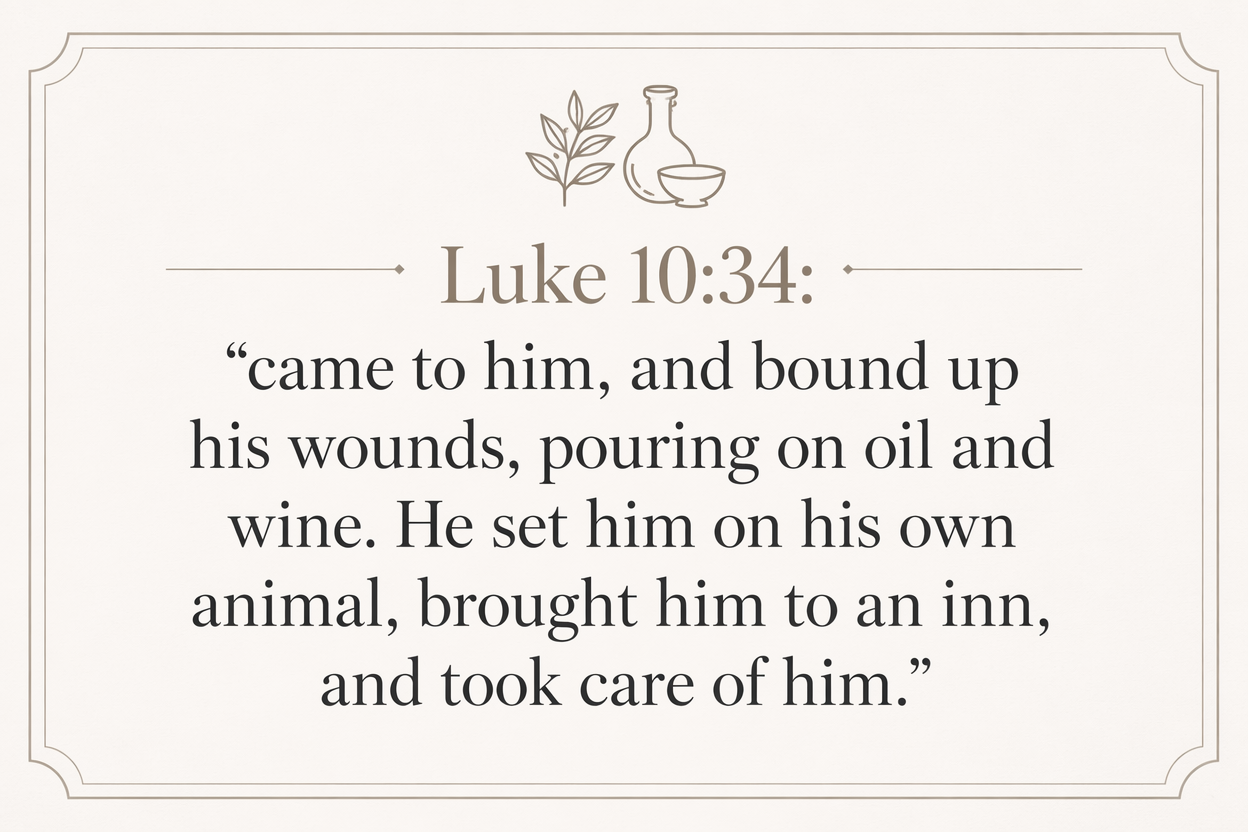
Luke 10:34: “came to him, and bound up his wounds, pouring on oil and wine. He set him on his own animal, brought him to an inn, and took care of him.”
Here ἐπιμελέομαι closes a sequence of practical actions: approaching the injured man, binding wounds, applying oil and wine, lifting him onto an animal, and bringing him to an inn. The verb gathers these steps into a continuing posture of care within the inn—attention that does not end with first aid on the road but follows the man into a place of shelter. In the flow of the sentence, the care is personal and hands-on: the caregiver remains present long enough for “took care of him” to describe more than a single act, matching the earlier concreteness of bandaging and transporting. The scene’s movement—from roadside danger to an inn—lets the verb bear the weight of ongoing supervision and help once immediate crisis is addressed.
Luke 10:35: “On the next day, when he departed, he took out two denarii, gave them to the host, and said to him, ‘Take care of him. Whatever you spend beyond that, I will repay you when I return.’”
In this continuation, ἐπιμελέομαι is spoken as an instruction: “Take care of him.” The speaker is now leaving (“On the next day, when he departed”), so the care must be delegated without being diminished. The verb functions as the moral and practical center of a financial arrangement: two denarii are given up front, further expenses are anticipated (“Whatever you spend beyond that”), and repayment is promised “when I return.” The command therefore assumes ongoing needs and ongoing oversight. It is care defined by responsibility across time: the host is entrusted with the task, and the departing benefactor binds himself to the cost that such care may require. In this verse, the word sits at the intersection of compassion and accountability—care that can be measured in provisions and expenses, yet remains focused on “him,” the vulnerable person needing attention.
1 Timothy 3:5: “(but how could someone who doesn’t know how to rule one’s own house take care of God’s assembly?)”
In this rhetorical question, ἐπιμελέομαι is applied to a community setting: “God’s assembly.” The verse sets household governance and communal care side by side: the person who “doesn’t know how to rule one’s own house” is portrayed as lacking the capacity to “take care” of a larger household-like body. The verb thus marks a kind of care that is not merely affectionate feeling but competent oversight—care that presupposes order, attentiveness, and the ability to manage ongoing needs. By framing the question in terms of capability (“how could someone…?”), the line treats care as a tested skill expressed through faithful responsibility. The community is presented as something that can be cared for, and the verb supplies the evaluative standard: leadership is measured by whether a person can provide such care.
Sense and Usage
Across these passages, ἐπιμελέομαι (“to care”) consistently operates in contexts where need is real and care must be enacted. In Luke 10:34 the care is immediate and embodied, following emergency attention and physical transport; it is the sort of care that stays with a wounded person after the first critical interventions. In Luke 10:35 the same care becomes a charge given to another, sustained by resources and by a promise to settle additional costs. The verb therefore supports both personal caregiving and delegated caregiving, but in each case the emphasis falls on ongoing concern that takes practical form.
In 1 Timothy 3:5 the word stretches from an individual patient to a collective body, yet it still retains the sense of concrete responsibility. The comparison between “rule one’s own house” and “take care of God’s assembly” places care within the sphere of reliable stewardship: the ability to care is evaluated by observable patterns in the smaller domain of a household. The word can thus describe care for a wounded stranger and care for a gathered community, without changing its essential character: attention that shoulders needs, maintains watchfulness, and provides what is necessary.
These uses also show that ἐπιμελέομαι can be closely tied to material support. Luke 10:35 anchors care in payment, anticipated expenses, and repayment; care is not reduced to money, but it is willing to bear cost. Luke 10:34 similarly embeds care among tangible helps—oil, wine, bandages, an animal, an inn—so that the verb sums up a pattern of responsive action. In the pastoral question of 1 Timothy 3:5, the costs are not itemized, but the same idea of dependable provision lies behind the comparison: care is what an orderly, competent ruler of a household should be able to extend to a broader assembly.
Imagery
The imagery surrounding ἐπιμελέομαι is shaped most vividly by the inn scenes in Luke. The verb stands beside wounds being bound, healing aids being applied, a patient being carried, and arrangements being made for continued attention. It evokes care that does not pass by need, but brings the needy person into a place where attentive help can continue and be funded “until” the caregiver returns.
Sources: Lexical data from Strong’s Exhaustive Concordance and the Translators Brief Lexicon of Extended Strongs for Greek (STEPBible, CC BY). Occurrence data from the Translators Amalgamated Greek New Testament (STEPBible, CC BY). Scripture quotations from the World English Bible (public domain).





