
Exploring the Meaning of Epikalupto in Greek
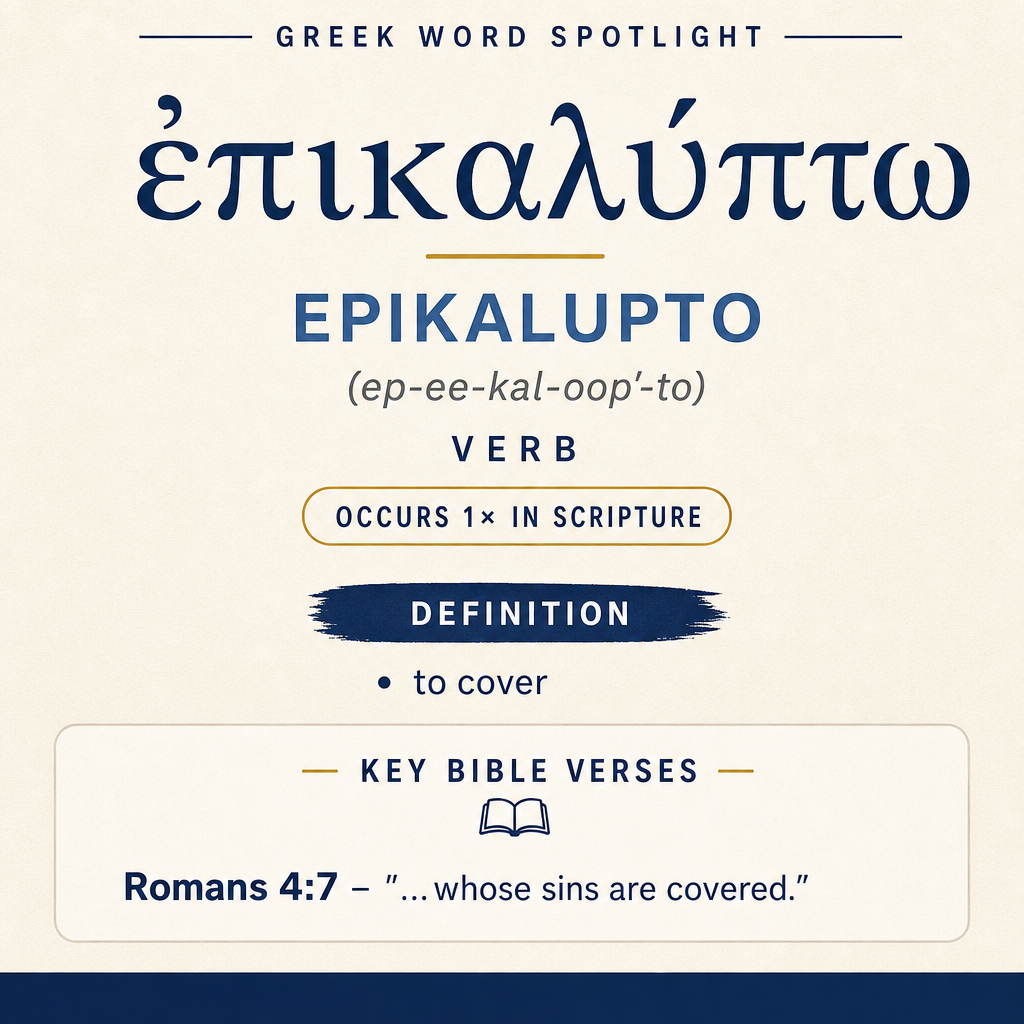
ἐπικαλύπτω means “to cover” and appears once in Scripture, in Romans 4:7.
Scripture Occurrence
This verb occurs one time in Scripture. Its single occurrence is in Romans 4:7.
Learn More →ἐπικαλύπτω means “to cover,” and it appears in the New Testament in Paul’s citation of a blessing in Romans 4:7. In that line, it describes what happens to “sins” in the condition of the blessed.
Root and Related Words
ἐπικαλύπτω (Epikalupto) is built from two elements: the preposition ἐπί (epi), “upon/to/against” (Strong’s G1909), and the verb καλύπτω (kalypto), “to cover” (Strong’s G2572). The compound form naturally presents the action as a covering placed “upon” something.

Occurrences
“Blessed are they whose iniquities are forgiven, whose sins are covered.” (Romans 4:7)
In this beatitude-style declaration, ἐπικαλύπτω is the second of two parallel descriptions of the same blessed condition. The first clause speaks of “iniquities” being “forgiven,” and the second clause speaks of “sins” being “covered.” The pair works as poetic reinforcement: two closely related moral categories (“iniquities” and “sins”) are met by two closely related acts (“forgiven” and “covered”), portraying a comprehensive relief for the person described as “blessed.”

The verb’s contribution is imagistic. “Forgiven” names a change in standing; “covered” adds the picture of something no longer exposed. Within the sentence itself, the object “sins” is what receives the covering. The statement does not locate the covering in time or explain its mechanism; its force is to describe the state of the blessed as one in which sins are not left open to view or left in the condition that makes them the defining feature of the person.
Because Romans 4:7 is framed as a pronouncement (“Blessed are they…”), the covering is not presented as a human action but as part of the beneficent outcome associated with blessing. The passive idea (“are covered”) keeps attention on what has been done for them rather than what they do. In the texture of the line, ἐπικαλύπτω functions as a vivid counterpart to “forgiven,” so that the reader hears both an accounting term and a visual term without the verse having to explain either one.
Sense and Usage
The basic sense “to cover” in Romans 4:7 is applied to an abstract object (“sins”) but expressed with concrete imagery. The choice of a physical action-word for a moral reality allows the sentence to communicate more than a bare statement that sins are dealt with; it communicates concealment from sight, removal from prominence, and the end of exposure as the operative condition. The word does this without adding extra components to its meaning: it remains “cover,” yet by taking “sins” as its object it evokes the kind of covering that changes how something is regarded—no longer displayed, no longer set out before others, no longer standing in the open.
The parallelism in the verse guides how the covering is heard. “Iniquities” correspond to “sins,” and “forgiven” corresponds to “covered.” This structure encourages the reader to interpret ἐπικαλύπτω as one facet of the same favorable outcome as forgiveness, rather than as a separate, competing idea. It intensifies the declaration of blessedness by offering two angles on the same relief: juridical release (“forgiven”) and visual concealment (“covered”). The verse is compact, but the pairing makes it rhetorically full.
Even in a single occurrence, the compound’s shape (ἐπί + καλύπτω) fits the line’s conceptual movement. A “covering” that comes “upon” sins conveys the sense that something is placed over them, so that what lies beneath is not the presented surface. The verse itself does not specify what does the covering or what the covering consists of; its concern is the result as experienced by “they” who are blessed. Thus ἐπικαλύπτω operates as a result-verb: it depicts the end state of sins in relation to the blessed person.
Finally, the term’s placement in a blessing statement gives it a communal, declarative tone. The sentence is not private introspection but public pronouncement: “Blessed are they…” In that genre, the verb helps articulate the kind of life-state being celebrated. Sins that are “covered” are no longer the defining visible reality; the blessedness is spoken over those who are characterized by that covered condition.
Imagery
Romans 4:7 attaches a simple, tangible picture to a moral reality: sins are treated as something that can be covered over. The line’s power lies in the everyday clarity of the image—something laid upon something else—pressed into service to describe the blessed state named in the verse: “whose sins are covered.”
Sources: Lexical data from Strong’s Exhaustive Concordance and the Translators Brief Lexicon of Extended Strongs for Greek (STEPBible, CC BY). Occurrence data from the Translators Amalgamated Greek New Testament (STEPBible, CC BY). Scripture quotations from the World English Bible (public domain).




