
Exploring the Meaning of Epautophoro in Greek
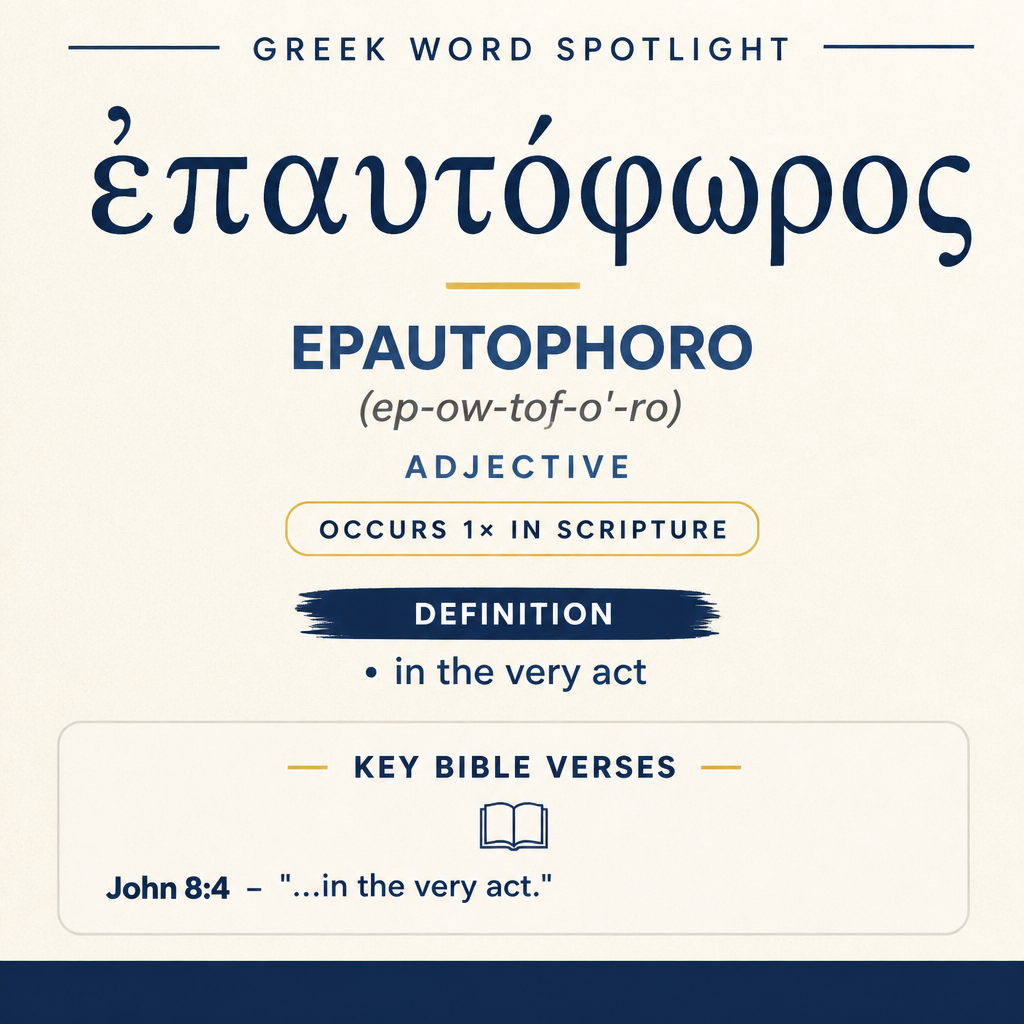
ἐπαυτόφωρος (αὐτόφωρος) means “in the very act” and appears once in Scripture, in John 8:4.
Biblical Usage
It occurs 1 time in Scripture. In John 8:4, it describes being found in adultery “in the very act.”
Learn More →Textual Context
In John 8:4, speakers report to Jesus that they found a woman in adultery, “in the very act.”
Learn More →ἐπαυτόφωρος (αὐτόφωρος) means “in the very act.” It appears in John 8:4 in a charge brought against a woman accused of adultery.
Root and Related Words
ἐπαυτόφωρος is related to epi (ἐπί), “upon/to/against” (Strong’s G1909), and autos (αὐτός), “it/s/he” (Strong’s G846). Together these related elements frame the adjective’s force as something set directly “upon” the person herself—an emphasis that fits a claim of immediate, personal involvement in what is alleged.

Occurrences
“they told him, “Teacher, we found this woman in adultery, in the very act.” (John 8:4)
In John 8:4, the word is attached to the accusers’ assertion of what they “found.” The sentence builds in stages: first the address (“Teacher”), then the accusation (“we found this woman in adultery”), and finally the intensifying detail (“in the very act”). ἐπαυτόφωρος functions as the climactic qualifier: it does not merely allege a moral conclusion or a hearsay report but presents the situation as being caught at the moment the act itself is taking place. The phrasing makes the charge sound immediate and observational, as though the speakers are presenting direct discovery rather than inference.

Because the accusation is expressed in the first-person plural (“we found”), the word also supports the accusers’ posture as witnesses who claim proximity to the event. In the tight compass of the verse, ἐπαυτόφωρος sharpens the rhetorical pressure on the one being addressed: it is offered as an evidential claim meant to settle the matter by the manner of discovery. The adjective therefore contributes not new information about the act (already named) but a particular kind of certainty about it—certainty anchored in the alleged timing of the discovery.
Sense and Usage
“In the very act” is a timing expression with argumentative weight. In John 8:4 it is not presented as a general description of the woman’s character, nor as a broad label for her past, but as a description of the circumstances under which she was “found.” The expression presses the accusation into the present tense of the scene: the speakers represent the offense as contemporaneous with their encounter. That is why the phrase feels like an evidentiary tag—an attempt to transform an accusation into an open-and-shut case by invoking immediacy.
The wording also creates a contrast between two kinds of claims that could be made in such an accusation. One could say only that an act occurred, or one could claim that the act was observed at the moment it was happening. ἐπαυτόφωρος belongs to the latter kind: it is a way of speaking that seeks to eliminate distance—distance in time (“it happened earlier”), distance in knowledge (“we deduced it”), or distance in responsibility (“someone else told us”). By using it, the speakers present themselves as having located the woman at precisely the point of wrongdoing, making their statement sound definitive and difficult to contest.
Within the single attested context, the adjective therefore functions as an intensifier that amplifies the seriousness and apparent clarity of the accusation. It turns “in adultery” into a claim framed as immediate apprehension. The result is a compressed portrayal of certainty: the woman is not merely accused of a known sin; she is claimed to have been discovered at the very moment the sin was being committed. That is the communicative effect of the term’s sense here—placing the alleged act and the alleged discovery on the same instant.
Imagery
The phrase “in the very act” carries the imagery of interruption—an act underway and observers arriving at the critical moment. In John 8:4, the accusers’ words paint a scene of sudden exposure: a situation that, in their telling, was not reconstructed afterward but encountered directly, with the accused presented as caught in the midst of what is named.
Sources: Lexical data from Strong’s Exhaustive Concordance and the Translators Brief Lexicon of Extended Strongs for Greek (STEPBible, CC BY). Occurrence data from the Translators Amalgamated Greek New Testament (STEPBible, CC BY). Scripture quotations from the World English Bible (public domain).




