Exploring the Meaning of Epaulis in Greek
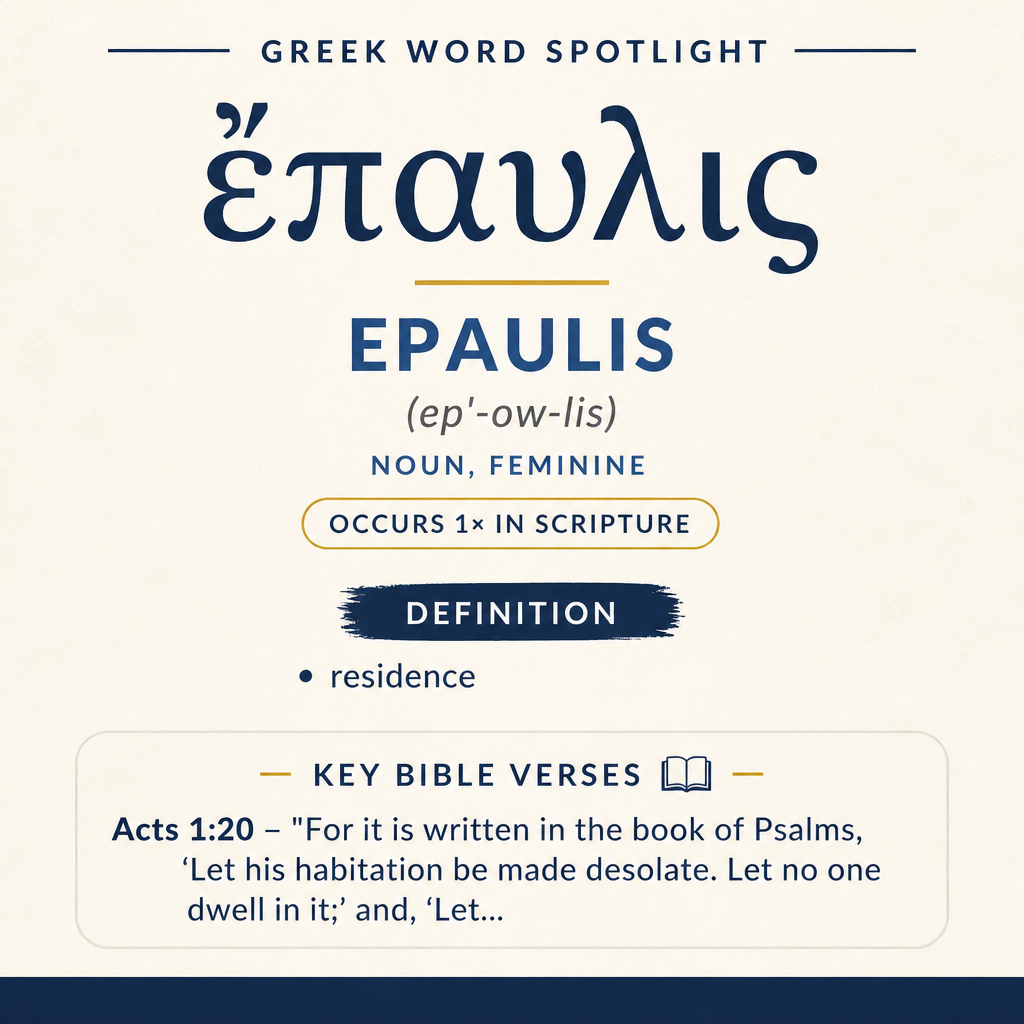
ἔπαυλις means “residence” and appears once in Scripture, in Acts 1:20.
Verse Context
In Acts 1:20 it appears in the line, “Let his habitation be made desolate. Let no one dwell in it;”
Learn More →ἔπαυλις refers to a residence. In the New Testament it appears in Acts 1:20 in a citation from the Psalms, where it frames the fate of a place once occupied and now left empty.
Root and Related Words
ἔπαυλις is connected with the preposition epi (ἐπί), “upon/to/against” (Strong’s G1909), and with aule (αὐλή), “palace/courtyard” (Strong’s G833). Together these relationships place the noun in the orbit of place-language: a settled location associated with dwelling and the space of a household setting.

Occurrences
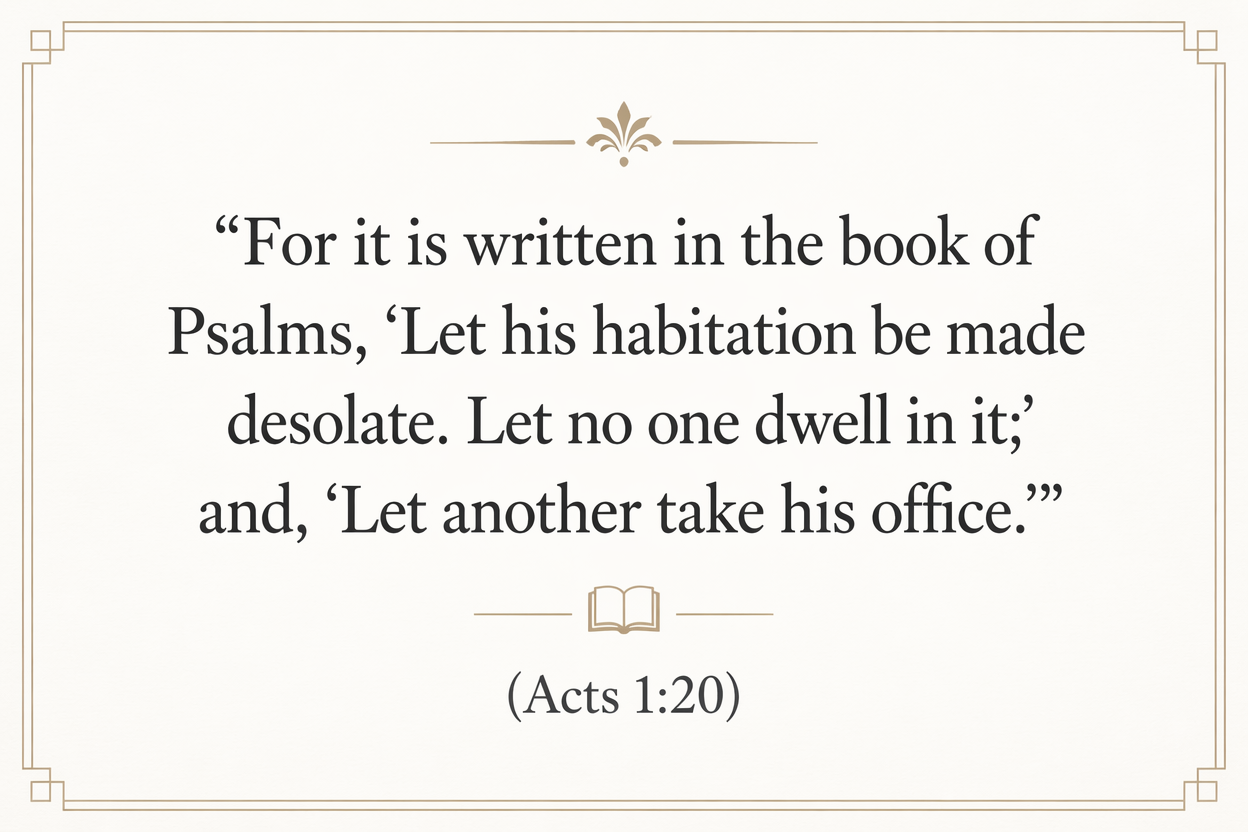
“For it is written in the book of Psalms, ‘Let his habitation be made desolate. Let no one dwell in it;’ and, ‘Let another take his office.’” (Acts 1:20)
In Acts 1, ἔπαυλις occurs within a paired quotation that speaks first of a “habitation” and then of an “office.” The first line, “Let his habitation be made desolate. Let no one dwell in it,” uses the noun to name the concrete sphere of a person’s settled life—his residence as a place where someone might “dwell.” The language is deliberately spatial and domestic: the “habitation” is not merely a concept but a location capable of becoming “desolate,” and the desolation is clarified by the clause that follows, “Let no one dwell in it.” In this scene, ἔπαυλις functions as the anchor for the image of vacancy: a residence emptied of occupants and therefore marked out as abandoned.
The immediate context in the verse also sets ἔπαυλις alongside a second loss: “Let another take his office.” Without collapsing the two into one idea, the quotation places the residence and the office as two distinct domains that can be forfeited—one tied to where a person lives, the other tied to a role that can be handed to “another.” ἔπαυλις, then, contributes the domestic, locative side of the judgment expressed in the quotation: it is the “habitation” that can be made desolate and cease to be inhabited.
Sense and Usage
Acts 1:20 shows ἔπαυλις operating as a straightforward term for a residence, but the verse draws out what a residence implies by pairing it with verbs and adjectives that describe its state. A residence is the kind of place that can either be lived in or left uninhabited; it can be characterized as “desolate” precisely because it is a dwelling-space meant for occupancy. The quotation intensifies that idea with a second clause that reads like an interpretive restatement: “Let no one dwell in it.” The residence is not only rendered empty in fact; it is declared off-limits for future occupants. In that way, the word carries more than an address or shelter; it evokes the social reality of habitation—someone belongs there, lives there, and is known there—so that making it “desolate” signifies the undoing of settled presence.
The placement of ἔπαυλις in a scriptural citation also gives it a particular rhetorical force. The speaker does not introduce the residence as a new detail but as a line already written: “For it is written in the book of Psalms.” Within that framework, ἔπαυλις becomes part of a formal declaration that what happens to a person can be spoken of in terms of what happens to his dwelling-place. The residence stands as a visible, locatable token of a person’s life: when the person is removed, the habitation is pictured as emptied, and the emptiness becomes a sign of desolation.
The verse further sharpens usage by juxtaposing the residence with an “office.” The residence belongs to the realm of dwelling; the office belongs to the realm of appointment and succession (“Let another take his office”). The residence, by contrast, is not reassigned; it is made desolate and left without a dweller. That contrast helps define the practical contour of ἔπαυλις here: it is not primarily presented as transferable property or a place for reassignment but as a lived-in space whose defining feature is that it is inhabited. When habitation ceases, what remains is not a neutral house but a desolated residence.
Imagery
The image tied to ἔπαυλις in Acts 1:20 is an emptied dwelling. The quoted words evoke a residence turned into a place of abandonment—“made desolate”—and then press the point with the stark consequence: “Let no one dwell in it.” In this single occurrence, ἔπαυλις gathers the ordinary idea of a residence into a vivid picture of vacancy and the lasting absence of a dweller.
Sources: Lexical data from Strong’s Exhaustive Concordance and the Translators Brief Lexicon of Extended Strongs for Greek (STEPBible, CC BY). Occurrence data from the Translators Amalgamated Greek New Testament (STEPBible, CC BY). Scripture quotations from the World English Bible (public domain).