Exploring the Meaning of Epano in Greek
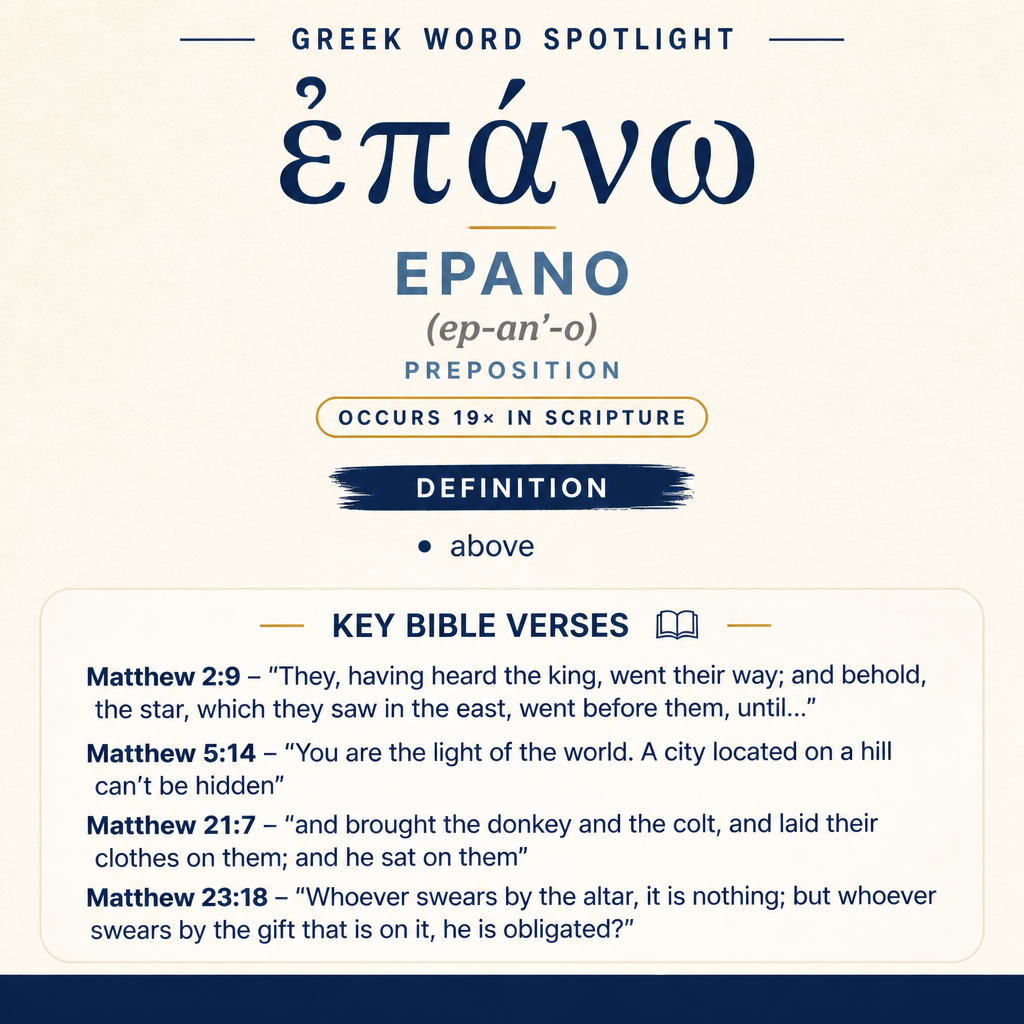
ἐπάνω (Epano) means “above” and occurs 19 times in Scripture, including uses in Matthew.
Matthew Examples
In Matthew it appears in contexts like something over a head (Matthew 27:37) and a star leading until it stands above (Matthew 2:9).
Learn More →Usage Snapshots
It is used of objects or realities located on or over something, as in “on it” in several Matthew 23 verses.
Learn More →ἐπάνω expresses the idea of being “above,” and in these passages it marks position or relation in space, often with a clear point of reference. The word helps the reader picture what is located higher than something else, or what is set over a person or object in a scene.
Occurrences
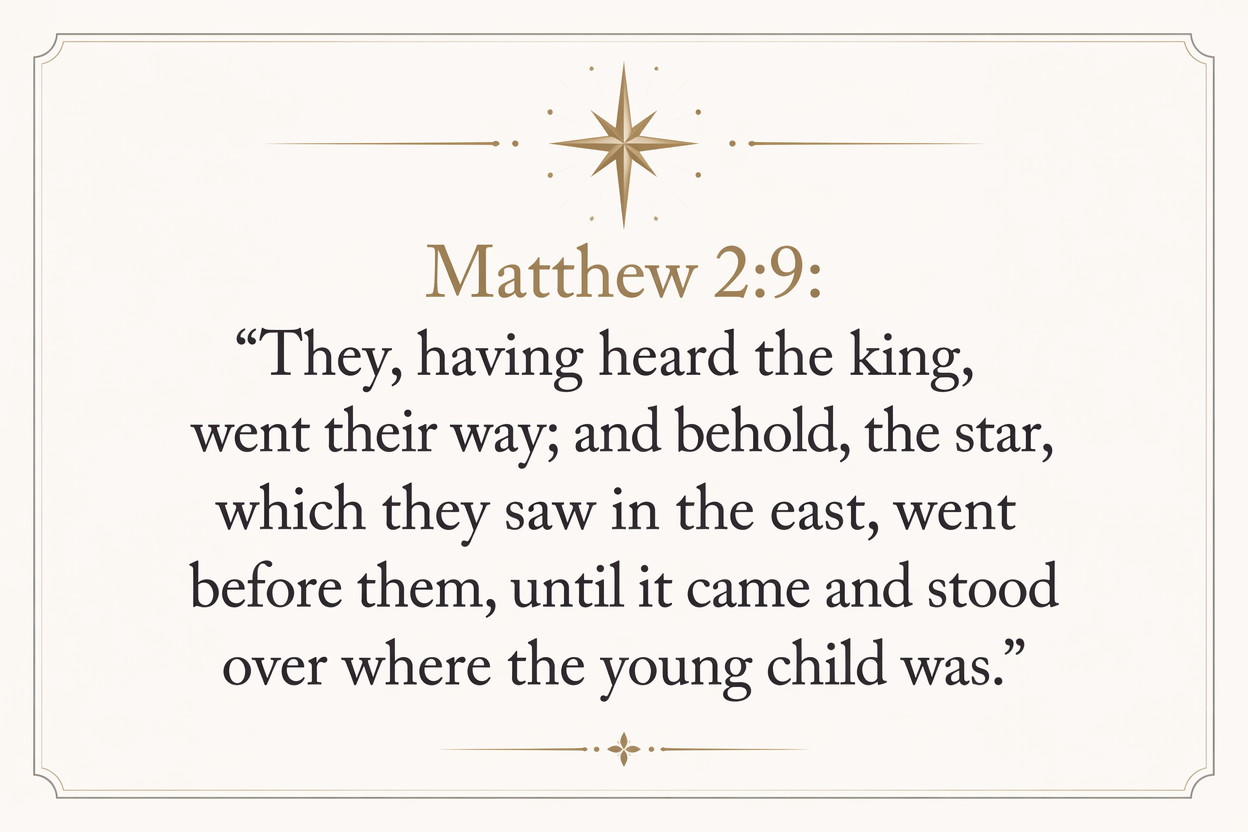
Matthew 2:9: “They, having heard the king, went their way; and behold, the star, which they saw in the east, went before them, until it came and stood over where the young child was.”
Here ἐπάνω anchors the star’s guidance in a precise spatial relation: it “stood over” a particular place. The narrative emphasizes not only that the star leads, but that it comes to rest in a position above the location associated with “the young child,” giving the scene a definite point of arrival.
Matthew 5:14: “You are the light of the world. A city located on a hill can’t be hidden.”
Within the image of a city’s visibility, ἐπάνω contributes to the idea of height in relation to what is below. The city’s placement “on a hill” depends on an “above” relationship: elevation makes concealment difficult and supports the point about being seen.
Matthew 21:7: “and brought the donkey and the colt, and laid their clothes on them; and he sat on them.”
The scene involves layered positions: clothes placed on the animals and someone seated “on” what has been arranged. ἐπάνω supplies the “above” orientation of one item or person in relation to another, helping the reader picture the physical stacking and placement that makes the riding possible.
Matthew 23:18: “‘Whoever swears by the altar, it is nothing; but whoever swears by the gift that is on it, he is obligated?’”
In this dispute over oaths, ἐπάνω identifies where the “gift” is situated—“on” the altar, that is, above it. The argument depends on this spatial relationship: the gift’s placement becomes the basis for treating one kind of oath as binding and another as negligible.
Matthew 23:20: “He therefore who swears by the altar, swears by it, and by everything on it.”
ἐπάνω widens the reference of an oath from the altar itself to “everything on it.” The “above” relation collects all items placed upon the altar into the scope of what is invoked, so that swearing “by the altar” implicates what rests above it as well.
Matthew 23:22: “He who swears by heaven, swears by the throne of God, and by him who sits on it.”
This sentence layers “above” relations in a structured way: heaven, the throne, and the one who “sits on it.” ἐπάνω marks the seated figure’s position above the throne’s surface, contributing to a vertical, ordered picture that supports the point about what an oath reaches.
Matthew 27:37: “They set up over his head the accusation against him written, “THIS IS JESUS, THE KING OF THE JEWS.””
Here ἐπάνω fixes the location of the written accusation: it is placed “over his head.” The word functions like a directional marker, guiding the reader’s eyes upward in the scene to where the charge is displayed in relation to the person being executed.
Matthew 28:2: “Behold, there was a great earthquake, for an angel of the Lord descended from the sky, and came and rolled away the stone from the door, and sat on it.”
After the stone is moved, ἐπάνω indicates the angel’s seated position “on” the stone—above it, resting upon it. The “above” relation reinforces the narrative’s physicality: the stone is not only displaced but becomes a surface for the angel’s posture.
Mark 14:5: “For this might have been sold for more than three hundred denarii, and given to the poor.” So they grumbled against her.
Within the complaint and the reaction against the woman, ἐπάνω expresses the sense of being “against” her as an “over” relation, portraying the grumbling as directed down upon its target. The word helps depict opposition as something pressed upon a person in social interaction.
Luke 4:39: “He stood over her, and rebuked the fever; and it left her. Immediately she rose up and served them.”
ἐπάνω paints a vivid bedside posture: someone “stood over her.” The “above” relationship places the healer upright and positioned higher than the sick woman, shaping the reader’s mental image of attentive presence immediately before the rebuke and the fever’s departure.
Luke 10:19: “Behold, I give you authority to tread on serpents and scorpions, and over all the power of the enemy. Nothing will in any way hurt you.”
In this statement of granted authority, ἐπάνω locates that authority “over all the power of the enemy.” The word frames the relationship as one of being above, portraying a superior position that encompasses “all” of that opposing power rather than a limited or partial scope.
Luke 11:44: “Woe to you, scribes and Pharisees, hypocrites! For you are like hidden graves, and the men who walk over them don’t know it.”
ἐπάνω supplies the physical relation between walkers and graves: people “walk over them,” moving above what lies concealed underfoot. The force of the comparison depends on this unseen “above/below” arrangement, where contact occurs without awareness because the graves are hidden.

Sense and Usage
Across these occurrences, ἐπάνω repeatedly establishes a reference point and then places something higher than it. Sometimes the reference point is a location (“where the young child was,” Matthew 2:9), sometimes a topographic feature (“on a hill,” Matthew 5:14), and often a tangible surface (altar, throne, stone). In each case the word does practical narrative work: it orients the reader in three-dimensional space, showing where an object is set, where a person stands, or how one element relates vertically to another.
The word also supports sequences that rely on placement. In Matthew 23:18–22, the reasoning about oaths turns on what is on the altar and who sits on the throne. ἐπάνω does not introduce new objects; it orders them. The logic is cumulative: if an oath involves an object, it also involves what is positioned upon it. The “above” relation becomes a way of mapping association and scope through spatial linkage.
In several scenes, ἐπάνω intensifies visibility. A city on a hill “can’t be hidden” (Matthew 5:14) precisely because being above affects what can be seen. Similarly, “They set up over his head the accusation” (Matthew 27:37): the placement above makes the charge prominent and readable in the moment. The word therefore often carries an implied function: what is above is set where it can be recognized, encountered, or noticed.
Other uses highlight proximity and interaction. “He stood over her” (Luke 4:39) places a person near enough for direct engagement; the vertical relation reinforces closeness and attentiveness at the point of healing. In Luke 11:44, those who “walk over” hidden graves are close enough to pass directly above them, yet remain unaware; the “above” relation underscores how near someone can be to something without recognizing it.
Finally, ἐπάνω can frame relationships that are not merely geometric but also directional in human affairs. In Mark 14:5, the grumbling is directed against a woman; the “over” orientation conveys pressure exerted upon a target. In Luke 10:19, being “over all the power of the enemy” expresses a comprehensive superiority through the same basic spatial metaphor of height and coverage. In these instances the word’s spatial core remains present, but it functions to describe how one party is positioned in relation to another.
Imagery
The collected passages give ἐπάνω a strong visual profile: a star poised above a place (Matthew 2:9), a city elevated on a hill (Matthew 5:14), objects set on an altar (Matthew 23:18, 23:20), a seated figure on a throne (Matthew 23:22), a placard fixed above a head (Matthew 27:37), and an angel sitting atop a stone (Matthew 28:2). Even where the scenes move into moral critique or authority (Luke 10:19; Luke 11:44), the word still works by making the reader imagine an “above” position that governs how the action is perceived.
Sources: Lexical data from Strong’s Exhaustive Concordance and the Translators Brief Lexicon of Extended Strongs for Greek (STEPBible, CC BY). Occurrence data from the Translators Amalgamated Greek New Testament (STEPBible, CC BY). Scripture quotations from the World English Bible (public domain).