Exploring the Meaning of Entrope in Greek
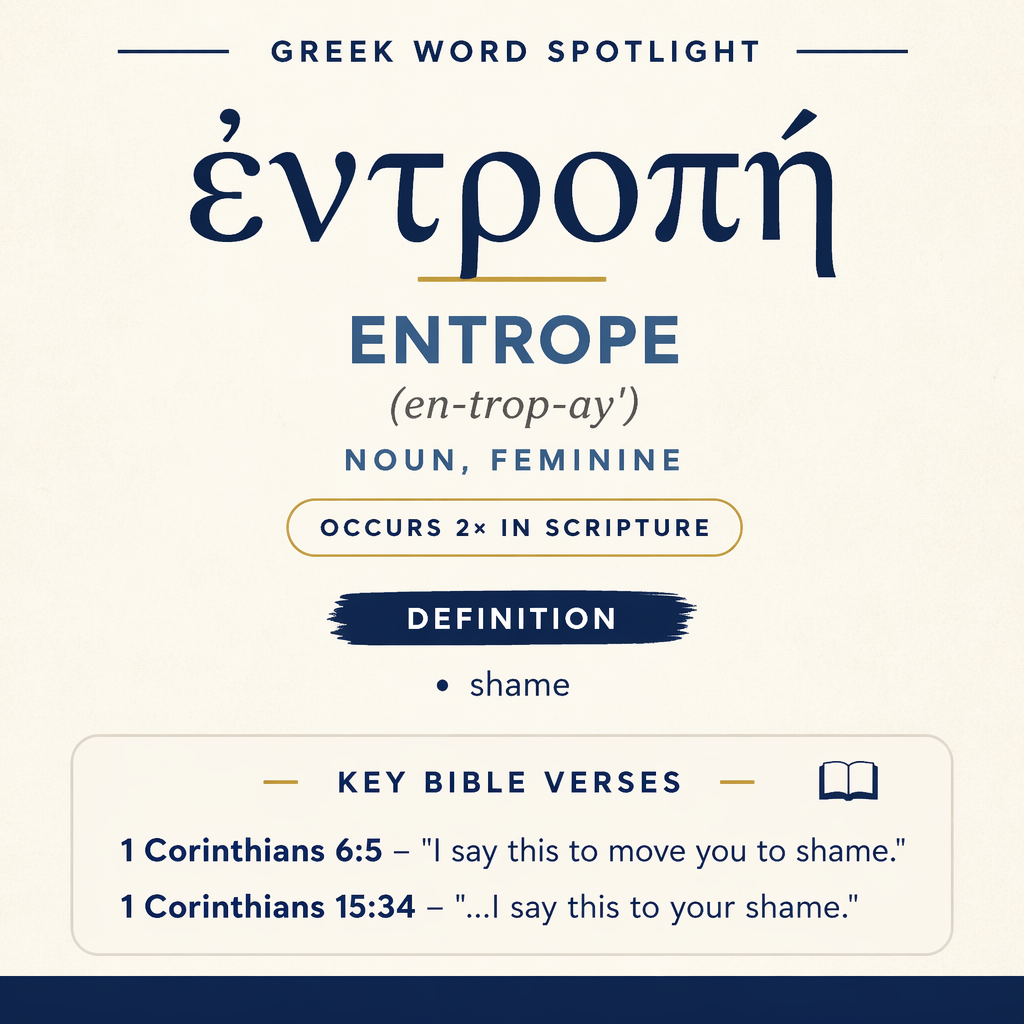
ἐντροπή means “shame” and appears twice in Scripture, both in 1 Corinthians (6:5; 15:34).
Scripture Occurrences
This word occurs 2 times in Scripture: 1 Corinthians 6:5 and 1 Corinthians 15:34.
Learn More →Context In Corinthians
In 1 Corinthians 6:5, it is used to move the readers to shame regarding disputes. In 1 Corinthians 15:34, it is spoken as “to your shame” concerning ignorance of God.
Learn More →ἐντροπή expresses “shame,” a social and moral sting that exposes behavior as unworthy in the eyes of others. In the New Testament it appears in two exhortations in 1 Corinthians, where Paul uses it as a pointed rhetorical tool to correct the community.
Root and Related Words
ἐντροπή is connected with the verb entrepo (ἐντρέπω), “to cause shame” (Strong’s G1788). The relationship helps explain why the noun naturally fits contexts where an admonition aims to produce a corrective sense of disgrace rather than mere information.

Occurrences
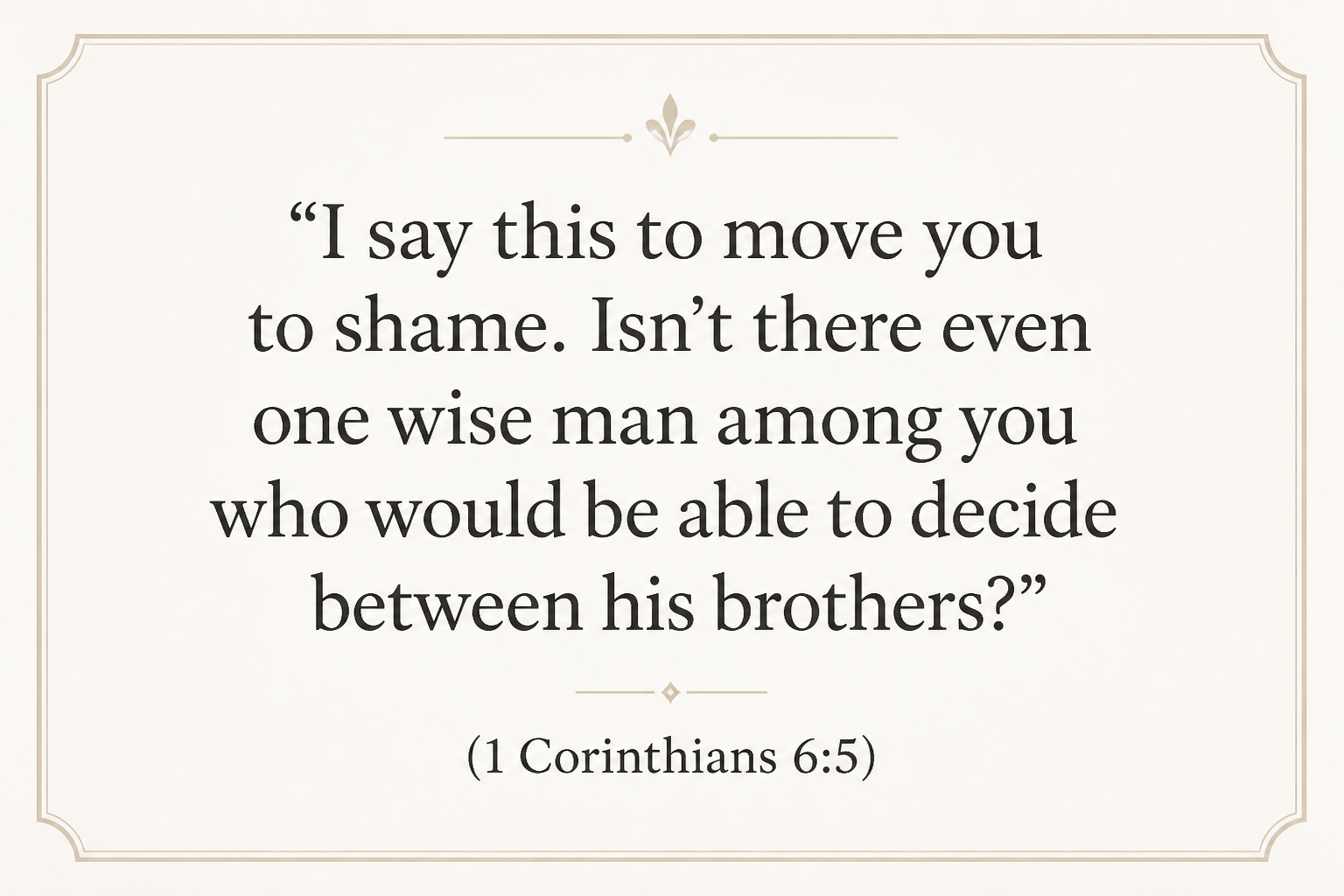
“I say this to move you to shame. Isn’t there even one wise man among you who would be able to decide between his brothers?” (1 Corinthians 6:5)
Here ἐντροπή names the intended effect of Paul’s words: he speaks so that the Corinthians will feel the weight of what their actions imply about them. The quoted question immediately clarifies what he is exposing—an apparent lack of internal wisdom and competence to settle disputes (“Isn’t there even one wise man among you”). Shame, in this sentence, is not treated as a vague emotion but as a moral-social verdict: the community’s behavior is publicly inconsistent with what they claim to be. The phrase “to move you to shame” frames the rebuke as corrective pressure, pushing them to see their situation as unacceptable and to change course. In the scene as presented, ἐντροπή functions like a spotlight: it illuminates a failure that should be obvious to them, especially in a context where “between his brothers” assumes a shared life that ought to include wise, peace-making judgment.
“Wake up righteously, and don’t sin, for some have no knowledge of God. I say this to your shame.” (1 Corinthians 15:34)
In this exhortation, ἐντροπή is the concluding sting that matches the urgency of the imperatives: “Wake up righteously, and don’t sin.” Paul identifies a condition within the group—“some have no knowledge of God”—and then attaches “I say this to your shame.” The shame is directed (“your shame”) and tethered to the moral seriousness of continuing in sin alongside spiritual ignorance inside the community. Within the verse’s flow, ἐντροπή works as an evaluative judgment on the situation: it tells the readers that the reality he has just named is not neutral or excusable, but disgraceful. It is also communal in its force: even though “some” lack knowledge, the rebuke lands on the whole audience (“your shame”), implying a shared responsibility for tolerating a state of affairs that should provoke alarm. The noun gathers up the verse’s commands and diagnosis into a final, uncomfortable assessment meant to jolt the Corinthians into “righteous” wakefulness.
Sense and Usage
Across these two occurrences, ἐντροπή consistently serves as a deliberate rhetorical outcome: Paul states that his speech aims to produce shame, not as an end in itself, but as a moral lever to correct the congregation’s conduct. In 1 Corinthians 6:5, shame is attached to a practical failure inside the community—an inability or unwillingness to find “even one wise man” capable of judging a matter between brothers. The disgrace is bound to their identity as a community that should be able to handle its own internal conflicts with wisdom. In 1 Corinthians 15:34, shame is linked to a deeper spiritual and ethical concern: the call to stop sinning is intensified by the claim that “some have no knowledge of God,” making the community’s condition not merely messy but dishonoring.
In both verses, shame is portrayed as something that can be “moved” or caused by speech. That is, ἐντροπή is not presented as a spontaneous personal feeling arising from private reflection; it is the public-facing moral discomfort that results when someone’s conduct is named plainly and measured against what ought to be true of them. The immediate contexts show that the shame Paul seeks is connected to clarity: he exposes a contradiction between the Corinthians’ behavior and the standards implied by wisdom, righteousness, and knowledge of God. The noun therefore carries the sense of an exposure that leaves the audience with no easy escape into self-justification. His statements aim to make the readers see themselves as they are, and to feel the appropriate disgrace of remaining that way.
Notably, ἐντροπή is expressed with a personal edge in each passage (“move you to shame”; “to your shame”). The grammar of address keeps the term from becoming a general moral principle; it is targeted, pastoral confrontation. Yet it is also communal: in both settings the shame concerns the life of the group—how disputes are handled “between his brothers,” and how the community lives when “some have no knowledge of God.” In this way, ἐντροπή acts as a community-shaping term, calling the Corinthians to feel corporate responsibility and to pursue conduct that will not invite disgrace.
Imagery and Force
The imagery suggested by these two uses is that of an abrupt unveiling: behavior that has been tolerated is brought into the open and evaluated as shameful. In 1 Corinthians 6:5 the picture is almost courtroom-like, with the pointed question about whether there is “even one wise man” to decide between brothers; ἐντροπή is the blush that follows when a community realizes it lacks what it should possess. In 1 Corinthians 15:34 the imagery is wakefulness after stupor—“Wake up righteously”—and ἐντροπή is the jarring recognition that sin and ignorance have no place among those who should know God. In both, shame is the sharp, immediate sensation that something is seriously out of order and must be set right.
Sources: Lexical data from Strong’s Exhaustive Concordance and the Translators Brief Lexicon of Extended Strongs for Greek (STEPBible, CC BY). Occurrence data from the Translators Amalgamated Greek New Testament (STEPBible, CC BY). Scripture quotations from the World English Bible (public domain).