
Exploring the Meaning of Entromos in Greek
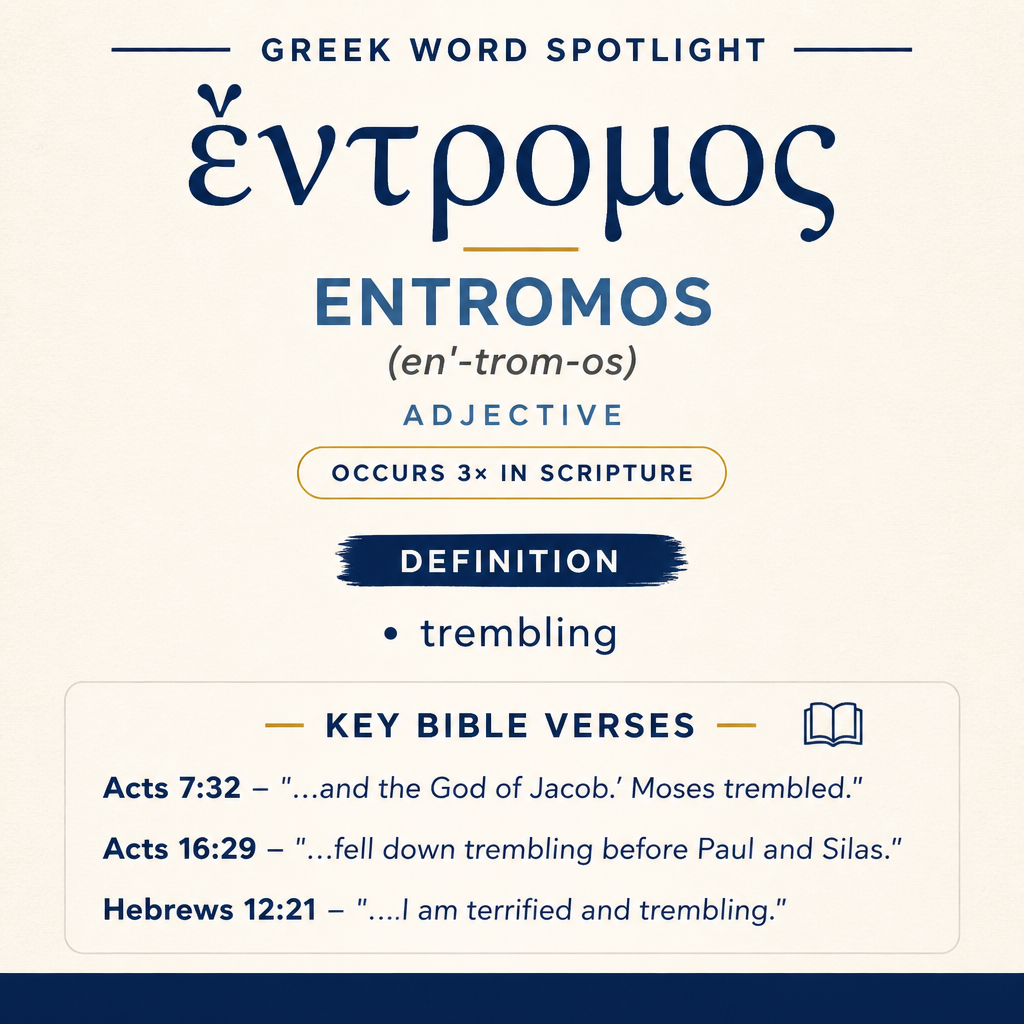
ἔντρομος means “trembling” and occurs three times in Scripture: Acts 7:32, Acts 16:29, and Hebrews 12:21.
Acts Occurrences
In Acts 7:32, Moses trembled at God’s words. In Acts 16:29, the jailer fell down trembling before Paul and Silas.
Learn More →Hebrews Occurrence
In Hebrews 12:21, Moses described himself as “terrified and trembling.”
Learn More →ἔντρομος describes a state of trembling, and in the New Testament it appears in scenes where the human body reacts to an overwhelming encounter or crisis. Its three uses cluster around Moses’ fearful response and the jailer’s alarmed approach to Paul and Silas.
Root and Related Words
ἔντρομος is connected with ἐν (en), “in/on/among” (Strong’s G1722), and τρόμος (tromos), “trembling” (Strong’s G5156). The combination links the idea of trembling with an enveloping condition—trembling as something a person is “in,” rather than a momentary external description.

Occurrences
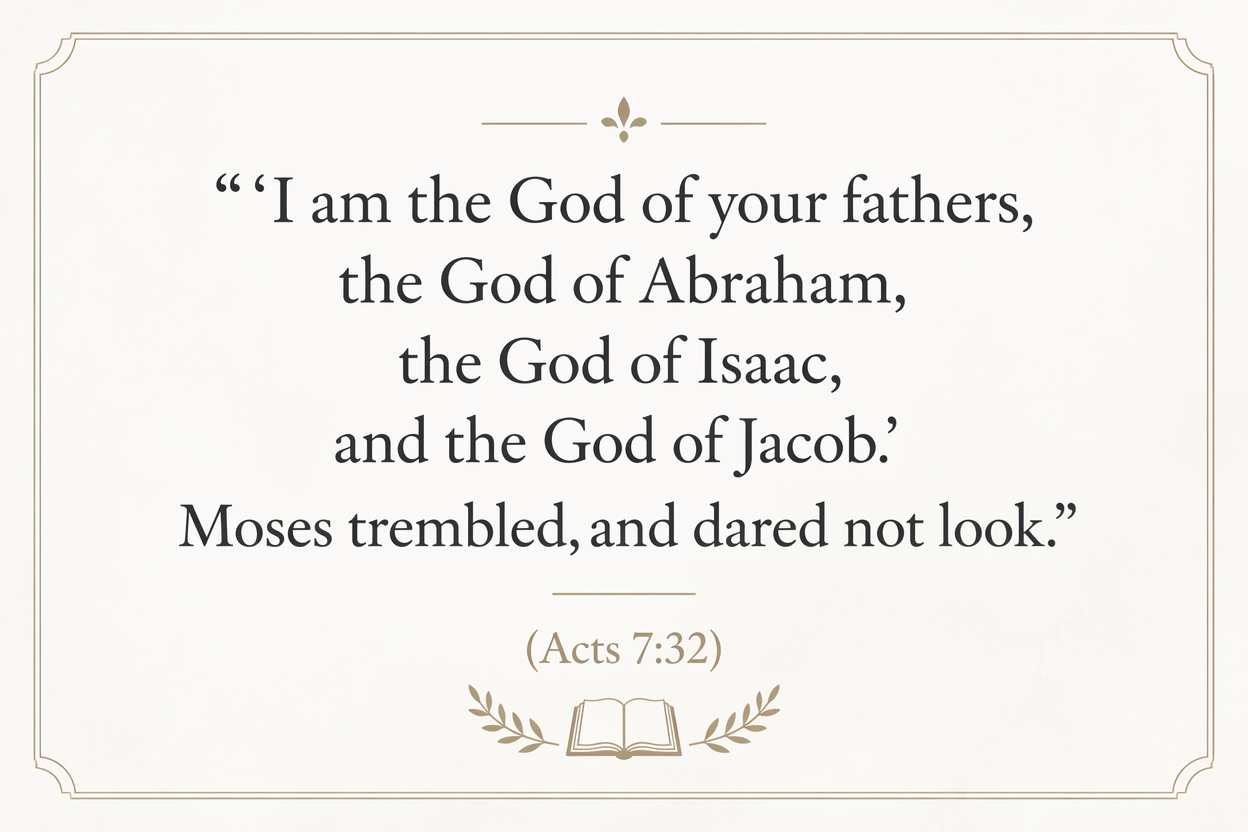
“‘I am the God of your fathers, the God of Abraham, the God of Isaac, and the God of Jacob.’ Moses trembled, and dared not look.” (Acts 7:32)
Here ἔντρομος marks Moses’ physical reaction to a divine self-identification: the voice names the patriarchs and claims covenantal continuity (“the God of… Abraham… Isaac… Jacob”), and Moses responds with trembling. The text pairs this bodily shaking with a deliberate restraint—“dared not look.” The trembling is not a detached symptom; it functions as the embodied edge of reverence and fear that constrains what Moses feels permitted to do in the moment. In this scene, ἔντρομος helps show that the encounter is not merely understood; it is endured in the body, with a reaction strong enough to govern Moses’ gaze.
“He called for lights, sprang in, fell down trembling before Paul and Silas,” (Acts 16:29)
In the prison episode, ἔντρομος characterizes the jailer’s approach to Paul and Silas. The sequence of actions is rapid and vivid: he “called for lights,” then “sprang in,” then “fell down… before” them. The trembling belongs to this cascade of movement: it is not a slow, reflective emotion but an urgent, destabilized condition that accompanies his abrupt entrance and his collapse at their feet. The word intensifies the posture “before Paul and Silas,” presenting his prostration as something driven by alarm and shock rather than ceremony. Even without additional description of his thoughts here, ἔντρομος makes clear that he is not composed; his body registers the crisis first, and his submission takes shape inside that shaking.
“So fearful was the appearance that Moses said, “I am terrified and trembling.”” (Hebrews 12:21)
This use places ἔντρομος inside Moses’ own reported speech: “I am terrified and trembling.” The sentence begins with an explanation—“So fearful was the appearance”—and then presents the response as Moses’ self-description. The pairing of “terrified” with “trembling” gives the trembling a clear setting: it is the bodily expression that corresponds to a fear powerful enough to be named aloud. Unlike Acts 7:32, where trembling is narrated and immediately tied to not daring to look, Hebrews 12:21 draws attention to what is seen (“the appearance”) and then to how that sight is internalized and voiced. ἔντρομος here functions as part of a compressed witness: the fearfulness of what appears is measured by the fact that even Moses speaks of himself as trembling.
Sense and Usage
Across these passages, ἔντρομος consistently depicts trembling as a whole-person condition, where the body’s shaking stands at the surface of an intense encounter. It is not used for mild nervousness or ordinary cold; it is placed where a moment carries weight that overwhelms normal steadiness. In Acts 7:32, the trembling is bound to restraint (“dared not look”): the body’s response and the will’s hesitation reinforce each other. In Acts 16:29, the trembling rides alongside sudden motion and a collapse into a lowered position (“sprang in,” “fell down”), showing trembling as compatible with frantic action rather than paralysis. In Hebrews 12:21, trembling is paired with articulated fear (“I am terrified and trembling”), so that ἔντρομος becomes a way of naming what fear does to a person, not only what fear is.
The distribution also shows that ἔντρομος can be either narrated from the outside (Acts) or confessed from the inside (Hebrews). In narrative description, it colors observable behavior—refusal to look, prostration before others. In direct quotation, it becomes part of self-report, a truthful summary of embodied experience. In both modes, trembling is not incidental detail; it provides a concrete register of the moment’s seriousness. The word anchors the scene in physical reality: what is happening is so weighty that it can be tracked by what happens to the hands, knees, and posture.
Two occurrences involve Moses, and in both, trembling accompanies exposure to a fearful manifestation of God’s presence or appearance. Without expanding beyond what is stated, the repeated association shows ἔντρομος as fitting language for moments when the boundary between ordinary life and a fear-inducing divine disclosure is crossed. The third occurrence, in Acts 16:29, demonstrates that the same trembling can be used in a different relational setting—“before Paul and Silas”—where the shaking body expresses urgent humility and dread in the presence of God’s servants during a crisis.
Imagery
The imagery carried by ἔντρομος in these verses is intensely physical: a person who cannot keep still. Moses’ trembling stands beside the refusal to look and the confession of being “terrified,” while the jailer’s trembling appears as he rushes in for light and collapses at the feet of Paul and Silas. In each case, trembling becomes a visible sign that the moment has exceeded normal control, pressing fear into the body and shaping what the person does next.
Sources: Lexical data from Strong’s Exhaustive Concordance and the Translators Brief Lexicon of Extended Strongs for Greek (STEPBible, CC BY). Occurrence data from the Translators Amalgamated Greek New Testament (STEPBible, CC BY). Scripture quotations from the World English Bible (public domain).




