Exploring the Meaning of Endeixis in Greek
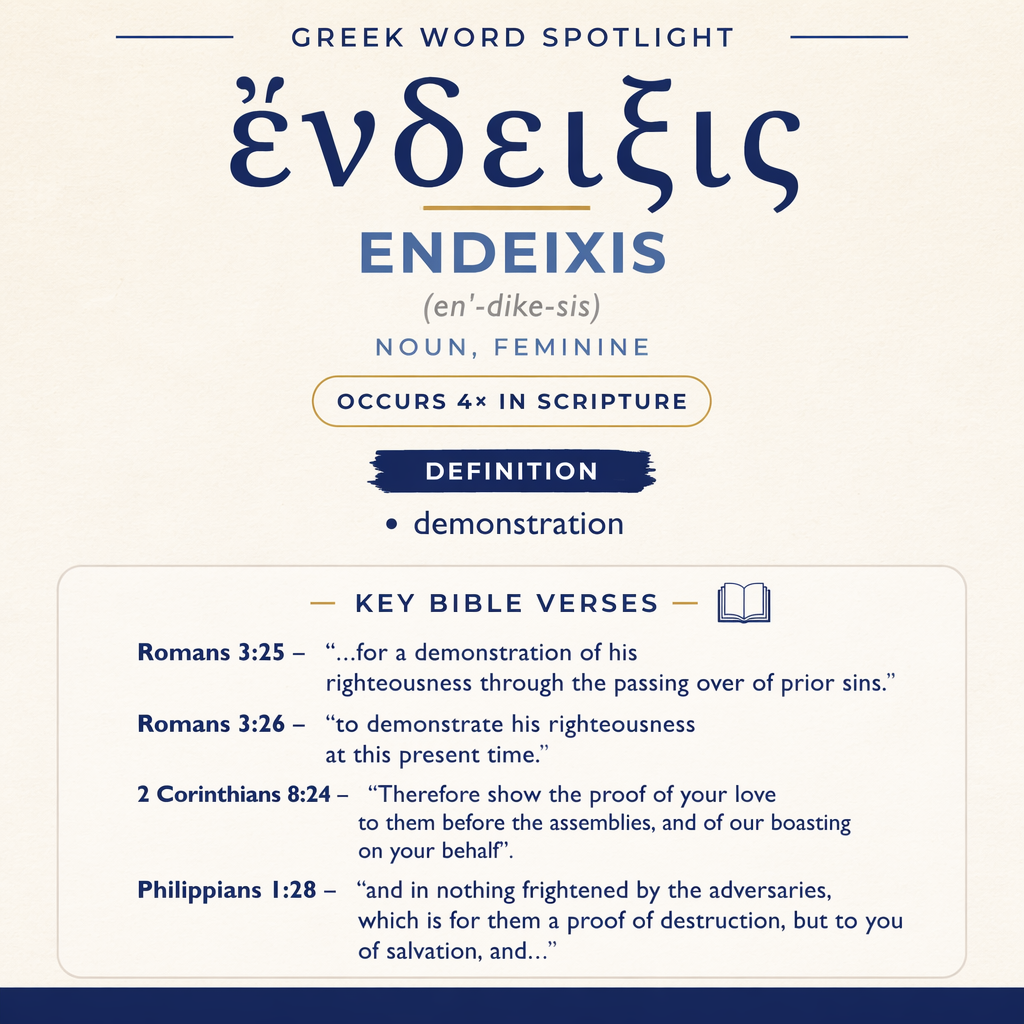
ἔνδειξις means “demonstration” and appears four times in Scripture: Romans 3:25–26, 2 Corinthians 8:24, and Philippians 1:28.
Core Meaning
ἔνδειξις is defined as “demonstration.” In its listed verses, it is rendered as “demonstration” or “proof.”
Learn More →Romans Usage
In Romans 3:25–26, ἔνδειξις is used for a demonstration of God’s righteousness. The text connects this demonstration with God being just and the justifier.
Learn More →Other Occurrences
In 2 Corinthians 8:24 it refers to showing the proof of love before the assemblies. In Philippians 1:28 it describes a proof related to destruction and salvation.
Learn More →ἔνδειξις expresses “demonstration,” the kind of showing that functions as evidence in view of an audience. In the New Testament it appears in Romans, 2 Corinthians, and Philippians in settings that range from God’s public display of righteousness to communal proof of love and the visible impact of courage under pressure.
Root and Related Words
ἔνδειξις is related to the verb endeiknymi (ἐνδείκνυμι), “to show” (Strong’s G1731). The noun names what results when something is shown—an exhibited proof set before observers.

Occurrences
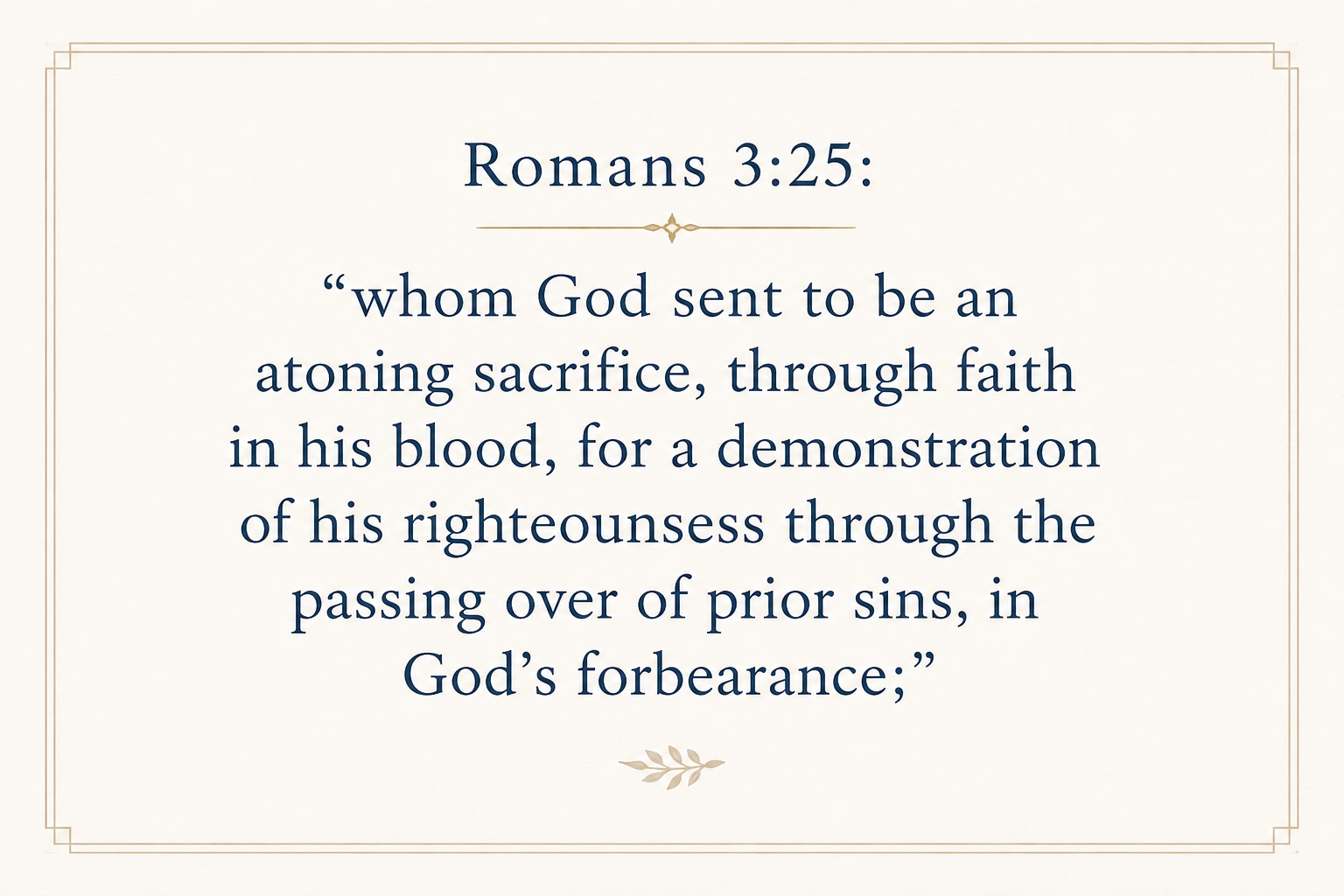
Romans 3:25: “whom God sent to be an atoning sacrifice, through faith in his blood, for a demonstration of his righteousness through the passing over of prior sins, in God’s forbearance;”
Here ἔνδειξις is attached to God’s action in sending Christ “to be an atoning sacrifice.” The “demonstration” is specifically “of his righteousness,” and it is framed in two coordinating explanations: it takes place “through the passing over of prior sins” and it is located “in God’s forbearance.” The word therefore contributes the idea of a public exhibit in which God’s righteousness is set forth as something that can be pointed to—something made visible and defensible in light of God’s earlier patience toward sins committed before this moment. The verse presents the demonstration as part of God’s purpose in the atoning act, with “faith in his blood” describing the way that act is engaged.
Romans 3:26: “to demonstrate his righteousness at this present time; that he might himself be just, and the justifier of him who has faith in Jesus.”
The second use continues the same line of thought but sharpens its temporal focus: “at this present time.” ἔνδειξις here serves to mark the present as the moment in which God’s righteousness is demonstrably on display. The verse ties that display to a particular outcome—“that he might himself be just, and the justifier of him who has faith in Jesus.” In this immediate context, “demonstration” functions as the bridge between what God is (just) and what God does (justifies). The word places emphasis on the manifested character of God’s righteousness: it is not only assumed, but shown in a way that supports the dual affirmation that God remains just while also justifying the one characterized by faith in Jesus.
2 Corinthians 8:24: “Therefore show the proof of your love to them before the assemblies, and of our boasting on your behalf.”
In 2 Corinthians the noun shifts to an explicitly interpersonal and communal setting. The imperative “show” sets the stage for ἔνδειξις as something the Corinthians are to supply: “the proof of your love.” The phrase “before the assemblies” locates the demonstration in public view, not merely in private sentiment. The proof is directed “to them,” implying identifiable recipients who are to be persuaded or assured by what is shown. The verse also links this proof with “our boasting on your behalf,” so that the demonstration has a validating function: it substantiates the claims that have been made about the Corinthians by those speaking. In this scene, ἔνδειξις is the tangible showing that makes love legible to a watching community.
Philippians 1:28: “and in nothing frightened by the adversaries, which is for them a proof of destruction, but to you of salvation, and that from God.”
In Philippians, ἔνδειξις belongs to the sphere of conflict and public opposition. The clause “in nothing frightened by the adversaries” describes a visible posture—steadiness in the face of hostile pressure. That stance is then interpreted as “a proof” with two contrasted reference points: “for them” it is “a proof of destruction,” and “to you” it is “of salvation.” The added phrase “and that from God” assigns the decisive origin of this evidential outcome to God. Here the noun highlights how observed behavior functions as evidence: the community’s fearlessness serves as an exhibited sign that is read in opposite ways by different parties, yet both readings are anchored in the passage’s claim that the outcome comes “from God.”
Sense and Usage
Across these passages, “demonstration” operates as a category of exhibited proof rather than a bare assertion. In Romans 3:25–26 the word is applied to God’s righteousness, and the surrounding clauses insist that righteousness is displayed in a way that addresses moral and judicial questions raised by “the passing over of prior sins” and by God’s aim to be both “just” and “the justifier” of those who have faith in Jesus. The noun thus fits a setting where something must be shown in the open to establish its integrity.
In 2 Corinthians 8:24, ἔνδειξις is not about God’s attribute but about a community’s love. Yet the same core idea holds: the love is to be demonstrable, capable of being recognized “before the assemblies.” The text’s pairing of “proof of your love” with “our boasting on your behalf” underscores how demonstration answers to scrutiny; it provides the observable basis by which spoken confidence is confirmed.
Philippians 1:28 illustrates another way demonstration works: it may arise from circumstances rather than from an explicit presentation. The community’s composure—“in nothing frightened”—becomes a proof that interpreters cannot ignore. The verse portrays demonstration as something that carries interpretive force: the same observable reality serves as evidence leading to different conclusions for different viewers (“for them… but to you…”), while the passage insists that the ultimate grounding of the proof is divine (“and that from God”).
Taken together, these occurrences show ἔνδειξις functioning in both theological and practical registers, but always with the same basic direction: what is real becomes publicly evident. Whether the object is “his righteousness,” “your love,” or the implications of steadfastness under adversaries, the noun points to proof that stands out in the shared space where claims are tested.
Imagery
The word often carries courtroom-like and public-assembly imagery in these contexts: righteousness set forth for inspection (Romans 3:25–26), love made visible “before the assemblies” (2 Corinthians 8:24), and courage observed in the face of “adversaries” that functions as a sign read by both sides (Philippians 1:28). In each case, ἔνδειξις evokes the scene of something placed in view—an exhibit that makes an unseen reality unmistakable to onlookers.
Sources: Lexical data from Strong’s Exhaustive Concordance and the Translators Brief Lexicon of Extended Strongs for Greek (STEPBible, CC BY). Occurrence data from the Translators Amalgamated Greek New Testament (STEPBible, CC BY). Scripture quotations from the World English Bible (public domain).