Exploring the Meaning of Endeigma in Greek
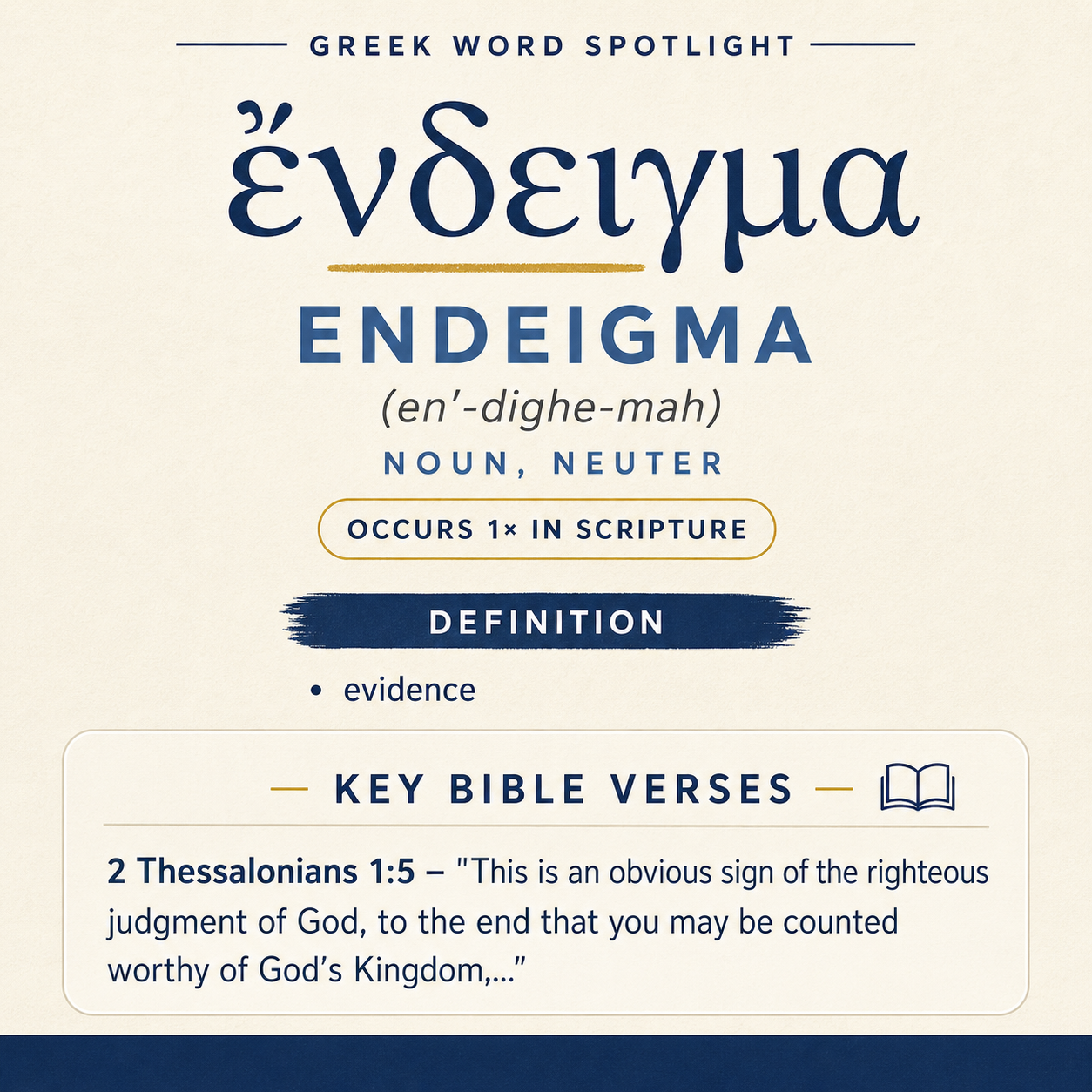
ἔνδειγμα (Endeigma) means “evidence” and appears once in Scripture, in 2 Thessalonians 1:5.
Scripture Occurrence
This word occurs 1 time in Scripture. Its single occurrence is in 2 Thessalonians 1:5.
Learn More →Verse Context
In 2 Thessalonians 1:5, it is used in the phrase “an obvious sign of the righteous judgment of God.”
Learn More →ἔνδειγμα means “evidence” and appears in the New Testament in Paul’s description of suffering and God’s righteous judgment in 2 Thessalonians 1:5. In that setting, the word names what the readers’ present experience visibly points to within God’s larger purpose.
Root and Related Words
ἔνδειγμα (Endeigma) derives from the verb ἐνδείκνυμι (endeiknymi), “to show” (Strong’s G1731). The noun expresses what is shown—something that functions as evidence in the situation being described.

Occurrences
“This is an obvious sign of the righteous judgment of God, to the end that you may be counted worthy of God’s Kingdom, for which you also suffer.” (2 Thessalonians 1:5)
Here ἔνδειγμα stands in a tightly argued sentence where Paul points to a present reality (“you also suffer”) and labels it “an obvious sign.” Within the verse, “this” gathers up the circumstance he has in view—namely, the believers’ suffering connected to “God’s Kingdom.” Calling it an “obvious sign” treats that suffering not as a meaningless accident but as something that shows something about God’s “righteous judgment.” The word therefore contributes a forensic flavor to the line: the situation is described as carrying evidential weight, like something that can be pointed to as proof within a case. It is not merely that God will judge righteously; the suffering itself is presented as a visible indicator that corresponds to that righteous judgment.
The verse further explains the direction of that evidence: “to the end that you may be counted worthy of God’s Kingdom.” ἔνδειγμα thus functions inside a purpose clause. The “obvious sign” is not framed as a bare omen; it is tied to a stated end—being “counted worthy.” The wording links the “righteous judgment of God” with God’s evaluative outcome regarding the sufferers. In that logic, ἔνδειγμα marks the sufferings as participating in the demonstrative side of God’s judgment: what they endure has a showing-function in relation to the righteousness of God’s judging and to the worthiness that is in view.
Finally, the verse specifies the sphere in which this evidence operates: “God’s Kingdom, for which you also suffer.” The evidence is not detached from allegiance; it is bound to the Kingdom and the cost associated with it. In context, ἔνδειγμα names a piece of lived experience that can be interpreted as evidence precisely because it is suffering “for” the Kingdom. The word therefore carries a public, legible quality: whatever “this” refers to, it is not hidden; it is “obvious,” and it has interpretive significance for understanding God’s righteous judgment as it bears on the community’s suffering.
Sense and Usage
The single New Testament use of ἔνδειγμα places “evidence” in a moral-judicial setting. The verse speaks of “the righteous judgment of God,” and the “obvious sign” language frames present circumstances as evidentiary material within that judgment. In ordinary terms, evidence is something that points beyond itself: it is an observed reality that substantiates a conclusion. In 2 Thessalonians 1:5, the observed reality is suffering connected to God’s Kingdom, and the conclusion it substantiates is bound up with God’s righteous judgment and the outcome of being “counted worthy.” The word therefore works as a bridge between experience and interpretation—between what the believers endure and what that endurance shows about God’s just dealings.
Because ἔνδειγμα is tied to what is “obvious,” its nuance in this verse leans toward evidence that is plain to see rather than evidence that must be teased out by subtle reasoning. The verse does not present an elaborate chain of proofs; it points to a situation and labels it as a sign that is manifest. That supports a reading where the “evidence” is embedded in the community’s reality in a way that can be recognized. The emphasis is not on collecting many items but on the evidential force of a single, concrete reality within their shared life.
The connection to ἐνδείκνυμι (“to show”) helps clarify how ἔνδειγμα functions conceptually. Evidence is not merely information stored away; it is something that can be shown, pointed out, or displayed in argument. Paul’s statement “This is…” is demonstrative in itself: it introduces the evidence as something presented before the audience. The word thus suits a pastoral-argumentative register, where the writer interprets the readers’ hardship and draws out its significance. The evidence is not separated from God’s action; it is evidence “of the righteous judgment of God,” meaning the showing is tied to what God is doing and what God will vindicate.
Within the verse, ἔνδειγμα also interacts with evaluation language: “counted worthy.” Evidence commonly functions in contexts where someone is judged or assessed, and this line places worthiness alongside God’s righteous judgment. The word therefore does more than label suffering as meaningful; it frames the suffering as having relevance to a divine assessment. The sufferers are not simply enduring; their endurance, as suffering connected to the Kingdom, is described in terms that make it pertinent to a righteous judgment and a future counting-worthy. ἔνδειγμα names the “showing” aspect of that connection: what they undergo stands as evidence within the moral order governed by God’s righteous judgment.
At the same time, the verse guards the direction of interpretation by attaching the evidence to God’s Kingdom: “for which you also suffer.” The evidence is not suffering in the abstract; it is suffering with reference to a specific allegiance and sphere. This keeps ἔνδειγμα from being a general claim that any hardship automatically signifies divine judgment; in this line it is their Kingdom-related suffering that is treated as evidence in the stated theological argument. The word’s placement therefore underscores how evidence is defined by context: what counts as evidence is determined by what it is evidence of and by what end it serves (“to the end that you may be counted worthy”).
Imagery
Although ἔνδειγμα is an abstract term, 2 Thessalonians 1:5 gives it a concrete feel by tying it to visible suffering. The word evokes the image of something put on display—an “obvious sign” that can be pointed to—so that the community’s hardships become a kind of exhibited proof within the frame of God’s righteous judgment and the hope of being counted worthy of God’s Kingdom.
Sources: Lexical data from Strong’s Exhaustive Concordance and the Translators Brief Lexicon of Extended Strongs for Greek (STEPBible, CC BY). Occurrence data from the Translators Amalgamated Greek New Testament (STEPBible, CC BY). Scripture quotations from the World English Bible (public domain).