Exploring the Meaning of Ektarasso in Greek
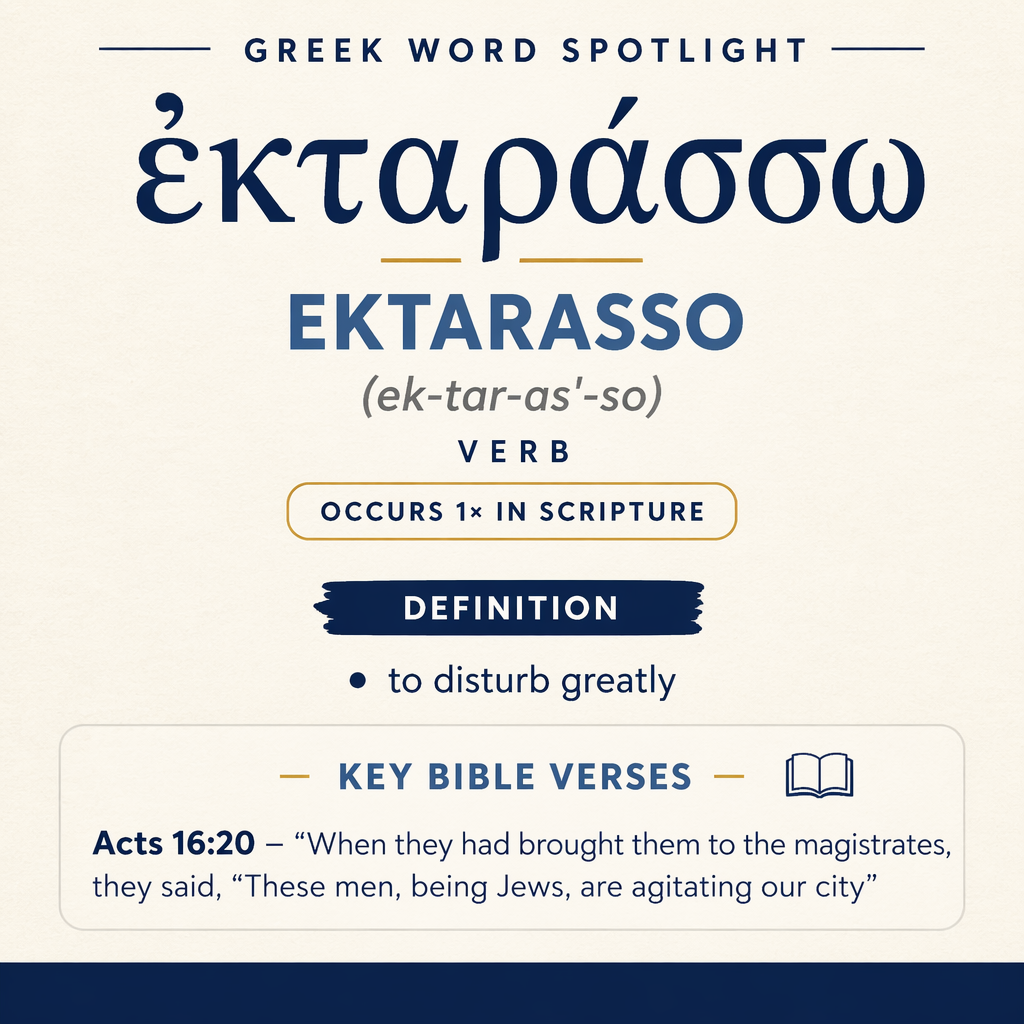
ἐκταράσσω means “to disturb greatly” and appears once in Scripture, in Acts 16:20.
Biblical Occurrence
This word occurs 1 time in Scripture. Its single occurrence is in Acts 16:20.
Learn More →Verse Context
In Acts 16:20, the accusation is that “These men, being Jews, are agitating our city.”
Learn More →ἐκταράσσω expresses the idea of disturbing someone or something greatly. It appears in the account of Paul and Silas being brought before city officials in Acts.
Root and Related Words
ἐκταράσσω (Ektarasso) is built from ἐκ (ek), “out from,” and ταράσσω (tarasso), “to trouble.” The combined form intensifies the notion of trouble by framing it as something driven outward—an upheaval that spills beyond a private feeling into public disruption.

Occurrences
“When they had brought them to the magistrates, they said, “These men, being Jews, are agitating our city” (Acts 16:20)
In Acts 16:20 the word is placed on the lips of accusers addressing “the magistrates.” The scene is formal and public: Paul and Silas are physically “brought” to officials, and a charge is voiced about their effect on the wider community. Within that accusation, ἐκταράσσω describes the alleged impact not as a minor irritation but as a severe disturbance—an agitation felt at the level of “our city.” The wording pushes the complaint beyond a personal grievance (“they upset me”) into a civic complaint (“they are agitating our city”), framing the matter as something that threatens order and stability.
The charge also works rhetorically: it casts the accused as active agents of disruption (“These men… are agitating”) and portrays the city as the object that is being thrown into turmoil. By coupling the action with a civic object (“our city”), the accusation implies consequences that would matter to magistrates—public peace, orderly life, and the reputation of the city—so the verb functions to heighten the seriousness of what is being alleged.
The statement “These men, being Jews,” introduces an identification of the accused immediately before the claim of agitation. In this sentence, ἐκταράσσω is the verb that converts that identification into a perceived public problem: the speakers are not merely naming who the men are, but asserting what they are doing to the city. The verb thus serves as the hinge of the charge, transforming a description of persons into an accusation of major disturbance.
Sense and Usage
Across its single attested use, ἐκταράσσω is applied to a social setting where disturbance is framed as a public matter. The context supplies several features of its force.
First, the disturbance is represented as extensive rather than localized. The object is not an individual, a household, or a small group, but “our city.” That scale fits a verb that communicates great disturbance: the accusers are claiming an effect that radiates outward through communal space, affecting the atmosphere of civic life.
Second, the verb is used within legal or quasi-legal speech. The speakers present their complaint to “the magistrates,” implying that the disturbance is of a kind that merits official attention. In such a setting, language tends to intensify: a charge that someone is disturbing greatly is stronger than saying they are merely contentious or annoying. The verb therefore functions as an escalator of perceived threat, suited to a moment when the goal is to secure action from authorities.
Third, the wording paints disturbance as destabilization. “Agitating our city” evokes unrest—a condition in which normal order is unsettled. Even without detailing the mechanisms of that agitation, the accusation communicates that the city’s equilibrium is being shaken. In this way ἐκταράσσω carries not just the idea of trouble, but trouble that is disruptive enough to be described in civic terms.
Finally, because the verb is embedded in a claim made by opponents, it shows how severe disturbance can be alleged as a way to define and condemn the presence of outsiders. The speakers use ἐκταράσσω to portray Paul and Silas as a disruptive force in the city; the word itself helps build the narrative posture of threat that the accusers wish the magistrates to accept.
Imagery
The picture suggested by ἐκταράσσω in Acts 16:20 is the unsettling of a whole civic environment: not a quiet, private disturbance, but a city thrown into agitation. In the brief accusation—spoken before magistrates—one hears the implied image of public order being jarred and communal life stirred up, with the disturbance presented as large enough to demand an official response.
Sources: Lexical data from Strong’s Exhaustive Concordance and the Translators Brief Lexicon of Extended Strongs for Greek (STEPBible, CC BY). Occurrence data from the Translators Amalgamated Greek New Testament (STEPBible, CC BY). Scripture quotations from the World English Bible (public domain).