
Exploring the Meaning of Ekkomizo in Greek
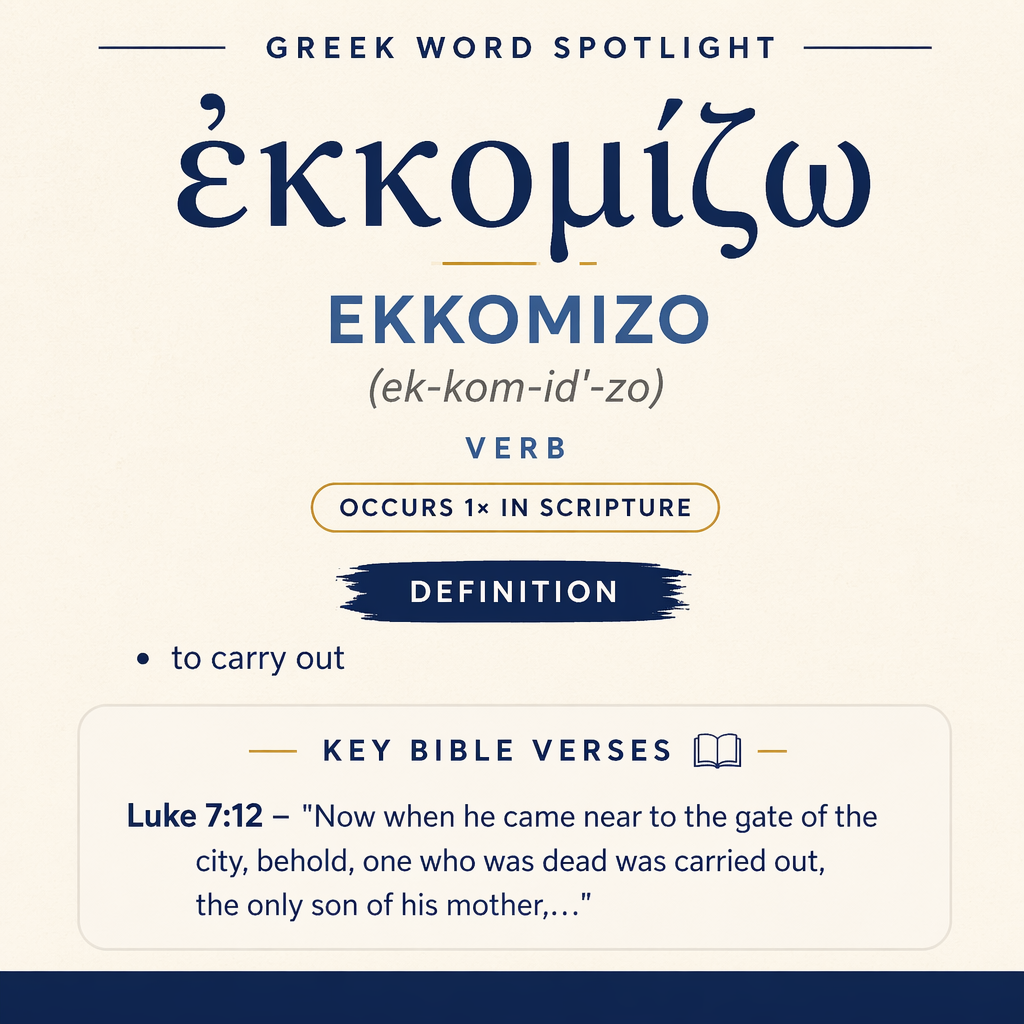
ἐκκομίζω (Ekkomizo) means “to carry out” and appears once in Scripture, in Luke 7:12.
Verse Context
In Luke 7:12, it describes one who was dead being carried out near the city gate.
Learn More →ἐκκομίζω means “to carry out,” and it appears in the New Testament in Luke’s account of a funeral procession at the city gate. The verb names the action being done to the dead man as the scene opens.
Root and Related Words
ἐκκομίζω is formed from ἐκ (ek), “out from” (Strong’s G1537), and κομίζω (komizo), “to bring/be repaid” (Strong’s G2865). In combination, the components foreground movement outward, with the sense of conveying someone or something to a destination.

Occurrences
“Now when he came near to the gate of the city, behold, one who was dead was carried out, the only son of his mother, and she was a widow. Many people of the city were with her.” (Luke 7:12)
In Luke 7:12, ἐκκομίζω supplies the key motion that sets the whole episode in view: as Jesus approaches “the gate of the city,” the narrative meets him with a body being moved “out.” The verb sits at the hinge between two directions—Jesus coming near to the gate, and the dead man being carried out—so the encounter is framed as a convergence of arrivals and departures at a boundary point.
The action is described in the passive (“was carried out”), placing emphasis on what is happening to the dead man rather than on the bearers. That choice matches the verse’s focus: the deceased is introduced not by name or status but by his condition (“one who was dead”), and then by his family relationship (“the only son of his mother”) and her condition (“and she was a widow”). ἐκκομίζω, in this context, is the verb that moves the description from identity and grief into the physical reality of loss: the son is not merely dead; he is being borne away from the city in a public procession.
The location detail—“near to the gate of the city”—helps ἐκκομίζω do more than mark transport. A city gate is the threshold between inside and outside, and the verb’s “out” directionality corresponds to that liminal setting. The body is being carried away from the community’s interior spaces toward what lies beyond. The scene is thus both communal and exposed: “Many people of the city were with her,” and the carrying out happens where coming and going can be witnessed. ἐκκομίζω contributes a sense of public movement that gathers people into a shared event and sets the mother’s bereavement in the open.
Because Luke pairs the carrying out with the mother’s status—“she was a widow”—the verb also functions narratively to intensify vulnerability. The only son is being removed from her presence, and the outward movement implied by ἐκκομίζω is irreversible within the scene as described: the procession is already underway when Jesus arrives. The verb therefore introduces the episode at its most final moment: not at sickness, not at deathbed, but at the point when the dead are being borne away.
Sense and Usage
Within its single attested New Testament occurrence, ἐκκομίζω expresses outward conveyance in a concrete, bodily sense. The verb does not describe an abstract change or an internal experience; it depicts the physical act of transporting a person out from a location. In Luke 7:12, that outward movement is not incidental detail but the narrative condition that makes the encounter possible: Jesus comes “near to the gate,” and at that same gate the dead man “was carried out.” The verb’s meaning is therefore activated at the meeting point of path and threshold.
The wording also shows how the sense of “carry out” can carry social weight without adding additional lexical meaning. The one being carried is “the only son of his mother,” and “she was a widow.” Those clauses interpret the event’s human significance; ἐκκομίζω supplies the event’s visible action. Together they portray grief as something that moves through space: the mother and the “many people of the city” accompany the outward transport. The verb thus fits a scene where death is not hidden but conducted as a communal passage, and the direction “out” shapes the reader’s sense of separation—away from the city and, by implication, away from ordinary life within it.
The passive construction (“was carried out”) is also an important usage feature in this verse. It aligns the dead man with the object of the action, underscoring his helplessness and the dependence on others to move him. The bearers remain unnamed, which keeps attention on the one being carried and on the mother whose loss is simultaneously social (“Many people of the city were with her”) and personal (“the only son of his mother”). ἐκκομίζω, used this way, serves as a compact verb for a procession’s defining motion.
Imagery
Luke’s scene places ἐκκομίζω at a city gate, where the inside/outside contrast is naturally vivid. The word’s imagery is therefore spatial and directional: a body borne outward, a mother surrounded by townspeople, and an approaching figure arriving at the same boundary. The carrying out is the picture of departure—an outward movement that makes the gravity of the moment visible before any further action is narrated.
Sources: Lexical data from Strong’s Exhaustive Concordance and the Translators Brief Lexicon of Extended Strongs for Greek (STEPBible, CC BY). Occurrence data from the Translators Amalgamated Greek New Testament (STEPBible, CC BY). Scripture quotations from the World English Bible (public domain).




