
Exploring the Meaning of Egkrino in Greek
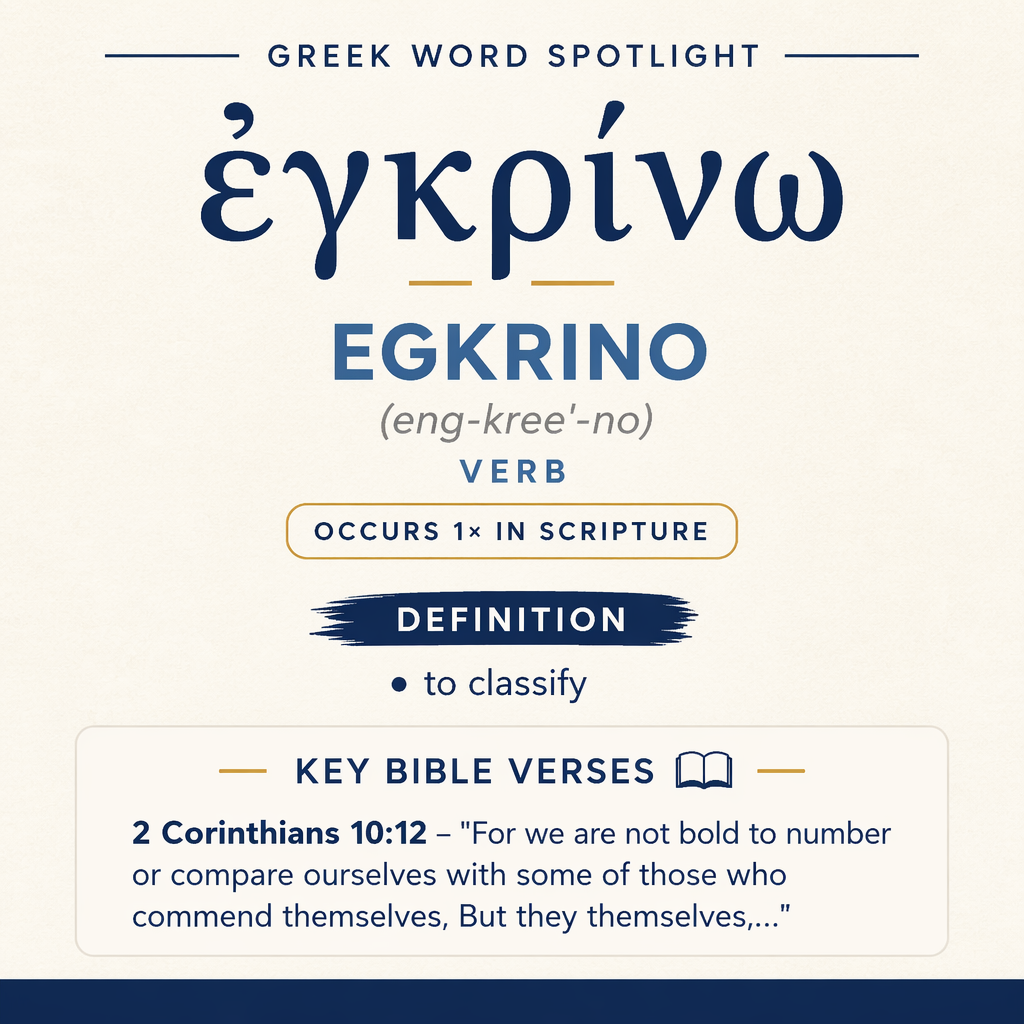
ἐγκρίνω means “to classify” and appears once in Scripture in 2 Corinthians 10:12.
Verse Context
In 2 Corinthians 10:12, it appears in a statement about numbering or comparing with those who commend themselves.
Learn More →ἐγκρίνω means “to classify,” and it appears once in the New Testament, in Paul’s discussion of self-comparison and self-commendation in 2 Corinthians 10:12. In that setting it stands in the orbit of counting, measuring, and comparing, where Paul contrasts his own stance with the habits of certain self-approving opponents.
Root and Related Words
ἐγκρίνω (Egkrino) is related to the preposition ἐν (en), “in/on/among” (Strong’s G1722), and to the verb κρίνω (krino), “to judge” (Strong’s G2919). Together these related forms situate ἐγκρίνω in the semantic neighborhood of judgment language, with an added sense of placement or inclusion suggested by ἐν.

Occurrences
“For we are not bold to number or compare ourselves with some of those who commend themselves. But they themselves, measuring themselves by themselves, and comparing themselves with themselves, are without understanding.” (2 Corinthians 10:12)
In this sentence Paul piles up activities that look like self-assessment: “number,” “compare,” “measuring,” and again “comparing.” Within that cluster, ἐγκρίνω functions as the verbal action of sorting people—especially oneself—into a recognized category by using comparisons as the tool. The point is not simply that comparisons are being made, but that those comparisons are being used to establish a class or standing: some “commend themselves,” and the process of measuring and comparing becomes the basis for how they place themselves.
The verse draws two sharply different postures. On the one hand, Paul speaks in the first person plural: “we are not bold to number or compare ourselves with some of those who commend themselves.” The wording presents the act as something he refuses to do—an act that would amount to placing himself within the same self-constructed framework as those who are engaged in self-commendation. On the other hand, the opponents are described with a closed loop of reference: “they themselves, measuring themselves by themselves, and comparing themselves with themselves.” That circularity shows what drives their classifying: the standard and the object are identical. ἐγκρίνω therefore contributes to the picture of an inward-facing evaluative system where the group’s categories are generated and validated from within the group itself.
The final clause, “are without understanding,” gives Paul’s evaluation of that whole self-referential procedure. In the flow of the sentence, being “without understanding” is not an incidental insult but the consequence of using self-based measurements as the ground for classification. The verse thus frames ἐγκρίνω as part of a larger critique: when people establish their standing by classifying themselves through self-comparison, the result is a failure of understanding. The emphasis falls on the method of classification—“by themselves…with themselves”—and Paul’s refusal to enter that method (“we are not bold”).
Sense and Usage
“To classify” in 2 Corinthians 10:12 is not an abstract academic action; it is embedded in social and rhetorical behavior. The verse makes classification concrete by pairing it with “number,” “measure,” and “compare.” Those accompanying verbs show classification operating as a practical sorting activity: people are being grouped, ranked, or placed by using measurements and comparisons as the means.
The immediate context also supplies two contrasting standards for classification. One standard is implied by the opponents: they “commend themselves” and then use themselves as the metric for further evaluation. Classification here becomes self-authorized and self-confirming. The other standard is implied by Paul’s refusal: he declines to “number or compare ourselves with” those who operate in this system, signaling that he will not accept their categories as the framework that determines placement. In other words, ἐγκρίνω participates in a dispute over who gets to define the classes and what measurements are legitimate for placing someone within them.
The wording “with some of those who commend themselves” suggests that classification is not merely internal self-talk; it is a community practice in which certain people form a recognized set (“some of those”) and maintain it through reciprocal comparison. The reflexive rhythm—“themselves…by themselves…with themselves”—portrays classification as a closed social circuit: the same group supplies the standard, performs the measurement, and awards the commendation. In that light, ἐγκρίνω highlights a kind of categorizing that is relational and competitive, because it depends on comparing persons to persons.
Finally, the evaluation “are without understanding” shows that this act of classification carries a moral and intellectual weight in Paul’s argument. The issue is not only that people classify, but that the way they do it—self-referential measurement leading to self-commendation—produces misunderstanding. ἐγκρίνω thus sits at the center of a critique of how people decide where they belong and how they justify that belonging: classification can be driven by self-made benchmarks rather than by a sound grasp of reality.
Imagery
Even in a single verse, ἐγκρίνω evokes the imagery of sorting and measuring. The language of “number,” “measuring,” and “comparing” paints a scene of assessment tools being turned inward, as though people are placing themselves into compartments by repeatedly holding up their own reflection as the ruler. Paul’s compact description captures the claustrophobic feel of such categorizing: a person or group enclosed within its own standards, busy with measurement, yet arriving at “without understanding.”
Sources: Lexical data from Strong’s Exhaustive Concordance and the Translators Brief Lexicon of Extended Strongs for Greek (STEPBible, CC BY). Occurrence data from the Translators Amalgamated Greek New Testament (STEPBible, CC BY). Scripture quotations from the World English Bible (public domain).




