Exploring the Meaning of ‘ed in Hebrew
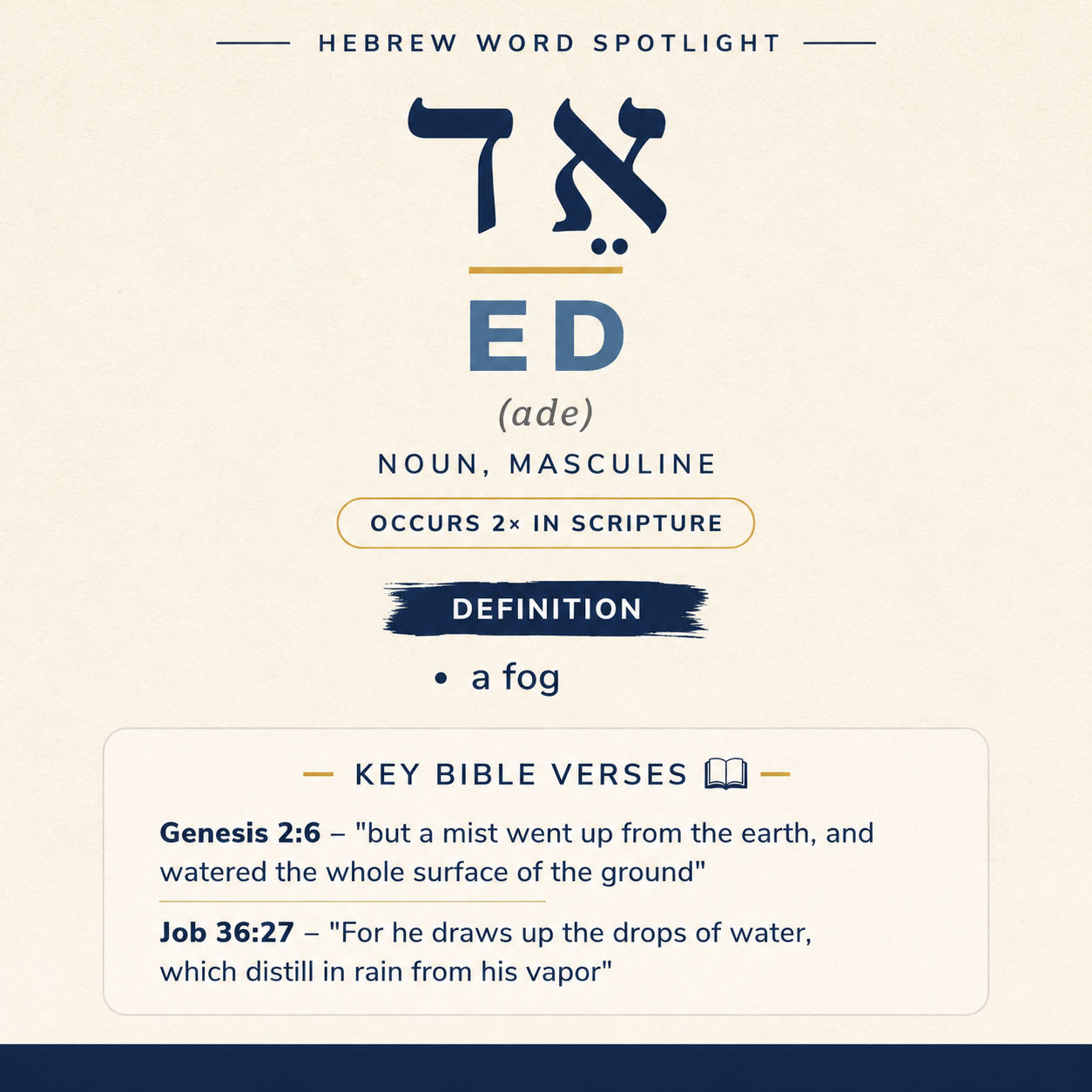
אֵד (ed) means “a fog” and appears twice in Scripture, in Genesis 2:6 and Job 36:27.
Genesis Context
In Genesis 2:6, a mist goes up from the earth and waters the whole surface of the ground.
Learn More →Job Context
In Job 36:27, God draws up water drops that distill in rain from his vapor.
Learn More →אֵד (ed) denotes “a fog” and appears in two poetic-and-narrative settings that picture moisture rising and then supplying water to the land and sky. In both contexts it belongs to a description of how water moves, whether across the ground or into the atmosphere.
Occurrences
“but a mist went up from the earth, and watered the whole surface of the ground.” (Genesis 2:6)
Here אֵד is the means by which the ground is watered: it “went up from the earth” and, as a result, “watered the whole surface of the ground.” The sentence presents a movement (upward from the earth) paired with an effect (watering across the ground’s surface). Within the line, the mist is not merely a visual detail; it functions as a water-bearing phenomenon that spreads moisture widely—“the whole surface.” The wording keeps the picture close to the land: the origin is “from the earth,” and the outcome is the wetting of the ground itself.
The verse’s phrasing also places emphasis on coverage. By attaching the mist to the verb “watered,” the line treats fog as something substantial enough to contribute to hydration, not only to obscure vision. The focus is practical and physical: the surface of the ground receives water by this rising mist. The scene is also deliberately general—there is no named location and no particular plot singled out—so the mist’s action is portrayed as a broad, environment-shaping activity.
“For he draws up the drops of water, which distill in rain from his vapor,” (Job 36:27)
In this line, אֵד appears in a description of water’s upward gathering and subsequent transformation into rainfall. The statement begins with the collection of water: “he draws up the drops of water.” The next clause connects those drawn-up drops with rain: they “distill in rain from his vapor.” Within the sentence, “vapor” is the atmospheric context from which rain is said to distill. The vapor is thus positioned as the immediate source environment for precipitation in the line’s imagery.
Although the verse uses the language of “drops,” “distill,” and “rain,” the presence of vapor keeps the picture suspended between what is seen and what is produced. The sequence moves from small, countable “drops” to the broader phenomenon of “rain,” and fog/vapor is the medium that stands between the two in the verse’s description. The line is crafted to highlight process: water is gathered upward, associated with vapor, and then rains out. In this setting, fog functions as part of the skyward stage of water’s movement, where moisture is present in a less condensed form before the visible event of rain.

Sense and Usage
The two attestations place אֵד within a consistent field of imagery: fog as moisture in motion. Genesis 2:6 locates it near the ground, rising “from the earth” yet directly responsible for wetting “the whole surface of the ground.” The fog is not a distant cloud layer; it is close enough to the land to be linked with the ground’s watering. The sentence makes fog a carrier of water across space, from its point of rising to the broad area it moistens.
Job 36:27, by contrast, sets fog/vapor within an upward-and-downward cycle: water is “drawn up,” associated with “vapor,” and then becomes rain. The fog here is not described as watering the ground directly; instead it belongs to the stage that precedes rainfall. Yet the two uses are compatible: both depict water rising and then supplying moisture—either immediately to the ground (Genesis) or by way of rain (Job). Fog, in these lines, is an expression of water’s availability in the environment, whether it clings near the land or participates in a larger atmospheric process.
The definition “a fog” fits both scenes in a concrete way. In Genesis 2:6, the fog is tied to the earth and to wetting the ground’s surface. In Job 36:27, the fog is framed as “vapor” linked with rain. These two contexts show fog in relationship to water without shifting the word into a different category: it remains a form of moisture that can be spoken of in terms of movement (going up, being drawn up) and effect (watering the ground; distilling into rain). The word’s placement alongside verbs of ascent and with imagery of drops and rain gives it a dynamic role: fog is not static haze but moisture that participates in watering.
Across both passages, the word also supports a particular viewpoint on the natural world: fog is portrayed as an active part of how water reaches where it is needed. Genesis 2:6 stresses distribution across “the whole surface,” painting fog as a quiet means of widespread watering. Job 36:27 stresses transformation and procession—drawn-up drops and rain distilling from vapor—so fog is part of a chain that culminates in rainfall. Together, they present fog as water in a suspended, diffuse state that nevertheless contributes to tangible watering outcomes.
Imagery
The imagery attached to אֵד in these verses is gentle but forceful in effect. Genesis 2:6 pictures moisture rising from the earth and then laying water over the ground’s entire surface, a scene of pervasive dampness that does its work without the drama of a storm. Job 36:27 places fog within a more expansive picture of water being gathered up and then descending as rain, so vapor becomes the threshold between the drawn-up drops and the rainfall. In both, fog is linked to the quiet movement of water that sustains the world described in the lines.
Sources: Lexical data from Strong’s Exhaustive Concordance and the Open Scriptures Hebrew Lexicon. Occurrence data from the Westminster Leningrad Codex with STEPBible reference data (CC BY). Scripture quotations from the World English Bible (public domain).