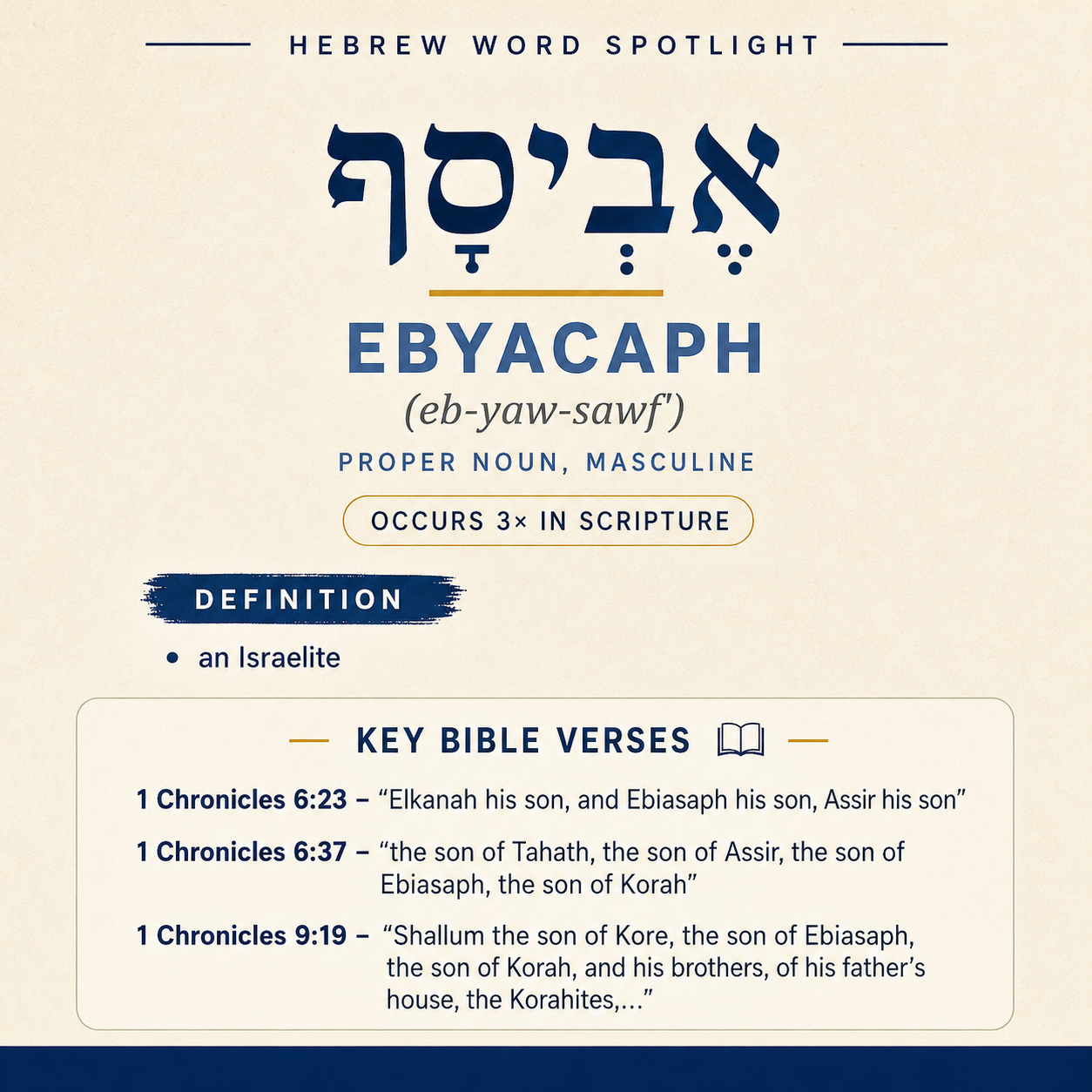
‘Ebyacaph

eb-yaw-sawf’
Parts of Speech: Proper Name Masculine

‘Ebyacaph Definition

NAS Word Usage – Total: 3
Ebiasaph = “my father has gathered”

  1. a son or descendant of Korah

Understanding ‘Ebyacaph in Hebrew

Many people encounter Hebrew words through religious texts, prayers, and cultural references, yet they may not fully understand the meanings behind these words. One such word is ‘Ebyacaph. The term ‘Ebyacaph can be translated to mean “I will gather” or “I will collect.” This expression embodies the idea of bringing things together, whether they are people, items, or ideas.

Books Worth Reading:
Sponsored
Book 3161Book 3162Book 3155Book 3129Book 3131

The Roots of ‘Ebyacaph

To better understand ‘Ebyacaph, one must look at its etymology. The word originates from the Hebrew root verb “ג-א-ב,” which relates to the concept of gathering or collecting. The prefix “‘E” typically denotes a first-person action in Hebrew, meaning “I will.” Thus, ‘Ebyacaph communicates the speaker’s intention to collect or bring together.

Biblical Context

The concept of gathering is prevalent throughout the Hebrew Bible. For instance, in the Book of Exodus, God gathers the Israelites in Egypt and leads them to freedom. In this context, ‘Ebyacaph reflects divine intervention and the overarching theme of community and unity. This gathering isn’t just physical; it often represents spiritual and emotional gathering as well.

Consider a hypothetical situation where a community is struggling with differences. A leader might invoke the phrase ‘Ebyacaph to symbolize their intent to unite the members for a common purpose. This shows how the term can serve as a motivational phrase to promote togetherness.

Books Worth Reading:
Sponsored
Book 3161Book 3162Book 3155Book 3129Book 3131

Cultural Significance

In Jewish tradition, gathering has significant cultural implications. Festivals often revolve around communal gatherings, symbolizing unity and shared experiences. For instance, during Passover, families come together to remember their ancestors’ exodus from Egypt. Here, ‘Ebyacaph can embody the spirit of the holiday—collective remembrance and celebration.

When discussing communal gatherings, one can use ‘Ebyacaph in various contexts. Imagine a synagogue planning a community event. The leader might express, “In our efforts to grow stronger, ‘Ebyacaph all members to join us on this day.” This utilization shows how the concept of gathering is active and emphasizes participation.

Modern Applications

In modern Hebrew, ‘Ebyacaph is often relevant in communal settings, such as schools or organizations. For example, a school principal might say, “As we prepare for the new school year, ‘Ebyacaph all students and parents to come together for the orientations.” This phrase captures a spirit of inclusion among students and families alike.

Books Worth Reading:
Sponsored
Book 3161Book 3162Book 3155Book 3129Book 3131

Additionally, businesses may also adopt this term in their marketing strategies. A company might run a campaign centered around community engagement, stating, “We ‘Ebyacaph our loyal customers to come and celebrate our anniversary.” This serves to uplift individuals while promoting a corporate identity centered around togetherness.

Linguistic Nuances

While ‘Ebyacaph translates to “I will gather,” understanding its full nuance requires a look at how it functions within Hebrew sentences. The word can shift meaning based on its surrounding context. For instance, adding a direct object may indicate what is being gathered.

Consider the phrase “Ebyacaph et ha-am,” which translates to “I will gather the people.” This highlights not only the action but also what or who is being gathered. The object of the gathering often clarifies the intent and focus of the phrase.

Books Worth Reading:
Sponsored
Book 3161Book 3162Book 3155Book 3129Book 3131

Variations in Usage

Hebrew is a rich language with various dialects and forms. The ways in which ‘Ebyacaph is employed can differ across regions and communities. In some contexts, the term might take on a more poetic form, signifying a longing or desire to gather rather than simply an intention.

For instance, in a poetic setting, a writer might say, “In grief, ‘Ebyacaph my loved ones to remember those lost.” Here, the word evokes a deeper emotional context, not just a physical gathering, but an emotional coalition in times of distress.

Connection to Other Hebrew Terms

Understanding ‘Ebyacaph also involves examining its relationship with other Hebrew terms. Words like “kibbutz,” meaning “gathering” or “collective,” share this core theme of bringing together. Kibbutzim, or communal settlements in Israel, reflect the idea of collective living and working, highlighting how gathering transcends mere verbal expression.

Books Worth Reading:
Sponsored
Book 3161Book 3162Book 3155Book 3129Book 3131

Moreover, the term “asaf,” which also means “to gather,” can offer additional depth. Both ‘Ebyacaph and asaf reflect the dynamic nuances of gathering but can vary based on usage. While ‘Ebyacaph may be more future-focused, asaf often refers to an action that has already taken place.

Personal Experiences with ‘Ebyacaph

Through real-life experiences, one can see how powerful ‘Ebyacaph can be in solidifying relationships and communities. For instance, think of a local charity organizing a drive for the needy. The leader might announce, “This week, ‘Ebyacaph donations from all around the community.”

Such an announcement not only highlights the action of gathering but also invites participation from all members of the community. It fosters a sense of belonging and shared responsibility among participants, making everyone feel like a contributor to a larger cause.

Books Worth Reading:
Sponsored
Book 3161Book 3162Book 3155Book 3129Book 3131

Religious Gatherings

In the context of religious gatherings, ‘Ebyacaph carries weight. It is often invoked in prayers or speeches to inspire congregations. A rabbi might say, “This Shabbat, let us all ‘Ebyacaph to share in the joy of community.” This energizing call to action emphasizes the importance of coming together, particularly in a religious context where unity is foundational.

Moreover, the term can serve to uplift spirits. During difficult times or during a communal fast, invoking ‘Ebyacaph reminds individuals that they are not alone; their community gathers to support them, reflecting a shared journey of faith.

The Role of Leadership

Leaders in various walks of life can harness the power of ‘Ebyacaph to unite people under a common cause. Political leaders, community organizers, and educators can all employ this term to rally support and motivate collective action.

Books Worth Reading:
Sponsored
Book 3161Book 3162Book 3155Book 3129Book 3131

For example, a local government official might say, “As we face challenges ahead, ‘Ebyacaph to find solutions together.” Such rhetoric emphasizes collaboration; the leader actively encourages citizens to join together, illustrating the practical implications of the term in everyday discourse.

Emotional Resonance

The emotional weight carried by ‘Ebyacaph cannot be overlooked. It signifies hope and the promise of togetherness. Especially in challenging times, the phrase holds potential to uplift and encourage.

In times of crisis, it becomes essential to remember the power of gathering. A community might face an emergency such as a natural disaster, and a leader might announce, “In our time of need, let us ‘Ebyacaph to support each other.” This urgent gathering invokes a spirit of resilience and unity, reminding everyone of the strength found in community.

Books Worth Reading:
Sponsored
Book 3161Book 3162Book 3155Book 3129Book 3131

Synonyms for ‘Ebyacaph

The richness of the Hebrew language allows for multiple synonyms and phrases that echo the sentiment of ‘Ebyacaph. Terms like “amass,” “collect,” and “gather” in English convey similar actions. These synonyms help reinforce the importance of the concept across various settings and discussions.

For example, in a family context, one might say, “Let’s amass our resources for a common goal.” This shows how ‘Ebyacaph may not be directly translated but retains its essence in different forms, mirroring broader themes of togetherness.

Variability Across Contexts

It is essential to recognize that ‘Ebyacaph’s application extends far and wide. The term can transition smoothly from religious to secular contexts, proving its versatility. In community service settings, one might hear, “Today we will ‘Ebyacaph to tackle this project together.”

Books Worth Reading:
Sponsored
Book 3161Book 3162Book 3155Book 3129Book 3131

This illustrates how the call to gather isn’t limited by its religious roots; it can easily adapt to communal service, charity work, or other modern contexts. The adaptability of ‘Ebyacaph illustrates its fundamental role in promoting cooperation and collective action.

Reflecting on Future Gatherings

As society continues to evolve, the themes embedded in ‘Ebyacaph endure in future gatherings. Whether in workplaces, communities, or families, the idea of unity remains foundational. The language encourages inclusivity, emphasizing that everyone has a role to play in supporting one another.

Whether expressed through a formal announcement or a casual invitation, the essence of ‘Ebyacaph resonates—reminding all of the importance of gathering together, united toward common goals and shared experiences.

Books Worth Reading:
Sponsored
Book 3161Book 3162Book 3155Book 3129Book 3131

By exploring the various dimensions of ‘Ebyacaph in Hebrew, we deepen our understanding of its significance, both linguistically and culturally, and appreciate the deeper meanings of gathering as a central human experience.

Little Known Secrets

The Hebrew word “Ebyacaph” carries intriguing meanings and connections that are often overlooked.

  1. The root of “Ebyacaph” is linked to the concept of “to gather” or “to assemble,” which reflects the idea of unity or bringing people together.
  2. This word can express not just physical gathering, like gathering crops, but also emotional or spiritual gathering, hinting at the importance of community in Hebrew culture.
  3. In some contexts, “Ebyacaph” connects to the gathering of souls, implying a wholeness that transcends mere physical presence.
  4. The pronunciation of “Ebyacaph” includes a soft ‘ch’, which in Hebrew tradition can symbolize gentleness or compassion, suggesting that the act of gathering should be approached with care.
  5. In certain biblical passages where “Ebyacaph” appears, it can take on a prophetic tone, hinting at divine promises of restoration and hope for the people.
  6. The word is sometimes associated with agricultural practices in ancient Israel, emphasizing the significance of harvest time and the communal effort required for successful farming.
  7. “Ebyacaph” is also used in rituals and festivals, where gathering is essential, highlighting its importance in religious celebrations and community bonding.
  8. The word has connections to other Hebrew words, such as “kabats,” which also means to gather but carries a more urgent or forceful connotation, contrasting with the gentleness of “Ebyacaph.”
  9. Scholars note that “Ebyacaph” reflects the broader theme of gathering found in Hebrew scriptures, where themes of exile and return emphasize God’s desire for His people to be united.
  10. The etymology of “Ebyacaph” can invoke imagery from nature, such as birds gathering together for migration, symbolizing instinctive unity and direction.

Conclusion

In summary, the Hebrew word “Ebyacaph” carries a deep and meaningful significance. It reflects the rich cultural and spiritual heritage found in the Hebrew Bible. Understanding such words helps us appreciate the beautiful language of the Scriptures and the messages they convey. As we explore these words, we gain not only knowledge of their meanings but also insight into the faith and traditions of the people who spoke them. Whether you are a scholar, a student, or just curious, the study of Hebrew words like “Ebyacaph” opens a door to the fascinating world of biblical history and language.

Books Worth Reading:
Sponsored
Book 3161Book 3162Book 3155Book 3129Book 3131

Common Questions Related to What Does ‘Ebyacaph Mean In Hebrew

Q. What does the word ‘Ebyacaph mean in Hebrew?
A. In Hebrew, ‘Ebyacaph (אֶבְיָקָף) means “to be a servant” or “to serve.” It suggests the idea of devotion and helping others.

Q. What are the roots of the word ‘Ebyacaph?
A. The word ‘Ebyacaph comes from the Hebrew root word ‘ebed (עֶבֶד), which means “slave” or “servant.” This root is often associated with service and loyalty.

Q. Is ‘Ebyacaph used in the Bible?
A. Yes, variations of the root word ‘ebed, including ‘Ebyacaph, appear throughout the Bible, often referring to serving God or others.

Books Worth Reading:
Sponsored
Book 3161Book 3162Book 3155Book 3129Book 3131

Q. How does ‘Ebyacaph relate to serving God?
A. ‘Ebyacaph emphasizes the concept of serving God faithfully, showing dedication and commitment to His will.

Q. Are there different interpretations of ‘Ebyacaph?
A. Yes, interpretations can vary, but most agree that it focuses on the aspects of servitude and devotion, both to God and to fellow humans.

Q. Can ‘Ebyacaph refer to a specific type of service?
A. While it generally implies service and devotion, it can refer specifically to roles in religious settings, such as priests or those who serve in the temple.

Books Worth Reading:
Sponsored
Book 3161Book 3162Book 3155Book 3129Book 3131

Q. How does the meaning of ‘Ebyacaph affect our understanding of duty?
A. The meaning of ‘Ebyacaph teaches us that duty involves more than obligation; it is about willingly giving ourselves to a greater purpose or serving others.

Q. Does ‘Ebyacaph have a cultural significance in Hebrew tradition?
A. Yes, in Hebrew tradition, serving is seen as a noble calling, and being a servant symbolizes humility and the importance of community and support.

Q. How is the concept of ‘Ebyacaph seen in modern practices?
A. In modern practices, ‘Ebyacaph can inspire people to volunteer, help others, and be active community members, reflecting the same spirit of service.

Books Worth Reading:
Sponsored
Book 3161Book 3162Book 3155Book 3129Book 3131

Q. What lesson can we learn from ‘Ebyacaph?
A. The main lesson from ‘Ebyacaph is that true strength lies in serving others, and that by helping our neighbors, we contribute to a better society.

About the Author

Ministry Voice

{"email":"Email address invalid","url":"Website address invalid","required":"Required field missing"}

Want More Great Content?

Check Out These Articles 

mba ads=96