
Exploring the Meaning of ‘ebuwc in Hebrew
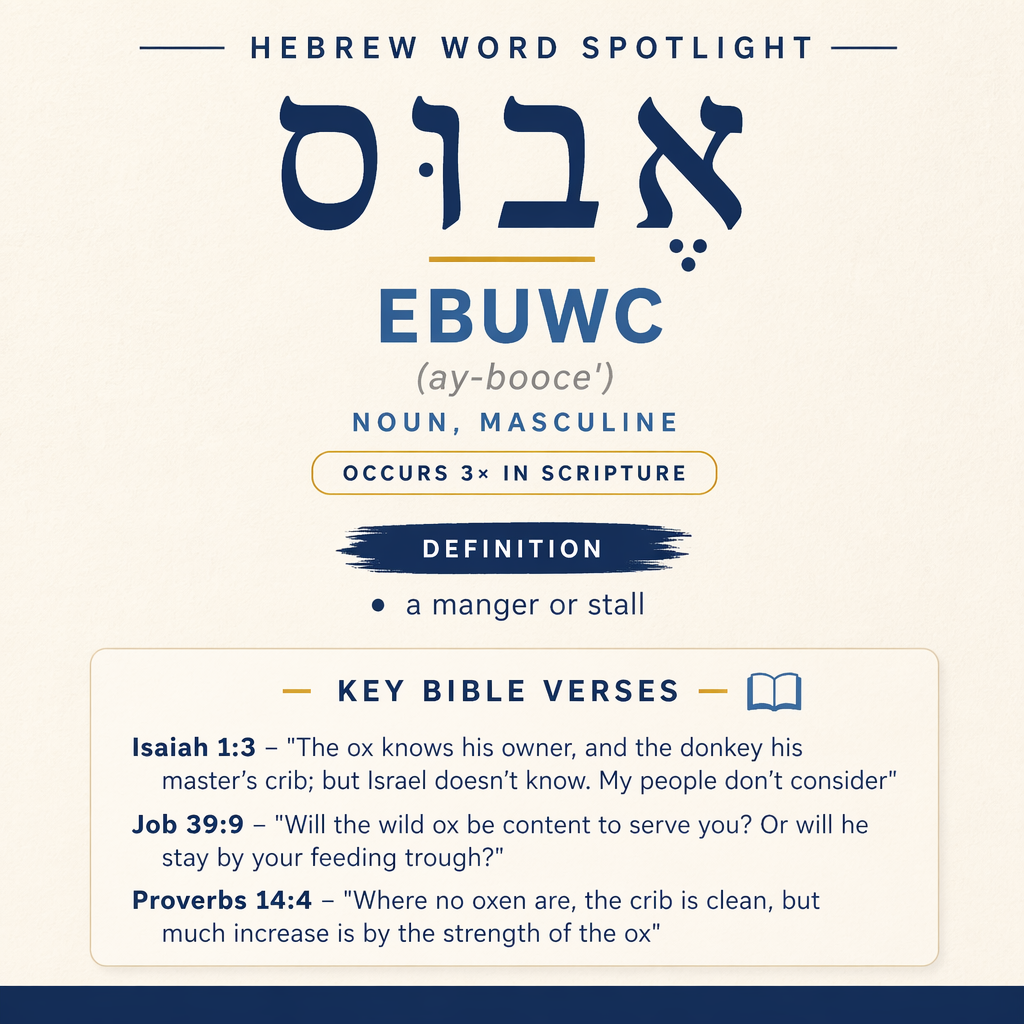
אֵבוּס means “a manger or stall” and appears in Isaiah 1:3, Job 39:9, and Proverbs 14:4.
Scripture Occurrences
This noun occurs 3 times in Scripture: Isaiah 1:3, Job 39:9, and Proverbs 14:4.
Learn More →Usage Contexts
It describes an animal’s crib or feeding trough, mentioned with oxen and a donkey.
Learn More →אֵבוּס names a fixed place where an animal is kept and fed: “a manger or stall.” It appears in three passages that picture common barnyard realities—oxen and donkeys, their feeding places, and what those places imply about care, service, and productivity.
Occurrences
Isaiah 1:3: “The ox knows his owner, and the donkey his master’s crib; but Israel doesn’t know. My people don’t consider.”
Here אֵבוּס functions as the donkey’s “master’s crib,” the particular feeding place that anchors the animal to a household. The line pairs two kinds of recognition: the ox knows “his owner,” and the donkey knows “his master’s crib.” The “crib” is not a mere object in the background; it is the concrete point of contact between an animal and its master’s provision, the place where routine care is received. By placing the donkey’s knowledge at the crib, the verse highlights recognition that is practical and embodied—an animal returns to the place where it is fed. The contrast that follows (“but Israel doesn’t know. My people don’t consider.”) relies on the clarity of this barnyard image: awareness of the crib is presented as obvious, even instinctive, so that failing to “know” and “consider” stands out as a stark anomaly.
Job 39:9: ““Will the wild ox be content to serve you? Or will he stay by your feeding trough?
In this question, אֵבוּס appears as “your feeding trough,” the human-owned place where a domesticated beast might be expected to remain. The verse sets “serve you” alongside “stay by your feeding trough,” linking service with the settled habit of remaining near the place of feed. The trough is framed as something that belongs to the one being addressed (“your”), suggesting the control implied in providing an animal’s fodder and having a set place where it eats. The question presses the mismatch between a “wild ox” and the stable arrangement suggested by a feeding trough: the scene imagines an animal that would need to accept proximity, routine, and restraint in order to remain by the trough. In the verse’s logic, the trough represents not just feeding but the whole structure of domestication—service, contentment, and staying put.
Proverbs 14:4: “Where no oxen are, the crib is clean, but much increase is by the strength of the ox.”
In this proverb, אֵבוּס (“the crib”) is a visible indicator of whether working animals are present. The first clause observes a plain fact of animal-keeping: without oxen, the stall remains “clean.” The second clause then juxtaposes that cleanliness with “much increase,” which comes “by the strength of the ox.” The crib thus becomes a concrete point where trade-offs show up: a clean stall may reflect the absence of oxen, yet the presence of oxen—whose “strength” yields increase—would naturally bring the dirt and disorder of animal habitation. The proverb uses the crib as a metonym for the whole working arrangement: if there is a stall for oxen, the stall will not stay pristine, but the household gains productive power. The word contributes a grounded, everyday setting that makes the proverb’s contrast immediate and observable.

Sense and Usage
Across these passages, אֵבוּס consistently denotes a dedicated animal space tied to feeding and keeping—whether rendered “crib” or “feeding trough.” Its sense is stable: a fixed place meant for an animal’s eating and lodging. Yet the word’s rhetorical force shifts with context, because a manger or stall is not only a location; it is also a sign of a relationship between people and animals, and of the ordinary systems that sustain life and labor.
In Isaiah 1:3, the crib is the point at which provision and recognition meet. The donkey’s awareness is directed toward the “master’s crib,” emphasizing the dependability of this place and the simple, habitual knowledge connected to it. The stall is where an animal receives food; therefore it is where an animal can be expected to return. Within the verse’s contrast, the crib embodies a kind of obviousness: even an animal “knows” the place associated with its master’s care, but “My people don’t consider.” The image depends on the everyday certainty of a feeding place that is reliably there.
In Job 39:9, the feeding trough becomes a test of willingness to be domesticated. The two questions—about serving and about staying by the trough—treat the trough as a focal point of human expectation. It is not merely a container but part of a managed routine: feeding happens in a set place, and the animal is expected to remain near it. The verse thus uses the stall/trough as a symbol of settled obedience within the sphere of human control. To “stay by your feeding trough” is to accept a predictable pattern of life under another’s provision, and the question implies that such acceptance cannot be presumed of a wild creature.
In Proverbs 14:4, the stall functions as evidence of presence and as a site where consequences accumulate. A clean crib tells a story: no oxen are there. But the proverb turns that apparent advantage (cleanliness) into a limited good, because “much increase” depends on the ox’s strength. The crib, therefore, highlights the cost of productivity: if there is real work being done by powerful animals, their stall will show it. The word anchors a broader observation in a specific physical setting—one can look at a crib and infer whether the household has chosen cleanliness over capacity, or capacity over cleanliness.
Taken together, these uses show how אֵבוּס naturally carries implications without changing its core sense. A manger or stall is where an animal is fed and kept; therefore it can imply provision (Isaiah), expected compliance within a household’s order (Job), or the tangible mess that accompanies productive strength (Proverbs). The word points to stable, repetitive realities: returning, staying, being housed, being fed. Because these realities are shared and observable, the stall becomes a ready-made image for contrasting knowledge with neglect, control with wildness, and tidy ease with fruitful labor.
Imagery
The three passages present אֵבוּס as a small, ordinary place that nevertheless carries weight. In Isaiah it is the donkey’s reference point for recognizing its master; in Job it stands for the settled routine a human might demand of an animal; in Proverbs it becomes the telltale location where the presence of strong oxen is both beneficial and untidy. In each case, the manger or stall is where daily dependence becomes visible—where food, ownership, service, and the marks of work all gather in one plain setting.
Sources: Lexical data from Strong’s Exhaustive Concordance and the Open Scriptures Hebrew Lexicon. Occurrence data from the Westminster Leningrad Codex with STEPBible reference data (CC BY). Scripture quotations from the World English Bible (public domain).





