Exploring the Meaning of Dorea in Greek
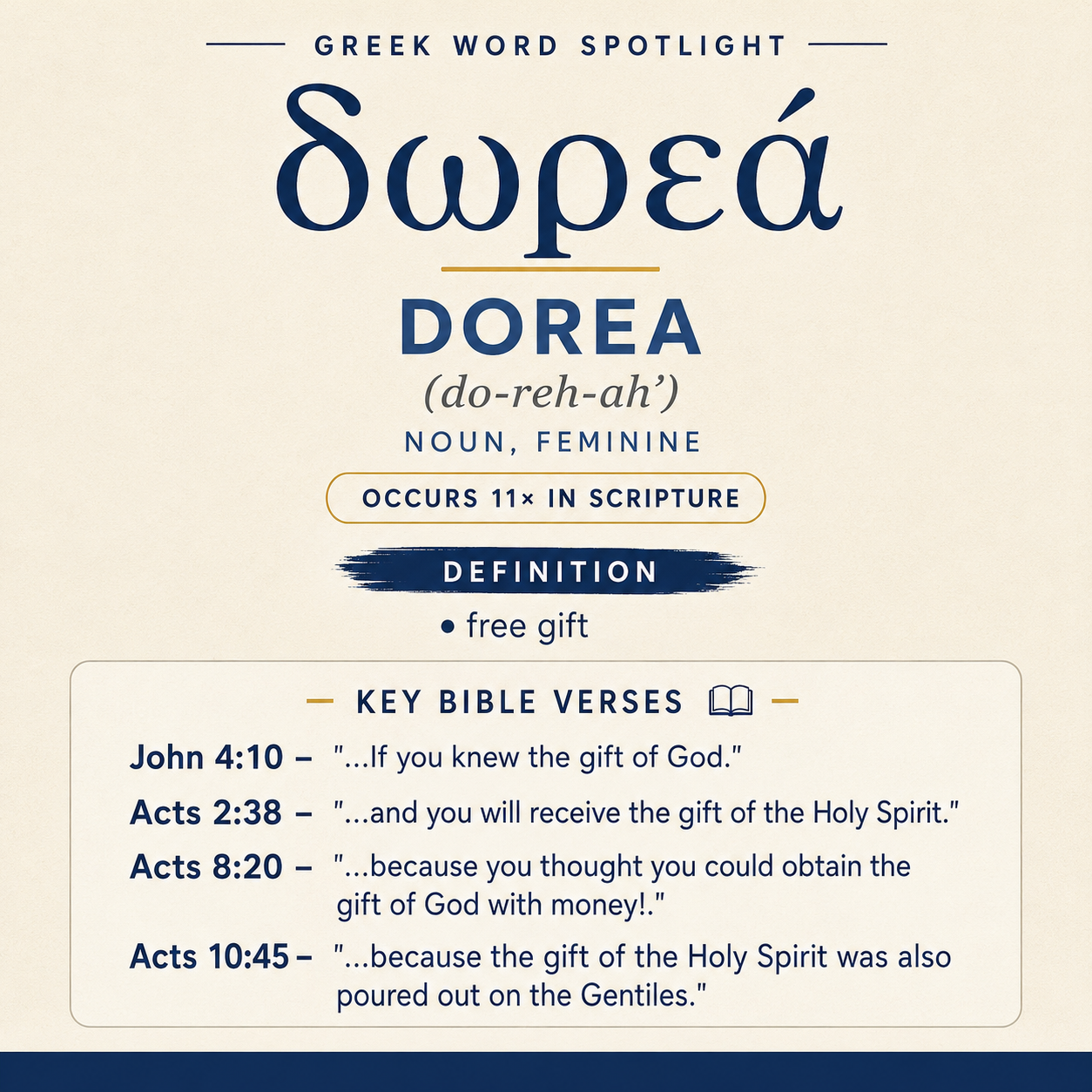
δωρεά means “free gift” and occurs 11 times in Scripture, including John 4:10; Acts 2:38; 8:20; 10:45; 11:17; Romans 5:15, 5:17; and 2 Corinthians 9:15.
Core Meaning
δωρεά is defined as a “free gift.” The term highlights a gift given without payment.
Learn More →Key Occurrences
It appears in John 4:10 in Jesus’ words about “the gift of God.” It also appears in Acts 8:20, where Peter rejects obtaining “the gift of God” with money.
Learn More →Notable Contexts
Acts 10:45 and Acts 11:17 use δωρεά for “the gift of the Holy Spirit.” Romans 5:15 and 5:17 use it in the context of a “free gift.”
Learn More →δωρεά speaks of a “free gift,” and the New Testament uses it repeatedly for what God gives rather than what humans purchase or earn. Its occurrences cluster around God’s saving generosity in Christ and the giving of the Holy Spirit, with several texts pressing the word into sharp contrast with human payment or human wrongdoing.
Occurrences
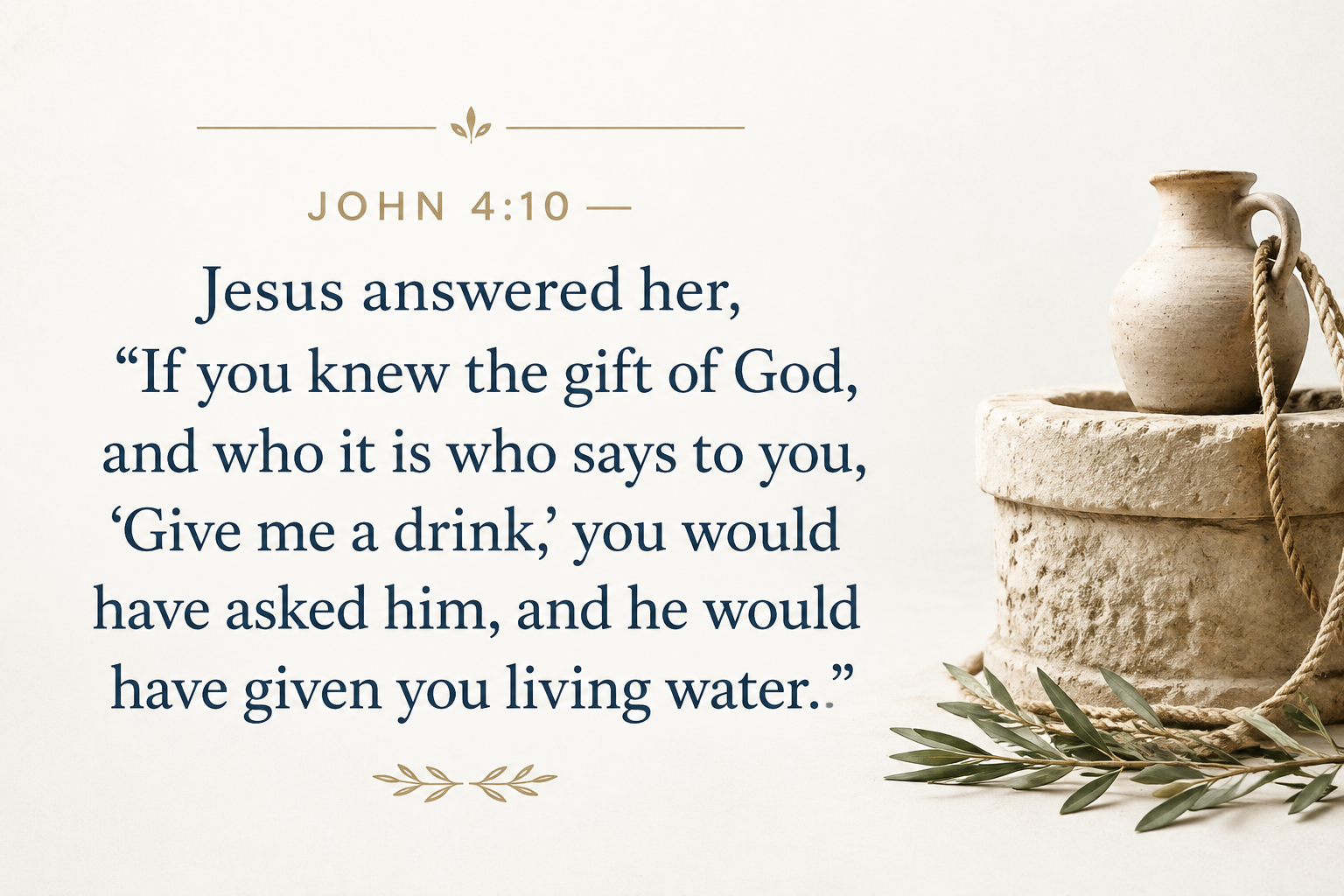
John 4:10 — Jesus answered her, “If you knew the gift of God, and who it is who says to you, ‘Give me a drink,’ you would have asked him, and he would have given you living water.”
Here δωρεά frames Jesus’ offer to the Samaritan woman as something God gives, not something extracted by bargaining. The scene is built on ordinary exchange (“Give me a drink”), yet Jesus redirects attention to “the gift of God” and depicts the proper response as asking and receiving, not trading. Within the verse’s own imagery, the “gift” is tied to Jesus’ ability to “give… living water,” so δωρεά marks the initiative and generosity of the giver.
Acts 2:38 — Peter said to them, “Repent, and be baptized, every one of you, in the name of Jesus Christ for the forgiveness of sins, and you will receive the gift of the Holy Spirit.
In Peter’s instruction, δωρεά names what follows repentance and baptism: “the gift of the Holy Spirit.” The word highlights that the Spirit is received, not achieved. The verse’s sequence places forgiveness and reception side by side; δωρεά supports the notion of a granted benefit that comes to those addressed, as part of God’s response to their turning and identification “in the name of Jesus Christ.”
Acts 8:20 — But Peter said to him, “May your silver perish with you, because you thought you could obtain the gift of God with money!
In this confrontation, δωρεά is explicitly set against money. The rebuke turns on a category mistake: trying “to obtain the gift of God with money.” By calling it a δωρεά, the verse underlines that what is being sought belongs to the realm of divine giving, not commercial transaction. The harsh tone (“May your silver perish with you”) intensifies the contrast: payment is not merely inadequate; it is an affront to the nature of the gift.
Acts 10:45 — They of the circumcision who believed were amazed, as many as came with Peter, because the gift of the Holy Spirit was also poured out on the Gentiles.
Here δωρεά again names “the gift of the Holy Spirit,” but the emphasis falls on the surprising breadth of the recipients. The believing circumcised observers are “amazed” because the gift “was also poured out on the Gentiles.” The verb phrase “poured out” makes the gift appear abundant and freely dispensed, and δωρεά marks the Spirit’s coming as God’s generous action that crosses expected boundaries.
Acts 11:17 — If then God gave to them the same gift as us, when we believed in the Lord Jesus Christ, who was I, that I could withstand God?”
This verse uses δωρεά in an argument about recognizing God’s work. The “same gift as us” functions as evidence that God has acted toward “them” in the same way he acted toward “us.” The stress falls on God as the giver (“God gave to them”), and the conclusion is practical and theological: resisting the inclusion of the recipients would amount to “withstand[ing] God.” δωρεά thus carries not only the sense of a granted benefit but also the force of a divine decision that humans must acknowledge.
Romans 5:15 — But the free gift isn’t like the trespass. For if by the trespass of the one the many died, much more did the grace of God, and the gift by the grace of the one man, Jesus Christ, abound to the many.
Paul places δωρεά in a structured contrast: “the free gift isn’t like the trespass.” The verse sets two representative acts side by side and tracks their consequences—death on the one hand, and on the other “the grace of God, and the gift by the grace… abound[ing] to the many.” In this context δωρεά is linked closely to grace and to Jesus Christ, and it is described as overflowing (“abound”), reinforcing that it is not measured out as repayment but given in superabundance over against the spread of death.
Romans 5:17 — For if by the trespass of the one, death reigned through the one; so much more will those who receive the abundance of grace and of the gift of righteousness reign in life through the one, Jesus Christ.
Here δωρεά appears in the phrase “the gift of righteousness,” coordinated with “the abundance of grace.” The recipients are defined as “those who receive,” and the outcome reverses the earlier reign of death: they “reign in life.” δωρεά contributes a receiving-and-granting logic to Paul’s comparison; righteousness is spoken of as a gift received, not a status seized, and its reception is tied to life “through the one, Jesus Christ.”
2 Corinthians 9:15 — Now thanks be to God for his unspeakable gift!
In this brief doxology, δωρεά stands alone without an explanatory phrase, as “his unspeakable gift.” The exclamation “thanks be to God” positions the gift as the ground of worshipful gratitude. Calling it “unspeakable” presents the gift as surpassing adequate description; δωρεά here carries a weight of wonder, not argument, and the possessive “his” anchors the gift in God’s generosity.
Ephesians 3:7 — of which I was made a servant according to the gift of that grace of God which was given me according to the working of his power.
In this autobiographical line, δωρεά is attached to Paul’s ministry: he became “a servant according to the gift of that grace of God.” The verse doubles down on givenness: the grace “was given me,” and it is linked with divine efficacy (“according to the working of his power”). δωρεά thus expresses a granted commissioning or enabling, locating Paul’s service not in self-appointment but in a gift-shaped calling empowered by God.
Ephesians 4:7 — But to each one of us, the grace was given according to the measure of the gift of Christ.
This verse makes δωρεά distributive: “to each one of us, the grace was given according to the measure of the gift of Christ.” The focus is on varied allotment (“measure”) within a shared reality (“each one of us”). δωρεά contributes the idea that Christ’s giving is both real and appropriately apportioned, and it grounds individual endowment in a common source—Christ’s gift—rather than in personal merit.
Hebrews 6:4 — For concerning those who were once enlightened and tasted of the heavenly gift, and were made partakers of the Holy Spirit,
Here δωρεά appears as “the heavenly gift,” described as something “tasted.” The verse places this tasting alongside being “once enlightened” and being “made partakers of the Holy Spirit,” stacking experiential descriptions. δωρεά contributes an experiential concreteness: the gift is not only conceptual but encountered, and it belongs to the sphere of heaven, paired closely with participation in the Holy Spirit.

Sense and Usage
Across these passages, δωρεά consistently marks God as the initiating giver and humans as recipients. The word’s “free” character is not treated as an abstract idea but is dramatized through contrasts and images: Jesus offers “living water” as a gift to be asked for (John 4:10); Peter rejects the attempt to “obtain the gift of God with money” (Acts 8:20), sharpening the point that this kind of giving does not belong to the marketplace. In Acts, δωρεά is repeatedly specified as “the gift of the Holy Spirit” (Acts 2:38; 10:45) and as “the same gift” shared across groups (Acts 11:17). The gift’s freedom is shown not only in its non-purchasability but also in its surprising reach, since it is “also poured out on the Gentiles” (Acts 10:45).
Paul’s use in Romans 5 places δωρεά within a larger comparison between destructive human action (“trespass”) and God’s overflowing beneficence. The gift is aligned with “the grace of God” and said to “abound to the many” (Romans 5:15), then named more particularly as “the gift of righteousness” received by those who consequently “reign in life” (Romans 5:17). In the letters to the Corinthians and Ephesians, δωρεά supports gratitude and vocation: God has an “unspeakable gift” that evokes thanks (2 Corinthians 9:15), and God’s grace functions as a gift that establishes service and apportions grace within the community (Ephesians 3:7; 4:7). Hebrews adds a sensory metaphor—“tasted of the heavenly gift” (Hebrews 6:4)—which portrays the gift as something encountered and participated in, in close proximity to sharing in the Holy Spirit.
Imagery and Emphasis
The texts attach δωρεά to vivid actions: it is “given” (John 4:10; Acts 11:17), “received” (Acts 2:38; Romans 5:17), “poured out” (Acts 10:45), and even “tasted” (Hebrews 6:4). These verbs keep the word concrete: the gift comes from God toward people, and its arrival produces amazement (Acts 10:45), gratitude (2 Corinthians 9:15), and a pattern of life contrasted with death’s reign (Romans 5:17). The recurring pairing with the Holy Spirit and with grace makes δωρεά a key term for describing divine generosity as a real bestowal rather than a wage, a commodity, or a human achievement.
Sources: Lexical data from Strong’s Exhaustive Concordance and the Translators Brief Lexicon of Extended Strongs for Greek (STEPBible, CC BY). Occurrence data from the Translators Amalgamated Greek New Testament (STEPBible, CC BY). Scripture quotations from the World English Bible (public domain).