Exploring the Meaning of Daimonizomai in Greek
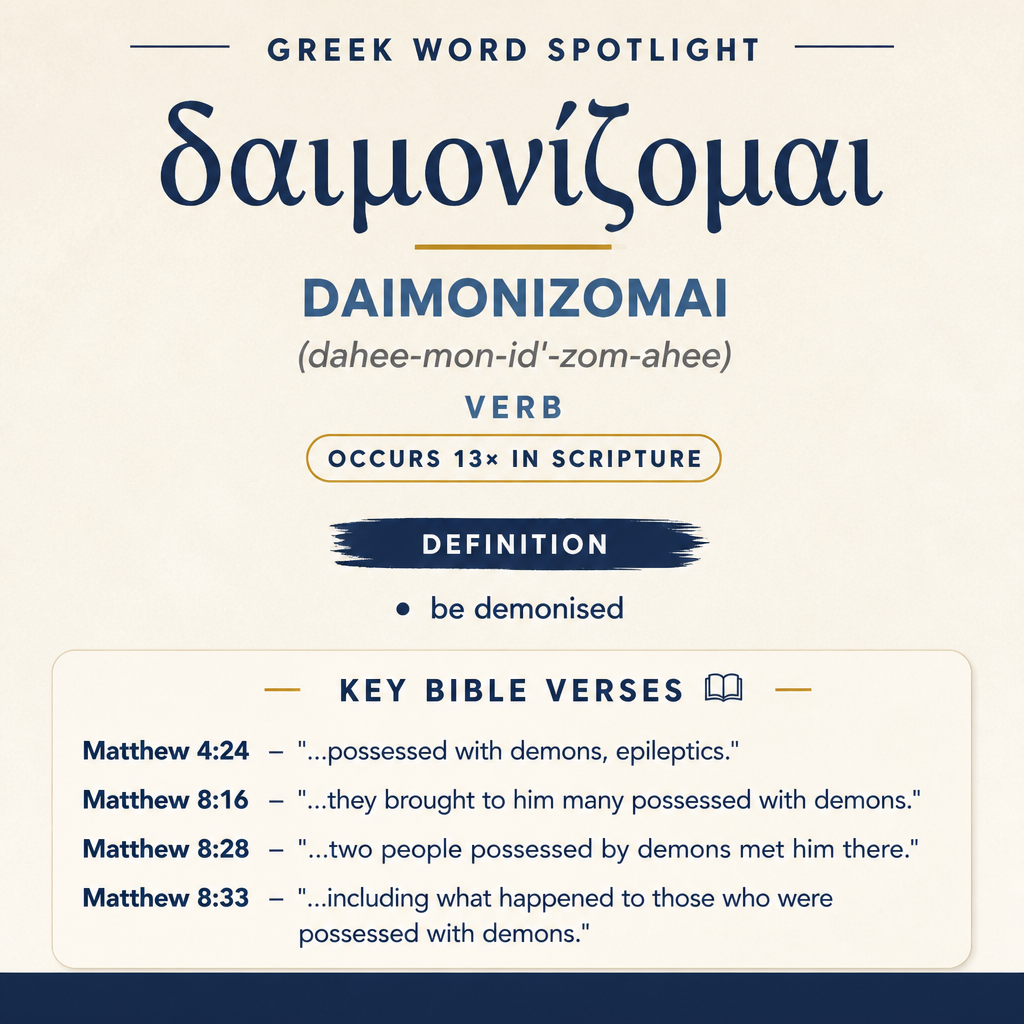
δαιμονίζομαι means “be demonised” and appears 13 times in Scripture, including in Matthew and Mark.
Core Meaning
δαιμονίζομαι is defined as “be demonised.” In the listed verses it describes people “possessed with demons” or “demon possessed.”
Learn More →Gospel Occurrences
Occurrences listed include Matthew 4:24; 8:16, 8:28, 8:33; 9:32; 12:22; 15:22. Mark 1:32 also contains the word.
Learn More →In Narrative Context
In several Matthew and Mark scenes, people described with δαιμονίζομαι are brought to Jesus. These accounts include reports of healing and spirits being cast out.
Learn More →δαιμονίζομαι means “be demonised,” describing a person under demonic affliction in the Gospel narratives where Jesus confronts illness, torment, and spiritual oppression. The term appears in scenes that emphasize both the severity of the condition and the public recognition of Jesus’ authority to heal and restore.
Occurrences
Matthew 4:24 — “The report about him went out into all Syria. They brought to him all who were sick, afflicted with various diseases and torments, possessed with demons, epileptics, and paralytics; and he healed them.”
Here δαιμονίζομαι belongs to a catalogue of desperate conditions brought to Jesus. Set alongside “various diseases and torments” and other afflictions, being demonised is presented as one recognizable kind of suffering among the crowds, and it is included within the scope of healings that spread his “report” throughout the region.
Matthew 8:16 — “When evening came, they brought to him many possessed with demons. He cast out the spirits with a word, and healed all who were sick;”
This verse places the demonised among “many” brought to Jesus at day’s end, and it pairs their condition with a specific response: “He cast out the spirits with a word.” δαιμονίζομαι therefore marks a situation where the remedy is not merely healing but the expulsion of “spirits,” distinguishing the kind of affliction being addressed.
Matthew 8:28 — “When he came to the other side, into the country of the Gergesenes, two people possessed by demons met him there, coming out of the tombs, exceedingly fierce, so that nobody could pass that way.”
In this encounter, δαιμονίζομαι frames a dramatic threat to ordinary movement and safety: two demonised individuals are “exceedingly fierce,” blocking passage. Their origin “out of the tombs” and the note that “nobody could pass that way” depict the condition as socially and geographically disruptive, not merely private distress.
Matthew 8:33 — “Those who fed them fled, and went away into the city, and told everything, including what happened to those who were possessed with demons.”
After the confrontation, δαιμονίζομαι becomes part of the public report: what happened was newsworthy “in the city.” The term identifies the prior state of the affected individuals and helps define the event that witnesses feel compelled to recount (“told everything”).
Matthew 9:32 — “As they went out, behold, a mute man who was demon possessed was brought to him.”
Here δαιμονίζομαι is linked to a specific impairment: the man is “mute.” The wording highlights how others respond to the condition—he “was brought to him”—so the term functions as the diagnosis that explains both the man’s plight and the community’s action in seeking Jesus.
Matthew 12:22 — “Then one possessed by a demon, blind and mute, was brought to him and he healed him, so that the blind and mute man both spoke and saw.”
In this scene, δαιμονίζομαι is tied to multiple disabilities (“blind and mute”) and to a clear reversal when Jesus heals him, resulting in restored speech and sight. The term locates the affliction’s source in demonic oppression, while the outcome (“both spoke and saw”) spotlights the comprehensive nature of the restoration.
Matthew 15:22 — “Behold, a Canaanite woman came out from those borders, and cried, saying, “Have mercy on me, Lord, you son of David! My daughter is severely possessed by a demon!””
δαιμονίζομαι appears in an urgent plea on behalf of a child: “My daughter is severely possessed by a demon!” The adverb “severely” intensifies the portrait of suffering, and the mother’s cry for mercy shows the term operating within a request for intervention, not as detached description.
Mark 1:32 — “At evening, when the sun had set, they brought to him all who were sick, and those who were possessed by demons.”
As in Matthew, δαιμονίζομαι is coordinated with sickness yet kept distinct: “all who were sick, and those who were possessed by demons.” The structure treats being demonised as a recognized category among those needing help, and the setting (“when the sun had set”) evokes a steady stream of need presented to Jesus.
Mark 5:15 — “They came to Jesus, and saw him who had been possessed by demons sitting, clothed, and in his right mind, even him who had the legion; and they were afraid.”
This verse focuses on the aftermath: the one formerly demonised is now visibly composed—“sitting, clothed, and in his right mind.” δαιμονίζομαι thus marks a prior condition contrasted with observable restoration, and the mention of “the legion” underscores the perceived magnitude of what has been overcome, prompting fear in the onlookers.
Mark 5:16 — “Those who saw it declared to them what happened to him who was possessed by demons, and about the pigs.”
δαιμονίζομαι functions as a label by which witnesses identify the central figure of the event (“him who was possessed by demons”). The report joins personal deliverance with a wider disturbance (“about the pigs”), showing how the demonised person’s story becomes inseparable from the notable consequences witnessed.
Mark 5:18 — “As he was entering into the boat, he who had been possessed by demons begged him that he might be with him.”
The former state named by δαιμονίζομαι remains part of the man’s identity in the narrative (“he who had been possessed by demons”), even as his current posture is one of petition and attachment: he “begged” to be with Jesus. The term therefore helps readers grasp the depth of change implied by his new desire and agency.
Luke 8:36 — “Those who saw it told them how he who had been possessed by demons was healed.”
Luke pairs δαιμονίζομαι directly with the outcome: “was healed.” The term highlights what kind of affliction the healing addressed, while the eyewitness retelling (“Those who saw it told them”) keeps the emphasis on public testimony about a specific kind of deliverance.
Sense and Usage
Across these passages, δαιμονίζομαι consistently designates a state of demonic affliction recognizable to others—so recognizable that people bring the afflicted to Jesus (Matthew 4:24; 8:16; 9:32; 12:22; Mark 1:32), plead on their behalf (Matthew 15:22), and later recount what occurred (Matthew 8:33; Mark 5:16; Luke 8:36). The scenes show that being demonised is not treated as a vague inner struggle but as a condition with outward consequences: it can be associated with “torments” (Matthew 4:24), with impairments such as muteness and blindness (Matthew 9:32; 12:22), and with extreme behavior that makes a road impassable (Matthew 8:28).
The verb’s force also comes through by contrast between the former state and the new state after Jesus’ intervention. In Matthew 8:16, deliverance is narrated as the casting out of “spirits,” indicating that the condition calls for an act of expulsion rather than only general healing. In Mark 5:15, the transformation is described in visible, practical terms—“sitting, clothed, and in his right mind”—so the reader is given concrete markers of restored life. Even where the narrative does not linger on the mechanics, the word’s usage points toward a before-and-after structure: someone is demonised, then something happens that becomes a story people repeat.
Finally, δαιμονίζομαι regularly appears in settings where crowds are watching and talking. Reports spread “into all Syria” (Matthew 4:24), city dwellers are told “everything” (Matthew 8:33), and eyewitnesses “declared” and “told” what happened (Mark 5:16; Luke 8:36). The word therefore carries not only the description of affliction but also the narrative weight of a public sign—an event that draws attention to Jesus through the relief of severe human misery.
Imagery
The imagery around δαιμονίζομαι is often stark and physical: afflicted people are brought in clusters at evening (Matthew 8:16; Mark 1:32), a daughter is described as “severely” afflicted (Matthew 15:22), and two demonised men emerge from tombs with dangerous fierceness (Matthew 8:28). Yet the word also sits beside images of restoration that can be seen at a glance—speech and sight returning (Matthew 12:22) and a man now “clothed” and “in his right mind” (Mark 5:15)—so the term becomes a pivot between disordered suffering and recognizable wholeness.
Sources: Lexical data from Strong’s Exhaustive Concordance and the Translators Brief Lexicon of Extended Strongs for Greek (STEPBible, CC BY). Occurrence data from the Translators Amalgamated Greek New Testament (STEPBible, CC BY). Scripture quotations from the World English Bible (public domain).