Exploring the Meaning of Chruseos in Greek
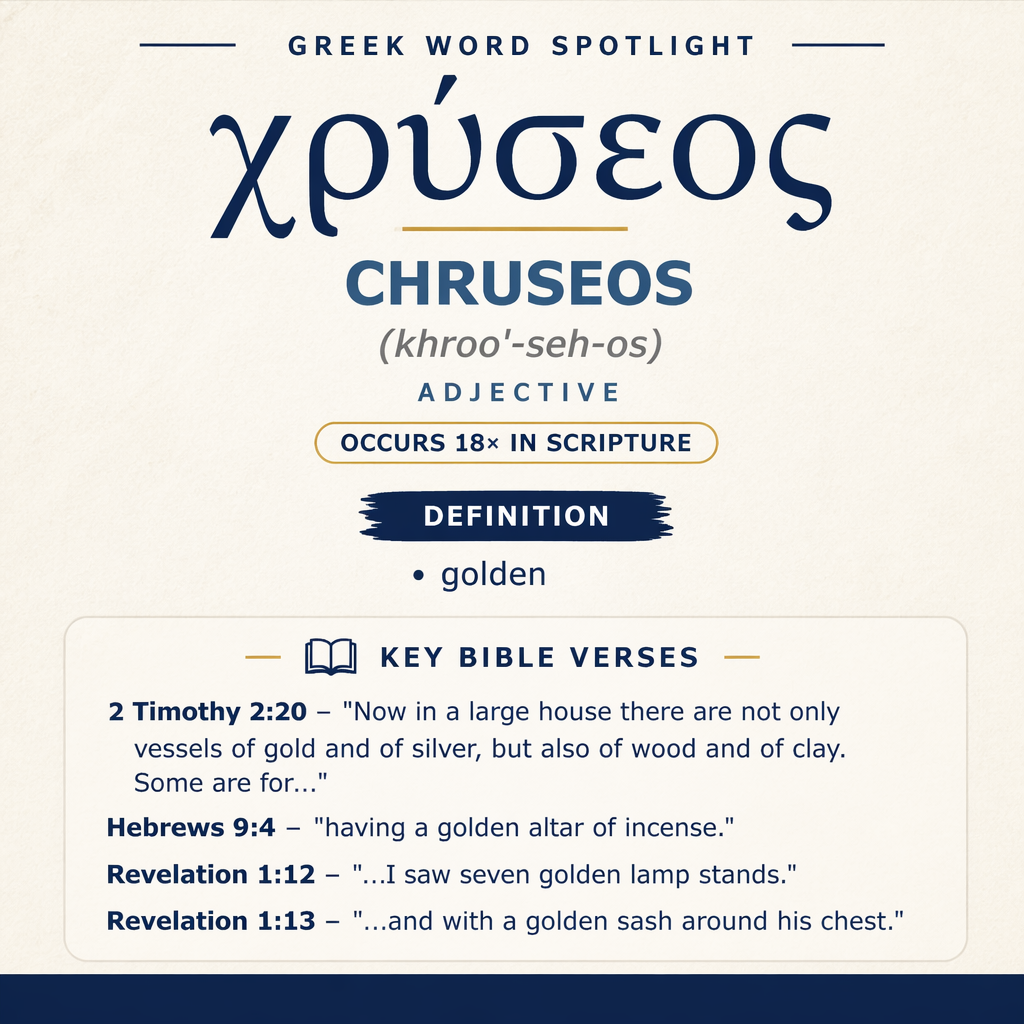
χρύσεος means “golden” and occurs 18 times in Scripture, including 2 Timothy 2:20, Hebrews 9:4, and multiple passages in Revelation.
Scripture Occurrences
It appears in 2 Timothy 2:20 and Hebrews 9:4, and repeatedly in Revelation (e.g., 1:12–13, 1:20; 2:1; 4:4; 5:8).
Learn More →Objects Described
It describes items such as vessels of gold, a golden altar of incense, a golden pot, and golden lamp stands.
Learn More →χρύσεος describes something as golden. In the passages where it appears, the adjective attaches to concrete objects—household vessels, tabernacle furnishings, and the repeated temple-throne imagery of Revelation—marking them out by their gold character within each scene.
Occurrences
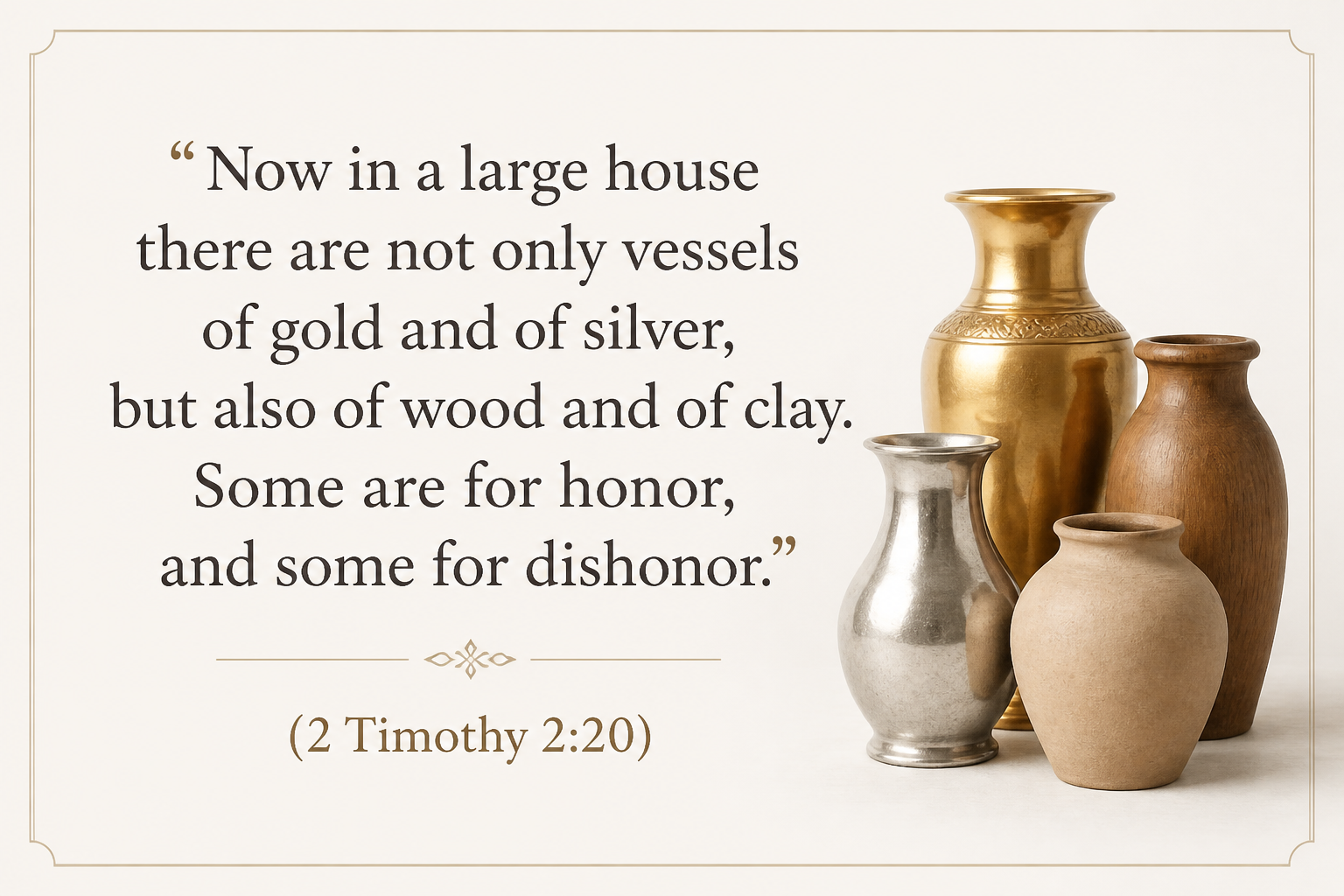
“Now in a large house there are not only vessels of gold and of silver, but also of wood and of clay. Some are for honor, and some for dishonor.” (2 Timothy 2:20)
Here the golden quality belongs to “vessels of gold” within a “large house” that also contains silver, wood, and clay vessels. The adjective helps set one class of household objects alongside other materials, and it supports the proverb-like contrast that follows (“honor” / “dishonor”) by placing “gold” in the array of materials that signal differing kinds of vessels in the same household setting.
“having a golden altar of incense, and the ark of the covenant overlaid on all sides with gold, in which was a golden pot holding the manna, Aaron’s rod that budded, and the tablets of the covenant;” (Hebrews 9:4)
In this catalog of sacred furnishings, χρύσεος marks two items: “a golden altar of incense” and “a golden pot holding the manna.” In the same sentence, gold is also mentioned as an overlay (“the ark of the covenant overlaid on all sides with gold”), so the adjective “golden” works alongside explicit “gold” language to emphasize that multiple objects in this space are characterized by gold, whether as their defining material quality (“golden”) or as a comprehensive covering (“overlaid…with gold”).
“I turned to see the voice that spoke with me. Having turned, I saw seven golden lamp stands.” (Revelation 1:12)
The first visionary object John reports upon turning is “seven golden lamp stands.” The adjective fixes the appearance of the lamp stands at the moment of sight: these are not merely lamp stands; they are lamp stands defined by their golden character, introducing a visual register of precious, radiant objects in the opening scene.
“And among the lamp stands was one like a son of man, clothed with a robe reaching down to his feet, and with a golden sash around his chest.” (Revelation 1:13)
Within the same setting of lamp stands, χρύσεος modifies “sash,” a detail of clothing: “a golden sash around his chest.” The adjective functions here as part of the descriptive inventory—robe length and sash location—so the golden quality becomes a salient feature of the figure’s appearance, in continuity with the golden lamp stands nearby.
“The mystery of the seven stars which you saw in my right hand, and the seven golden lamp stands is this: The seven stars are the angels of the seven assemblies. The seven lamp stands are seven assemblies.” (Revelation 1:20)
The phrase “seven golden lamp stands” is repeated as the vision is interpreted. The adjective remains attached to the lamp stands even as they are explained: the same objects that were seen as golden are now identified with “seven assemblies.” The golden description therefore persists as part of how these symbolic lamp stands are presented before their meaning is stated.
““To the angel of the assembly in Ephesus write: “He who holds the seven stars in his right hand, he who walks among the seven golden lamp stands says these things:” (Revelation 2:1)
Again the lamp stands are “golden,” now within a message addressed to an assembly. The golden lamp stands form the environment in which the speaker is depicted as walking—“walks among the seven golden lamp stands”—so the adjective contributes to the scene-setting for authority and presence: the addressee hears from the one whose sphere includes these golden objects.
“Around the throne were twenty-four thrones. On the thrones were twenty-four elders sitting, dressed in white garments, with crowns of gold on their heads.” (Revelation 4:4)
Gold appears here as “crowns of gold,” attached to the elders enthroned around the central throne. Though the verse uses “of gold” rather than “golden,” the scene reinforces the same visual field: gold belongs to regalia worn “on their heads,” paired with “white garments” and the repeated throne imagery, presenting gold as a visible mark of what is on and around these thrones.
“Now when he had taken the book, the four living creatures and the twenty-four elders fell down before the Lamb, each one having a harp, and golden bowls full of incense, which are the prayers of the saints.” (Revelation 5:8)
Here χρύσεος modifies “bowls”: “golden bowls full of incense.” The adjective highlights the bowls’ material character as part of a liturgical tableau—harps, bowls, incense—while the verse itself interprets the incense (“which are the prayers of the saints”). The golden quality thus marks the vessels that carry what the verse connects with prayer, giving the offering scene a distinctive, precious concreteness.
“Another angel came and stood over the altar, having a golden censer. Much incense was given to him, that he should add it to the prayers of all the saints on the golden altar which was before the throne.” (Revelation 8:3)
This verse contains two χρύσεος phrases: “a golden censer” and “the golden altar.” The adjective links the censer the angel “having” with the altar “before the throne,” binding the action (receiving and adding “much incense”) to objects defined by their gold character. In the verse’s own logic, the golden implements are the immediate instruments by which incense is joined “to the prayers of all the saints.”
“The sixth angel sounded. I heard a voice from the horns of the golden altar which is before God,” (Revelation 9:13)
As the sixth angel sounds, John hears “a voice from the horns of the golden altar.” The adjective “golden” again characterizes the altar, and now the altar is specified by its location—“before God”—and by the detail of “horns.” The golden altar is not only seen but becomes the marked source-point from which the voice proceeds in the narrative.
“The rest of mankind, who were not killed with these plagues, didn’t repent of the works of their hands, that they wouldn’t worship demons, and the idols of gold, and of silver, and of brass, and of stone, and of wood; which can’t see, hear, or walk.” (Revelation 9:20)
Gold enters this verse as one material among several that characterize “idols”—“idols of gold, and of silver, and of brass, and of stone, and of wood.” The sequence stresses that the objects of worship can be made from precious or common materials alike, and the concluding line (“which can’t see, hear, or walk”) underlines the futility of such objects regardless of what they are made of. Gold here therefore participates in a list that places it alongside other substances without granting it any saving power.
“I looked, and saw a white cloud, and on the cloud one sitting like a son of man, having on his head a golden crown, and in his hand a sharp sickle.” (Revelation 14:14)
In this vision, χρύσεος modifies “crown”: “a golden crown.” The adjective sharpens the visual contrast within the sentence: the “white cloud,” the seated figure “like a son of man,” the “golden crown” on the head, and the “sharp sickle” in the hand. Gold here belongs to headwear that accompanies an action-ready implement, presenting the crowned figure in a striking, carefully detailed tableau.

Sense and Usage
Across these passages, χρύσεος functions as a straightforward descriptor of gold character applied to tangible objects. Two broad settings dominate: (1) ordinary domestic imagery (“vessels of gold…of silver…of wood…of clay” in 2 Timothy 2:20) and (2) sacred or heavenly furnishings and regalia (Hebrews 9:4; Revelation 1–14). In the domestic picture, gold is one material among others within a single “large house,” supporting an argument built on the coexistence of different kinds of vessels and their differing purposes. In Hebrews 9:4, the adjective is attached to cultic items (“altar of incense,” “pot holding the manna”), reinforcing the clustered presence of gold in the described sacred space.
Revelation repeatedly uses χρύσεος to paint a coherent visual world. The adjective marks fixed features of the vision (the “seven golden lamp stands” repeated in Revelation 1:12, 1:20, 2:1), and it also marks portable implements involved in offering imagery (“golden bowls,” “golden censer,” “golden altar”). When the scene shifts from implements to persons, the same adjective highlights worn items of distinction (“golden sash,” “golden crown”). Within these visions, the golden description is rarely isolated; it is one detail among other concrete descriptors—numbers (“seven,” “twenty-four”), colors (“white”), locations (“before the throne,” “before God”), and actions (turning, walking among, falling down, standing over, sounding, hearing). The result is that “golden” operates as a stable, repeated visual cue that helps bind the objects together across separate scenes while still serving each scene’s immediate narrative function.
Imagery
The passages place golden objects in contexts of display, proximity, and action: lamp stands among which someone walks (Revelation 2:1), an altar before the throne connected with incense and prayers (Revelation 8:3), and a crown worn by a figure seated on a cloud with a sickle in hand (Revelation 14:14). Gold also appears in a pointed contrast: “idols of gold” stand among other man-made materials and are described as unable to “see, hear, or walk” (Revelation 9:20). Within this set of texts, golden imagery can therefore frame both reverent scenes of worship and offering, and a critique of material objects treated as worthy of worship.
Sources: Lexical data from Strong’s Exhaustive Concordance and the Translators Brief Lexicon of Extended Strongs for Greek (STEPBible, CC BY). Occurrence data from the Translators Amalgamated Greek New Testament (STEPBible, CC BY). Scripture quotations from the World English Bible (public domain).