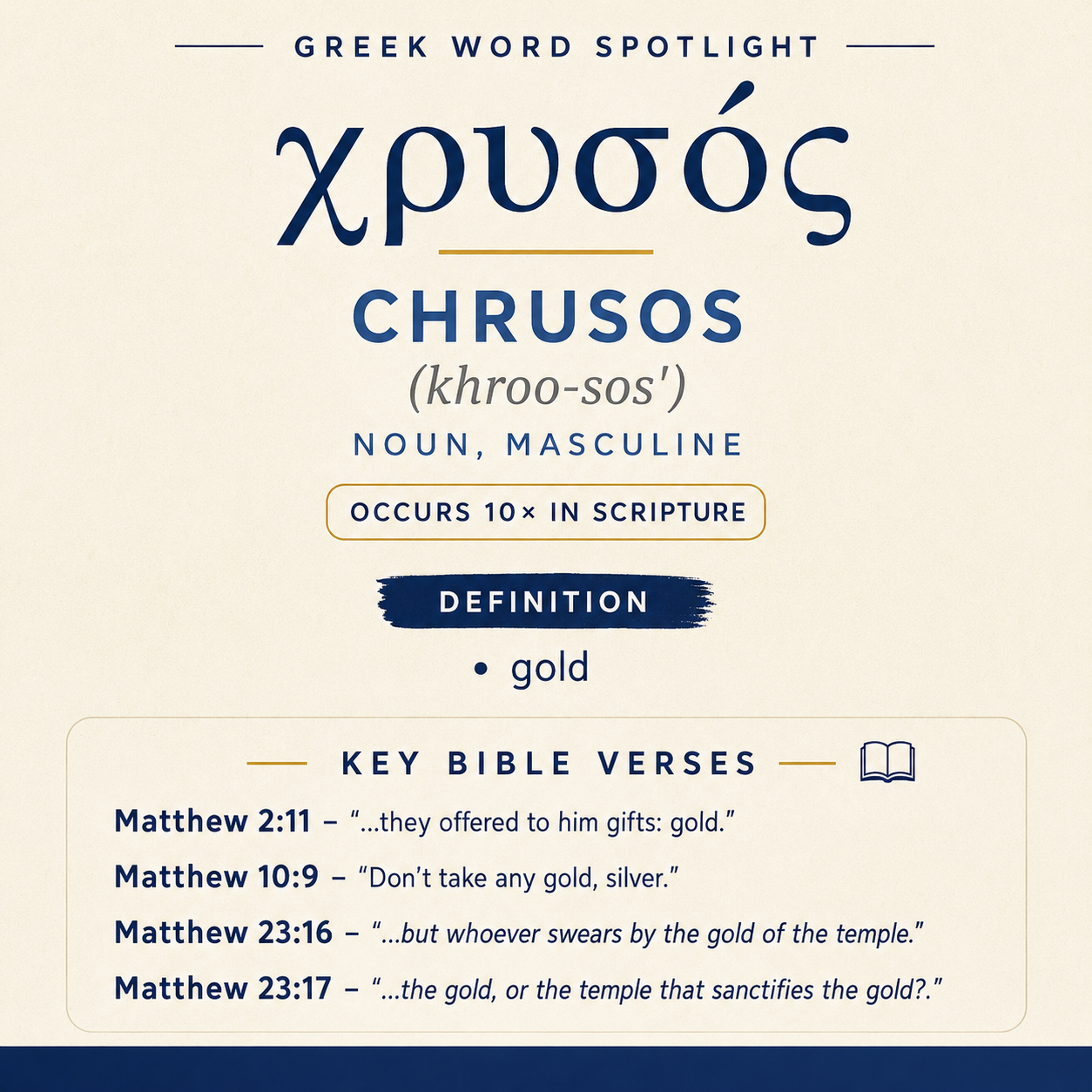
Exploring the Meaning of Chrusos in Greek
χρυσός (Chrusos) means “gold” in Greek and occurs 10 times in Scripture, including Matthew 2:11 and 1 Corinthians 3:12.
Scripture Occurrences
It appears 10 times in Scripture, including Matthew (2:11; 10:9; 23:16–17), Acts 17:29, 1 Corinthians 3:12, and James 5:3.
Learn More →Usage Examples
It names literal gold (Matthew 10:9) and also appears in comparisons and imagery (Acts 17:29; Revelation 9:7).
Learn More →χρυσός refers to gold, a material that appears in scenes of gift-giving, instruction, moral critique, argument about worship, imagery of judgment, and commercial wealth. In the passages where it occurs, gold can function as a tangible offering, a portable form of money, an object attached to sacred space, a comparison-point for human ideas about God, a metaphor for what one “builds” with, and an emblem of luxury that can become evidence against hoarded riches.
Occurrences
Matthew 2:11: “They came into the house and saw the young child with Mary, his mother, and they fell down and worshiped him. Opening their treasures, they offered to him gifts: gold, frankincense, and myrrh.”
Here χρυσός is one item in a set of costly gifts brought from “treasures” and presented in a setting marked by worship. Gold contributes the sense of a valuable, concrete offering that can be placed before the child as an act that accompanies reverence. The verse’s emphasis on “opening their treasures” frames gold as something stored and then deliberately given.
Matthew 10:9: “Don’t take any gold, silver, or brass in your money belts.”
In this instruction, χρυσός stands at the head of a trio of metals connected to carrying funds (“in your money belts”). Gold functions as a recognized medium of wealth and travel provision. The command highlights gold’s practical role as portable financial security—the sort of thing one could normally bring along, but is forbidden here.
Matthew 23:16: ““Woe to you, you blind guides, who say, ‘Whoever swears by the temple, it is nothing; but whoever swears by the gold of the temple, he is obligated.’”
Gold here is not simply material; it becomes a focus of oath-making logic. The phrase “the gold of the temple” ties χρυσός to a sacred location and to claims about what makes an oath binding (“he is obligated”). In the critique’s setup, gold is treated as carrying more weight than “the temple” itself, revealing how material value can be elevated in religious reasoning.
Matthew 23:17: “You blind fools! For which is greater, the gold, or the temple that sanctifies the gold?”
This verse keeps the same temple setting but reverses the valuation by posing a comparison: “the gold” versus “the temple that sanctifies the gold.” Gold remains the disputed object, but the wording places it under the temple’s influence—gold is presented as something that can be “sanctified” by its association. χρυσός thus serves as the material example used to expose a distorted hierarchy of what is “greater.”
Acts 17:29: “Being then the offspring of God, we ought not to think that the Divine Nature is like gold, or silver, or stone, engraved by art and design of man.”
In this argument, χρυσός is part of a list of substances (“gold, or silver, or stone”) that are shaped (“engraved”) by human “art and design.” Gold contributes the idea of a revered, precious material that people might use when constructing an image, but the point is that even the highest-valued material is an inadequate analogy for “the Divine Nature.” The mention of engraving presses gold into the category of crafted objects—things made and formed—contrasted with God.
1 Corinthians 3:12: “But if anyone builds on the foundation with gold, silver, costly stones, wood, hay, or stubble,”
Here χρυσός appears as a building material in a series that moves from expensive and enduring-sounding items (“gold, silver, costly stones”) to ordinary and perishable materials (“wood, hay, or stubble”). Gold contributes the sense of a choice material for construction—something selected deliberately when “build[ing] on the foundation.” The verse uses gold to evoke workmanship that is not random but evaluated by what one decides to use.
James 5:3: “Your gold and your silver are corroded, and their corrosion will be for a testimony against you and will eat your flesh like fire. You have laid up your treasure in the last days.”
In James, χρυσός is addressed directly as “Your gold,” linked with “your silver,” and pictured as subject to “corrosion.” Gold’s presence intensifies the accusation: even what people commonly treat as secure wealth is portrayed as decaying, and that decay becomes “a testimony against you.” Gold here functions as stored treasure (“laid up”) whose condition turns into evidence, shifting gold from a symbol of safety to a witness in judgment language.
Revelation 9:7: “The shapes of the locusts were like horses prepared for war. On their heads were something like golden crowns, and their faces were like people’s faces.”
In this visionary description, χρυσός modifies “crowns” through the phrase “something like golden crowns.” Gold contributes the visual impression of splendor, authority, or regality attached to terrifying warlike creatures. The careful wording (“something like”) uses gold to suggest appearance—an arresting, glittering likeness—without making the detail merely decorative; it is part of the scene’s threatening grandeur.
Revelation 18:12: “merchandise of gold, silver, precious stones, pearls, fine linen, purple, silk, scarlet, all expensive wood, every vessel of ivory, every vessel made of most precious wood, and of brass, and iron, and marble;”
Here χρυσός heads a catalog of luxury goods called “merchandise.” Gold functions as a prime example of traded wealth, placed alongside other valuables and high-status materials. The list’s breadth (from precious stones to fabrics to vessels of rare materials) frames gold as part of an economy of opulence: goods that can be counted, bought, and sold as markers of prosperity.

Sense and Usage
Across these passages, χρυσός consistently points to gold as a concrete, recognizable substance with high perceived value, but its narrative role shifts depending on context. In Matthew 2:11 it is willingly offered from opened “treasures,” placing gold in the sphere of gift and honor. In Matthew 10:9 it belongs to the everyday mechanics of travel and provision—something carried in a “money belt”—so that the prohibition presses on reliance upon wealth.
Matthew 23:16–17 uses gold to expose moral and spiritual misjudgment: the debated “gold of the temple” becomes the object by which guides measure obligation, and then the rhetorical question forces a reassessment by pairing “the gold” with “the temple that sanctifies the gold.” Gold’s value is not denied; rather, the argument shows how easily value-language can be misapplied when material worth starts to govern religious reasoning.
In Acts 17:29 gold becomes part of a philosophical-theological correction. Even when gold is fashioned with human skill (“engraved by art and design of man”), it remains a created medium that should not be used as a likeness for “the Divine Nature.” Gold thus represents the pinnacle of humanly esteemed materials, and precisely for that reason it is included as a rejected comparison.
Paul’s construction image in 1 Corinthians 3:12 puts gold into a different field: workmanship and building choices. Gold stands among materials that imply careful investment and durability in contrast to what is ordinary and easily consumed. The verse’s concern is not about gold as currency or ornament, but gold as a deliberate component in what someone “builds on the foundation.”
James 5:3 turns gold from an asset into an accusation. By addressing “Your gold” as “corroded,” the passage treats wealth as something that can decay and testify, and it locates the problem in “laid up” treasure. Gold’s function here is moral and forensic: the state of one’s stored riches becomes evidence “against you.”
Revelation uses gold in two distinct ways within the quoted texts. In 9:7 it paints a frightening spectacle: “golden crowns” (or something like them) contribute a gleaming, regal appearance to creatures “prepared for war.” In 18:12 gold stands at the head of a merchandise list, representing the commercial side of luxury and the accumulation of precious goods. In both cases gold intensifies the scene—either by heightening visual splendor in a terrifying vision or by signaling wealth in an inventory of trade.
Imagery
The imagery of χρυσός in these passages ranges from opened treasure presented in worship (Matthew 2:11) to metal carried for practical support (Matthew 10:9), debated as spiritually weighty because of its temple association (Matthew 23:16–17), and rejected as a way to picture God (Acts 17:29). It can evoke careful, costly building (1 Corinthians 3:12), but also the unsettling picture of treasured wealth turning into “testimony” through “corrosion” (James 5:3). In Revelation, gold appears both as dazzling crown-like adornment in a warlike vision (Revelation 9:7) and as the first item in a long ledger of luxury commerce (Revelation 18:12), showing how the same material can serve worship, warning, and vivid description.
Sources: Lexical data from Strong’s Exhaustive Concordance and the Translators Brief Lexicon of Extended Strongs for Greek (STEPBible, CC BY). Occurrence data from the Translators Amalgamated Greek New Testament (STEPBible, CC BY). Scripture quotations from the World English Bible (public domain).