Exploring the Meaning of Cheiropoietos in Greek
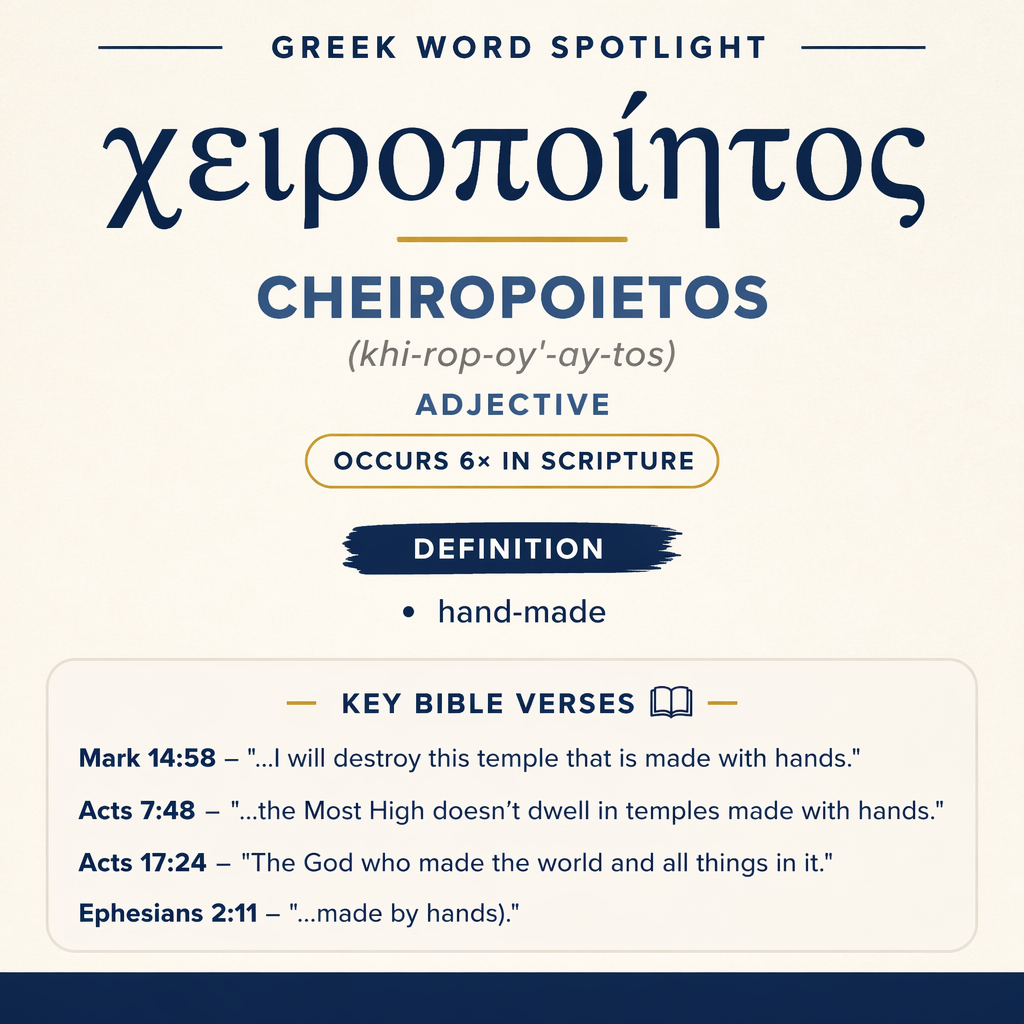
χειροποίητος means “hand-made” and occurs six times in Scripture: Mark 14:58; Acts 7:48; Acts 17:24; Ephesians 2:11; Hebrews 9:11; 9:24.
Core Meaning
χειροποίητος is defined as “hand-made.” In its listed passages, it describes things “made with hands.”
Learn More →Temple Language
In Mark 14:58, it refers to a temple “made with hands” contrasted with another “made with” hands. In Acts 7:48 and Acts 17:24, temples “made with hands” are mentioned in statements about God’s dwelling.
Learn More →Hebrews Contrast
Hebrews 9:11 speaks of a tabernacle “not” made with hands. Hebrews 9:24 says Christ did not enter holy places made with hands.
Learn More →χειροποίητος describes something “hand-made.” In the New Testament it appears in sayings and speeches that contrast what is constructed by human hands with what is “not made with hands,” especially in references to temples, holy places, and a bodily marker of identity.
Occurrences
“We heard him say, ‘I will destroy this temple that is made with hands, and in three days I will build another made without hands.’ ” (Mark 14:58)
Here χειροποίητος characterizes “this temple” as a structure that belongs to the realm of human craftsmanship: it is a building that can be spoken of as “made with hands.” Within the same report, the adjective gains force by being set directly against its opposite description, “made without hands.” The contrast sharpens the claim being attributed to Jesus: the first temple is described in terms of ordinary human making, while the second is presented as belonging to a different category of making altogether. In this line, χειροποίητος helps define the kind of thing that is threatened with destruction—an edifice whose origin is explicitly human labor.
However, the Most High doesn’t dwell in temples made with hands, as the prophet says, (Acts 7:48)
In this sentence the adjective modifies “temples,” and the statement turns on the limitation implied by that description: temples “made with hands” are not suitable as a dwelling place for “the Most High.” The word functions as a qualifier that frames a theological claim about God’s presence. The point is not simply that temples exist, but that their being hand-made marks them as belonging to a created, human-built order that cannot contain or house God in the way the verb “dwell” would suggest. The phrase “doesn’t dwell” makes the adjective do explanatory work: the very nature of these temples—as hand-made—stands behind the claim about non-dwelling.
The God who made the world and all things in it, he, being Lord of heaven and earth, doesn’t dwell in temples made with hands. (Acts 17:24)
Paul’s sentence sets a wide frame: God “made the world and all things in it” and is “Lord of heaven and earth.” Against that scale, “temples made with hands” are again treated as an inadequate dwelling place. χειροποίητος emphasizes the human origin of such temples in contrast with God’s creative making of “the world and all things in it.” The adjective therefore supports a rhetorical contrast between the Maker of all and human-made structures. The line does not merely deny that God dwells in temples; it specifies the kind of temples in view—those defined by human hands—so that the denial is tied to their character as human artifacts.
Therefore remember that once you, the Gentiles in the flesh, who are called “uncircumcision” by that which is called “circumcision” (in the flesh, made by hands), (Ephesians 2:11)
In this setting χειροποίητος modifies the identifying mark “circumcision,” further described as “in the flesh.” The adjective highlights that the label “circumcision” can refer to something done by human agency—“made by hands”—and thus functions as a descriptor of a physical, embodied practice that becomes a social boundary (“called ‘uncircumcision’ … by that which is called ‘circumcision’”). By attaching “made by hands” to the parenthetical phrase, the sentence underscores the tangible, human-performed character of this bodily distinction. In context, the adjective serves to locate the naming and dividing practice in what is physically done and socially recognized among people.
But Christ having come as a high priest of the coming good things, through the greater and more perfect tabernacle, not made with hands, that is to say, not of this creation, (Hebrews 9:11)
Here the adjective appears in the negative, describing the “greater and more perfect tabernacle” as “not made with hands.” Even so, the force of χειροποίητος is present in defining what this tabernacle is not: it is not a product of human construction. The writer immediately restates the point with an interpretive clarification, “that is to say, not of this creation,” drawing a line between humanly made structures and a tabernacle belonging to a different order. Within the sentence, “through the greater and more perfect tabernacle” ties Christ’s high-priestly action to the character of the tabernacle; the denial of hand-made origin helps distinguish the setting of his priestly work from any ordinary crafted sanctuary.
For Christ hasn’t entered into holy places made with hands, which are representations of the true, but into heaven itself, now to appear in the presence of God for us; (Hebrews 9:24)
This occurrence returns to the positive form: “holy places made with hands.” The adjective marks these holy places as humanly constructed sanctuaries, and the sentence then assigns them a particular status: they “are representations of the true.” In other words, their hand-made character aligns with their representational role; they are real “holy places,” yet they are not the ultimate reality. The contrast is explicit: instead of entering those hand-made holy places, Christ entered “heaven itself.” Here χειροποίητος contributes to the argument by helping distinguish between a humanly made sacred space and the heavenly presence where Christ “appear[s] in the presence of God for us.”

Sense and Usage
Across these passages χειροποίητος consistently identifies things that bear the mark of direct human workmanship. The word is most often attached to sacred architecture—“temples” (Acts 7:48; Acts 17:24), “this temple” (Mark 14:58), and “holy places” (Hebrews 9:24)—and in that architectural setting it helps frame a recurring claim: God’s dwelling and Christ’s priestly entrance are not ultimately tied to, or contained within, structures that can be described in terms of human manufacture. The adjective does not by itself deny the significance of such places, but in these contexts it makes their origin and category explicit, and that explicitness becomes the basis for contrast.
The contrast is sometimes stated by pairing the hand-made with the “not made with hands” (Mark 14:58; Hebrews 9:11). This pairing makes χειροποίητος function as one side of a twofold classification: what is made by human hands and what is not. In Mark 14:58, the opposition serves a dramatic claim about destruction and rebuilding, giving “this temple” a character that can be spoken of as replaceable by something of a different kind. In Hebrews 9, the opposition serves a more sustained distinction of spheres: Christ operates “through the greater and more perfect tabernacle, not made with hands” (Hebrews 9:11) and enters “into heaven itself” rather than “holy places made with hands” (Hebrews 9:24). In both books, the adjective helps identify the category being surpassed or contrasted, even when the focus lies on what is “not made with hands.”
The single non-architectural use in these verses (Ephesians 2:11) shows that the adjective can qualify not only built spaces but also a physical act or condition tied to “the flesh.” There it marks “circumcision” as something “made by hands,” placing emphasis on the humanly performed, bodily character of the marker that underlies the labels “circumcision” and “uncircumcision.” In that setting the adjective supports the sentence’s concern with remembered identity (“Therefore remember that once you, the Gentiles in the flesh…”) and with how names and boundaries are maintained through visible, humanly enacted signs.
In Acts, the repeated denial that God “doesn’t dwell in temples made with hands” (Acts 7:48; Acts 17:24) shows χειροποίητος working in service of a particular theological grammar: the transcendence of “the Most High” and the universal scope of “The God who made the world and all things in it” stand in tension with the idea that a hand-made structure could serve as God’s dwelling. The adjective helps make that tension concrete by pointing to the human origin of the temples in question, placing them on the side of human craft rather than on the side of divine making.
Imagery
χειροποίητος evokes the tactile world of construction and craft: hands shaping wood, stone, fabric, or flesh. In these passages that tactile imagery becomes a way of sorting realities. A “temple that is made with hands” (Mark 14:58) and “holy places made with hands” (Hebrews 9:24) belong to a recognizable human realm, even when they are sacred. By contrast, the repeated mention of what is “not made with hands” (Mark 14:58; Hebrews 9:11) and the move “into heaven itself” (Hebrews 9:24) uses the hand-made category as a foil, drawing attention to what cannot be reduced to human manufacture or contained within it.
Sources: Lexical data from Strong’s Exhaustive Concordance and the Translators Brief Lexicon of Extended Strongs for Greek (STEPBible, CC BY). Occurrence data from the Translators Amalgamated Greek New Testament (STEPBible, CC BY). Scripture quotations from the World English Bible (public domain).