Exploring the Meaning of Cheilos in Greek
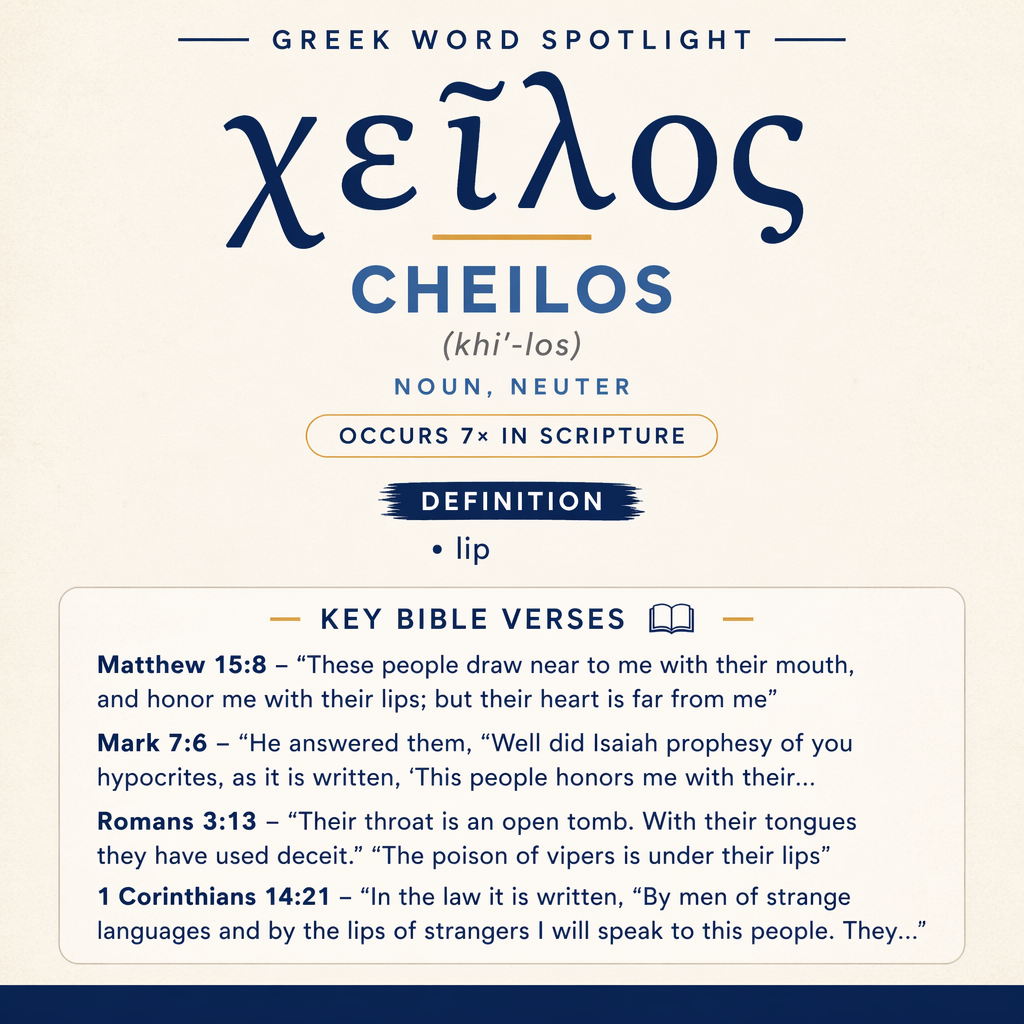
χεῖλος (Cheilos) means “lip” and occurs 7 times in Scripture: Matthew 15:8; Mark 7:6; Romans 3:13; 1 Corinthians 14:21; Hebrews 11:12; Hebrews 13:15; 1 Peter 3:10.
Core Meaning
χεῖλος means “lip.” It appears in contexts of speech, honor, deceit, and praise.
Learn More →Quoted Speech
In Matthew 15:8 and Mark 7:6, people honor God “with their lips.” These verses contrast lips with a heart that is far from God.
Learn More →Moral Use
Romans 3:13 and 1 Peter 3:10 connect lips with deceit and evil speech. Hebrews 13:15 speaks of “the fruit of lips” that proclaim praise to God.
Learn More →χεῖλος means “lip,” and in the New Testament it appears in passages that speak about speech, praise, deceit, and the contrast between outward words and inward disposition. The word can be used for literal lips in the body, and it also serves as a concrete image for what a person voices.
Occurrences
Matthew 15:8 — ‘These people draw near to me with their mouth, and honor me with their lips; but their heart is far from me.
Here “lips” stand in parallel with “mouth” and in contrast with “heart.” The verse portrays a tension between verbal honor—what is expressed at the level of the lips—and inner distance. χεῖλος anchors “honor” in the physical organ of speech, making the act of honoring something that can be performed outwardly even when the heart does not match it.

Mark 7:6 — He answered them, “Well did Isaiah prophesy of you hypocrites, as it is written, ‘This people honors me with their lips, but their heart is far from me.
As in Matthew, “lips” identify the bodily means by which honor is expressed. Within the rebuke (“you hypocrites”), χεῖλος helps draw the line between speech that sounds reverent and a heart that remains “far.” The word does not merely name anatomy; it sharpens the critique by focusing attention on honor as something that can be located in what is said.
Romans 3:13 — “Their throat is an open tomb. With their tongues they have used deceit.” “The poison of vipers is under their lips.”
In a chain of images involving speech organs (“throat,” “tongues,” “lips”), χεῖλος participates in a portrait of destructive speech. “Under their lips” places the danger close to the point of utterance: the lips frame what is released into speech, and what lies “under” them is described as “poison.” The verse’s progression moves from the throat to the tongue to the lips, using concrete bodily parts to depict verbal deceit and harm.
1 Corinthians 14:21 — In the law it is written, “By men of strange languages and by the lips of strangers I will speak to this people. They won’t even hear me that way, says the Lord.”
Here χεῖλος appears in the phrase “the lips of strangers,” joined with “strange languages.” The “lips” are not a generic symbol of speech but a vivid way to mark the otherness of the speakers: the utterance comes from unfamiliar mouths. In the quoted line, speech is portrayed as God’s instrument (“I will speak”), yet the result is resistance (“They won’t even hear me that way”). χεῖλος thus highlights the embodied, audible character of the message—speech coming through particular lips that are perceived as foreign.
Hebrews 11:12 — Therefore as many as the stars of the sky in multitude, and as innumerable as the sand which is by the sea shore, were fathered by one man, and him as good as dead.
In this verse, the scene is a sweeping description of multitude—“stars of the sky” and “sand…by the sea shore”—and the theme is progeny coming from “one man.” Within that setting, “lip” would naturally evoke the edge or boundary of a thing, as “by the sea shore” draws attention to a line where land meets water. The imagery is spatial and concrete, with emphasis on innumerability rather than speech.
Hebrews 13:15 — Through him, then, let’s offer up a sacrifice of praise to God continually, that is, the fruit of lips which proclaim allegiance to his name.
χεῖλος is brought into worship language: “a sacrifice of praise…continually,” defined as “the fruit of lips.” The “lips” are presented as productive, yielding “fruit” when they “proclaim allegiance to his name.” The phrase keeps praise grounded in bodily speech—praise is not only inward sentiment but voiced confession. The verse also sets lips within ongoing practice (“continually”), portraying a sustained pattern of spoken devotion.
1 Peter 3:10 — For, “He who would love life and see good days, let him keep his tongue from evil and his lips from speaking deceit.
Here “lips” are paired with “tongue,” both governed by moral restraint: “keep his tongue from evil and his lips from speaking deceit.” χεῖλος names the boundary of speech at the point where words are formed and released. The verse depicts ethical discipline in communication, with the lips specifically associated with the act of “speaking deceit.”

Sense and Usage
Across these passages, χεῖλος (“lip”) functions in two dominant ways. First, it serves as a concrete metonym for speech—what a person says and how it is said. In Matthew 15:8 and Mark 7:6, lips are the location of “honor,” highlighting the possibility of verbal reverence existing alongside a distant heart. In Romans 3:13 and 1 Peter 3:10, lips mark the immediate context of deceit: poison is pictured as lying “under” them, and deceit is portrayed as something lips can “speak.” In Hebrews 13:15, lips become the instrument of praise, producing “fruit” by proclaiming allegiance. In these uses, the physicality of the lips matters: speech is not abstract, but embodied and therefore observable—honor can be offered, deceit can be voiced, praise can be proclaimed.
Second, χεῖλος can sit naturally within spatial imagery. Hebrews 11:12 presents a scene framed by innumerable “sand…by the sea shore,” drawing attention to a boundary line at the water’s edge. In such a context, “lip” readily evokes the idea of an edge or margin in a physical landscape, fitting the verse’s concrete, visual scale. The term’s flexibility allows it to function both in bodily description (as part of the speech apparatus) and in imagery of borders and edges, depending on the scene.
When χεῖλος is tied to speech, these texts repeatedly connect the lips with moral and spiritual realities without detaching them from the body. Lips are not treated as neutral; they are the site where hypocrisy can present itself (honor on the lips while the heart is far), where deceit and harm can be poised (“poison…under their lips”), where foreignness can be heard (“the lips of strangers”), where ethical restraint must be practiced (lips kept from deceit), and where worship takes audible form (“fruit of lips”). The word’s concreteness helps each writer speak with immediacy: what is said is as near as the lips themselves.
Imagery
The imagery associated with χεῖλος in these verses is tactile and near at hand. Lips can frame honor that lacks inward nearness (Matthew 15:8; Mark 7:6), conceal something deadly close to speech (Romans 3:13), or become fruitful in continual praise (Hebrews 13:15). Even where the setting widens to stars and seashore sand (Hebrews 11:12), the language keeps the reader anchored in concrete edges and surfaces, reinforcing the word’s capacity to evoke something visible and bounded.
Sources: Lexical data from Strong’s Exhaustive Concordance and the Translators Brief Lexicon of Extended Strongs for Greek (STEPBible, CC BY). Occurrence data from the Translators Amalgamated Greek New Testament (STEPBible, CC BY). Scripture quotations from the World English Bible (public domain).