Exploring the Meaning of Chalao in Greek
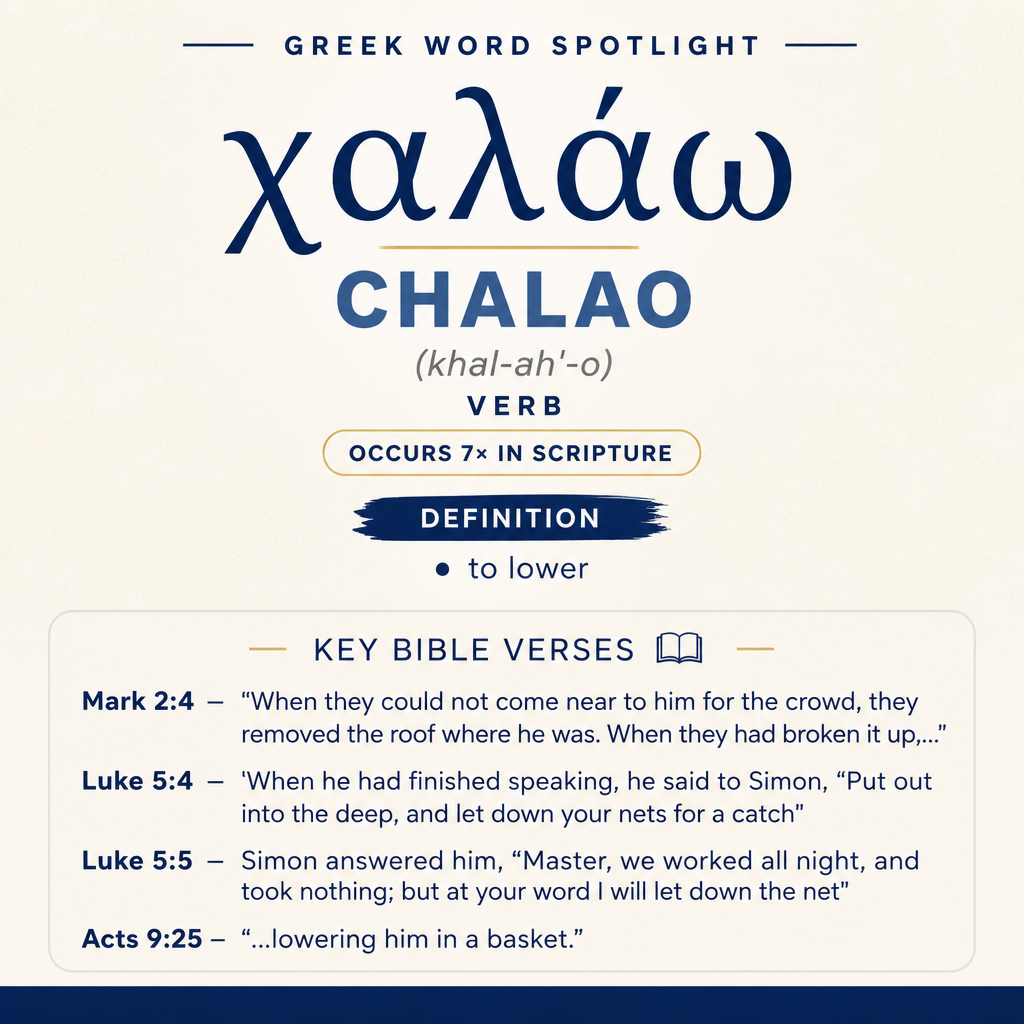
χαλάω means “to lower” and occurs 7 times in Scripture: Mark 2:4; Luke 5:4–5; Acts 9:25; Acts 27:17, 30; 2 Corinthians 11:33.
Core Meaning
χαλάω is defined as “to lower.” In its listed occurrences, it describes lowering nets, a person in a basket, and a boat.
Learn More →Gospel Scenes
In Luke 5:4–5, Jesus tells Simon to “let down” nets for a catch. In Mark 2:4, it appears in the account of accessing Jesus through a roof.
Learn More →Acts & Escape
Acts 9:25 and 2 Corinthians 11:33 describe being “let down” through a wall in a basket. Acts 27:17 and 27:30 use it for actions taken with a ship and a boat.
Learn More →χαλάω means “to lower.” In the New Testament it appears in scenes of a mat being lowered through a roof, nets being lowered into deep water, people being lowered in baskets down walls, and ship’s gear being lowered at sea.
Occurrences
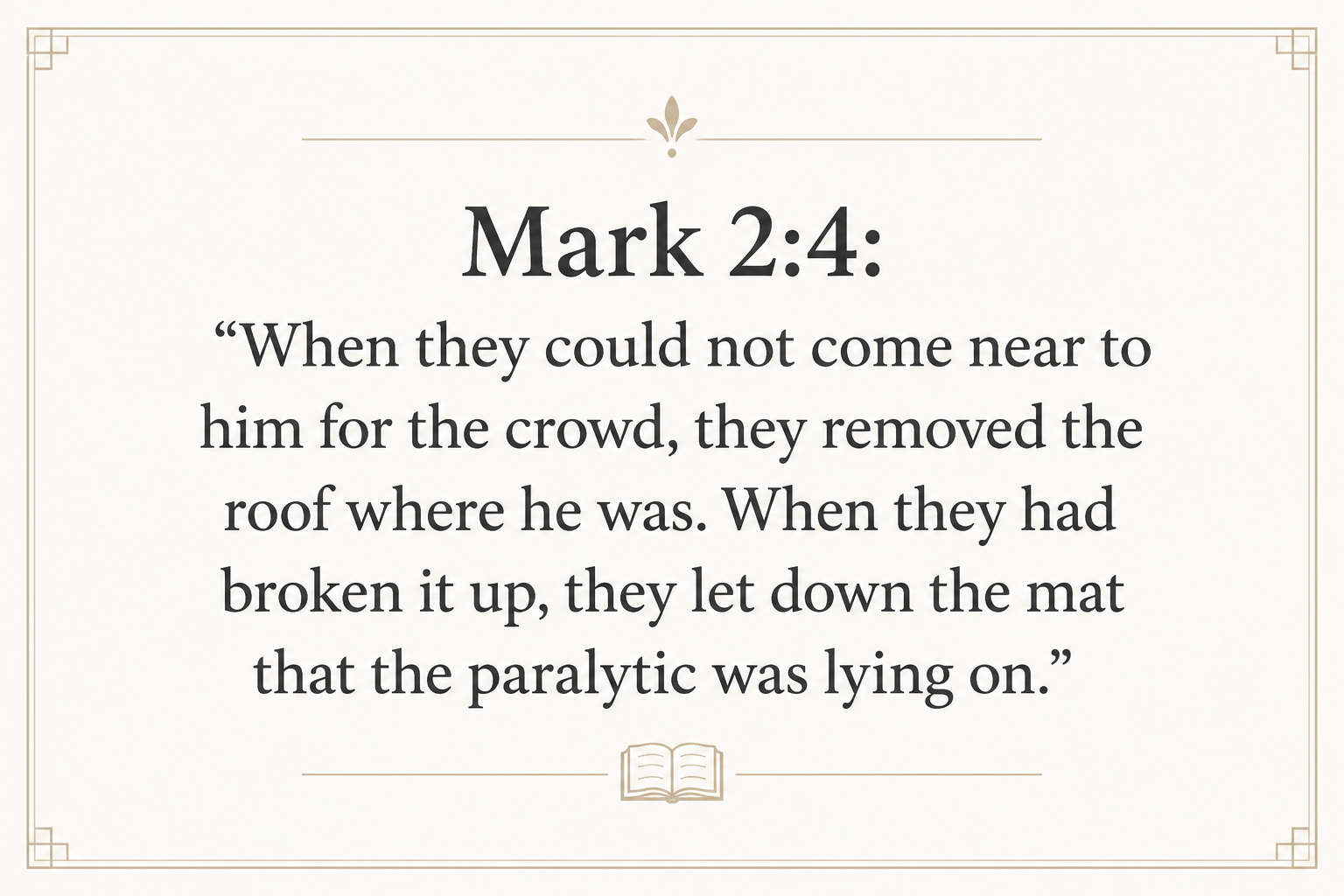
Mark 2:4: “When they could not come near to him for the crowd, they removed the roof where he was. When they had broken it up, they let down the mat that the paralytic was lying on.”
Here χαλάω describes a controlled downward movement from above to below: the mat moves from roof level into the space where Jesus is. The narrative stresses obstacles (“could not come near to him for the crowd”), then deliberate action (“removed the roof,” “broken it up”), culminating in the decisive act of lowering. The verb supplies the crucial transition from effort on the roof to the man’s placement before Jesus, with the mat remaining the support under the paralytic as it descends.
Luke 5:4: “When he had finished speaking, he said to Simon, “Put out into the deep, and let down your nets for a catch.”
In this setting χαλάω is an instruction tied to a location (“into the deep”) and a purpose (“for a catch”). Lowering is the concrete action that puts the nets into the water where fish may be taken; the command assumes the nets begin out of the water and must be set downward into the deep. The verb highlights the moment when intention becomes practice: it is not merely going out, but lowering the gear that makes fishing possible.
Luke 5:5: “Simon answered him, “Master, we worked all night, and took nothing; but at your word I will let down the net.”
This occurrence picks up the same fishing action but shifts the focus to response and resolve. Simon contrasts a failed night of labor (“worked all night, and took nothing”) with a choice rooted in obedience (“at your word”). The act of lowering becomes the specific, measurable deed that embodies his reply. By using χαλάω, the verse frames faithfulness not as a vague attitude but as the concrete act of lowering the net again despite discouraging experience.
Acts 9:25: “but his disciples took him by night and let him down through the wall, lowering him in a basket.”
Here χαλάω appears in an escape scene where the descent is both vertical and protective. The movement is “through the wall,” and it happens “by night,” emphasizing secrecy and urgency. The text adds an explanatory detail—“lowering him in a basket”—so the verb carries the idea of carefully managing a person’s downward movement, not simply dropping him. The basket functions as the means of safe lowering, and the verb marks the decisive step in getting him from a dangerous position to safety.
Acts 27:17: “After they had hoisted it up, they used cables to help reinforce the ship. Fearing that they would run aground on the Syrtis sand bars, they lowered the sea anchor, and so were driven along.”
In the storm narrative, χαλάω is used for lowering equipment rather than a person. The sequence “hoisted it up” followed later by “lowered the sea anchor” places lowering within a larger set of seamanship actions taken under fear of grounding. Lowering here is a tactical response: the crew’s concern (“Fearing that they would run aground”) leads to lowering an implement that affects how the ship moves—“and so were driven along.” The verb therefore sits at the hinge between danger perceived and a stabilizing measure enacted.
Acts 27:30: “As the sailors were trying to flee out of the ship, and had lowered the boat into the sea, pretending that they would lay out anchors from the bow,”
This use again describes lowering maritime gear, but now the moral and narrative weight shifts to deception. The sailors’ purpose is escape (“trying to flee out of the ship”), and lowering “the boat into the sea” is the practical means of carrying it out. The participial framing (“had lowered”) portrays the lowering as already accomplished as part of their attempt. The verb emphasizes that the act is concrete and observable even if cloaked in a pretense (“pretending that they would lay out anchors from the bow”).
2 Corinthians 11:33: “I was let down in a basket through a window by the wall, and escaped his hands.”
Paul recounts an escape using the same basic action as in Acts 9:25, but told in the first person and tied directly to the outcome: “and escaped his hands.” The descent is specified as “through a window by the wall,” giving a vivid spatial picture—movement from inside to outside by lowering. The basket again indicates the method of controlled lowering. The verb supplies the bodily experience of being moved downward to safety, linking the physical lowering to deliverance from pursuit.

Sense and Usage
Across these passages, χαλάω consistently centers on a downward motion that is deliberate rather than accidental. The lowered object varies—mat, nets, a person in a basket, a sea anchor, a boat—but the verb unifies them by focusing on the act that brings something from a higher position to a lower one. In narrative terms, χαλάω often marks the turning point where a plan is enacted: the roof is opened and then the mat is lowered (Mark 2:4); the boat is positioned and then the nets are lowered (Luke 5:4–5); danger presses and then an escape is carried out by lowering (Acts 9:25; 2 Corinthians 11:33); fear rises and then ship’s gear is lowered (Acts 27:17); self-preservation motivates sailors and the boat is lowered as part of their ruse (Acts 27:30).
The contexts also show how “lowering” can function either as service to another or as self-serving action, without changing the basic sense. In Mark 2:4, lowering the mat is an act done for the paralytic, moving him into reach when the crowd blocks access. In Luke 5:5, lowering the net is a chosen action that responds to a command despite prior failure. In Acts 9:25 and 2 Corinthians 11:33, lowering a person in a basket is a cooperative rescue maneuver. In Acts 27:17, lowering the sea anchor is a communal survival measure taken in fear of grounding. By contrast, Acts 27:30 uses the same kind of downward maneuver—lowering the boat—but frames it as part of an attempt to abandon ship under false pretenses. The verb’s sense remains stable while the surrounding motives and stakes shift.
The verb’s typical companions in these verses reinforce its concrete, physical profile. It is paired with clear directionality (“through the wall,” “into the sea,” “through a window by the wall”), with instruments that enable controlled descent (a mat that carries a man; nets deployed for fishing; a basket that holds a person; ship’s implements), and with situational pressures that make lowering urgent (a crowd that blocks access; an unproductive night; threats that require nighttime escape; storms and fear of running aground). Even where the lowered object is not explicitly described as being on a rope, the scenes presuppose management of descent: lowering nets into deep water and lowering a basket through a wall both imply careful handling to place the object where it needs to be.
Imagery
In these passages, χαλάω repeatedly evokes the space between above and below—rooftop to room (Mark 2:4), boat to deep water (Luke 5:4–5), wall or window down to safety (Acts 9:25; 2 Corinthians 11:33), and deck to sea (Acts 27:17, 27:30). The act of lowering becomes a vivid way to portray access gained, obedience enacted, rescue accomplished, or peril managed. Whether it is a mat descending into the presence of Jesus or gear descending into stormy waters, the verb highlights the moment when something is brought down into the place where the next decisive outcome will unfold.
Sources: Lexical data from Strong’s Exhaustive Concordance and the Translators Brief Lexicon of Extended Strongs for Greek (STEPBible, CC BY). Occurrence data from the Translators Amalgamated Greek New Testament (STEPBible, CC BY). Scripture quotations from the World English Bible (public domain).