
Exploring the Meaning of Bruo in Greek
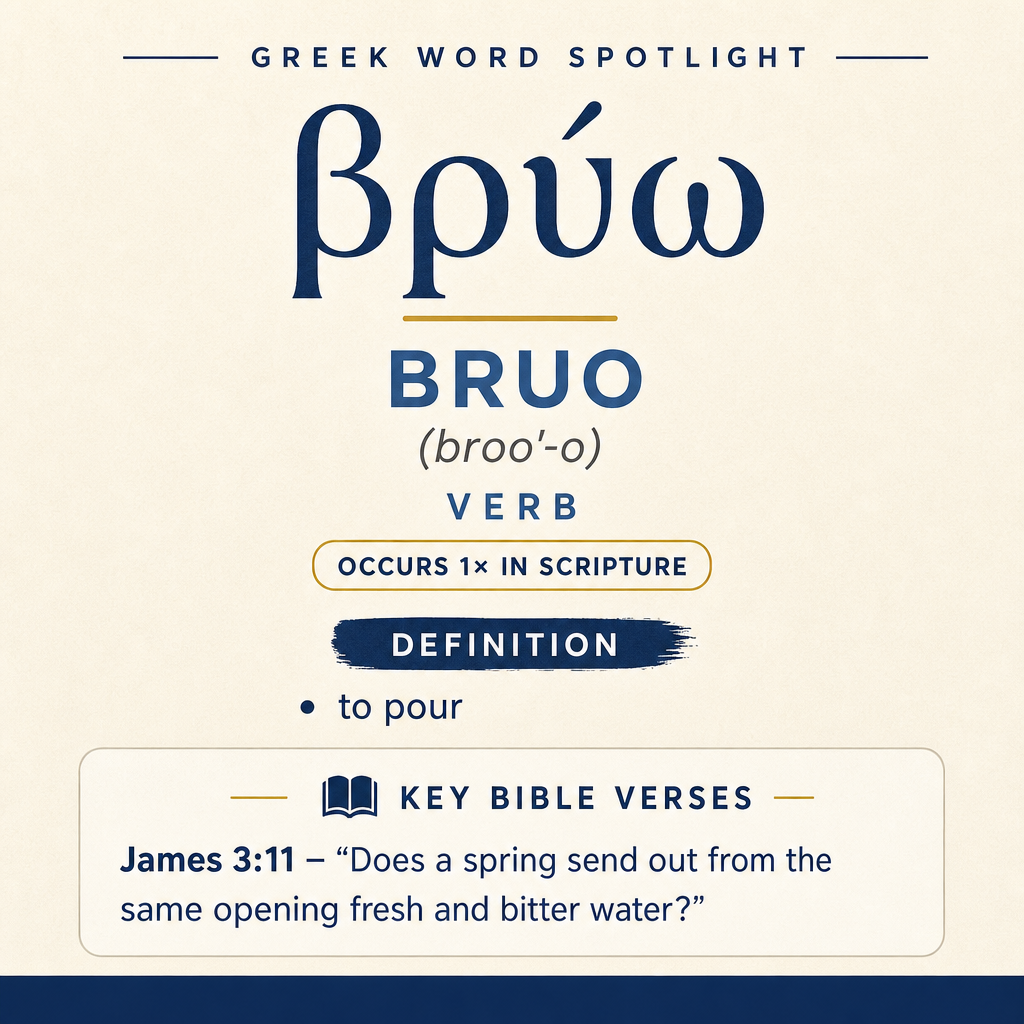
βρύω means “to pour” and appears once in Scripture in James 3:11.
Verse Context
In James 3:11 it is used in a question about a spring producing fresh and bitter water from the same opening.
Learn More →βρύω expresses the action “to pour” in a vivid image drawn from the behavior of a spring. It appears in James 3:11, where the question turns on what kind of water issues from a single opening.
Occurrences
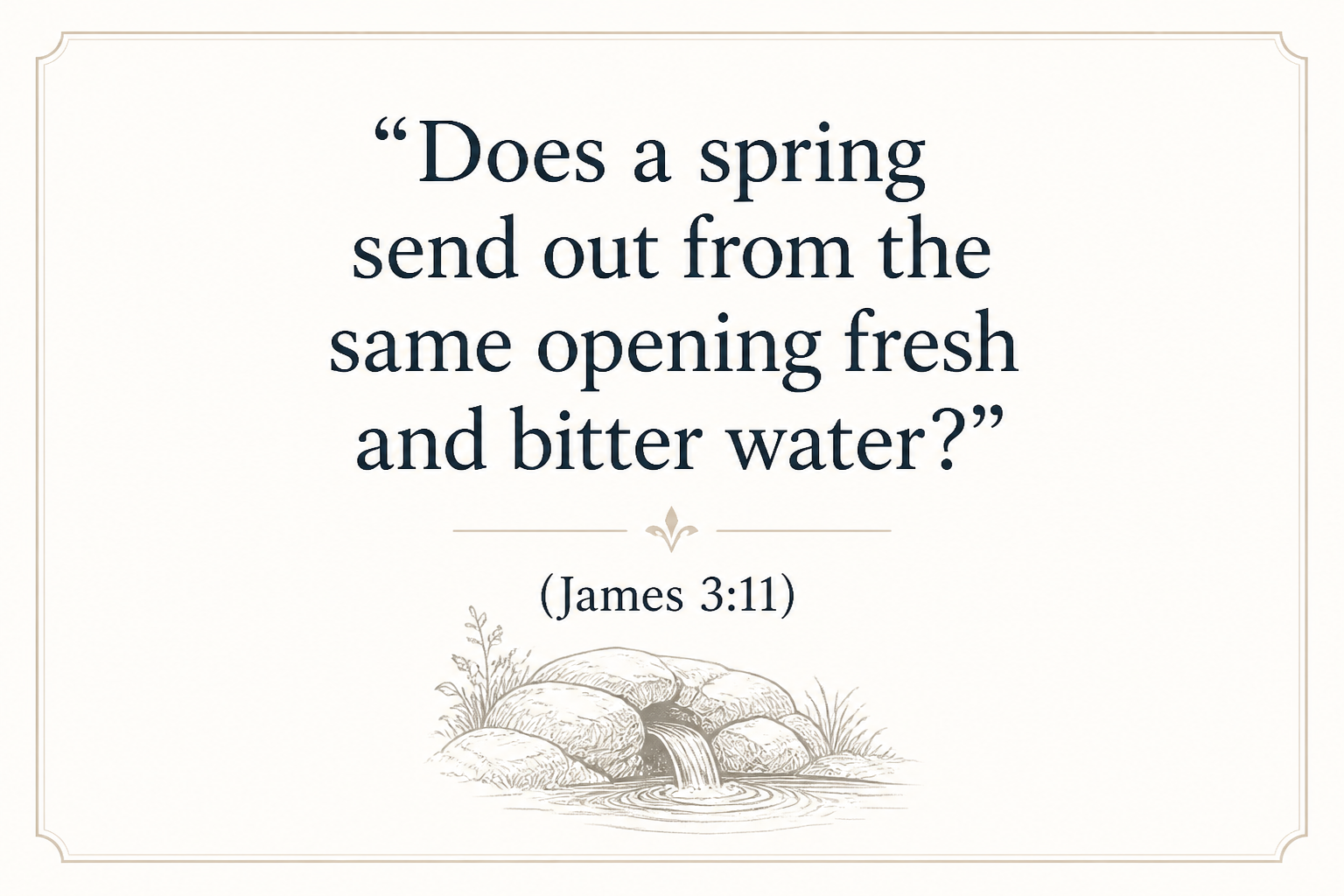
“Does a spring send out from the same opening fresh and bitter water?” (James 3:11)
In this rhetorical question, βρύω is applied to a spring’s output: what comes out of it and how it comes out. The imagery is concrete—water issuing from an “opening”—and the issue is whether one source can be responsible for two opposed results, “fresh and bitter.” The verb’s contribution is to cast speech-like output in the terms of a physical outpouring: a steady source producing what it contains and communicates through its outlet. James frames the scene as a matter of congruity between source and stream. A spring’s “same opening” is fixed, and what it “send[s] out” is expected to match the nature of the spring itself rather than oscillate between incompatible kinds of water. Within the question’s logic, “to pour” supplies the sense of continuous issuing rather than a one-time spill—an active flow that can be evaluated by its product. The contrast between “fresh” and “bitter” sharpens the point: the outflow is not merely water in general but water characterized by its taste and quality, and the verb anchors that quality in the act of coming forth from the source.

Sense and Usage
The definition “to pour” fits the passage’s spring imagery by focusing on the motion from within to without: something contained is released through a defined exit. In James 3:11 the action is not described as random or accidental; the spring is treated as a stable origin, and the pouring is the natural expression of that origin through “the same opening.” The question assumes that pouring is revealing: what is poured out discloses what the source is capable of producing. Because the imagery is of a spring rather than a container tipped over, the pouring is pictured as an ongoing issuing, a continuing outflow that can be compared across time and assessed as consistent or inconsistent with its source.
James’s paired adjectives (“fresh and bitter”) show that the verb can carry evaluative weight even when the action itself is simple. Pouring, in this setting, is not a neutral motion detached from content; it is the means by which content becomes public and testable. The “opening” functions as the point where the inside of the spring meets the world outside; the pouring is the boundary-crossing act that makes internal reality visible. That is why the question is framed around sameness: “from the same opening.” If the outlet is one, then the act of pouring becomes a way of arguing for coherence—what comes out should harmonize with the nature of the one source that produces it.
Within the verse’s imagery, the verb also implies directionality and source-dependence. The spring is the agent that “send[s] out,” and the water is what is poured. This aligns pouring with origination: the spring does not merely contain water; it drives an outward flow. James’s question presses the hearer to recognize the incongruity of opposite outputs from one origin. “To pour” thus serves the rhetorical force of the verse: it makes the argument tangible, because anyone can picture water issuing from a spring and can grasp that a single spring is expected to produce water of a consistent kind.
Imagery
The verse’s picture of a spring pouring out water is deliberately ordinary, but it carries sharp implications through contrast. “Fresh and bitter” are not abstract categories in the scene; they are qualities one would immediately perceive in what has been poured out. By anchoring the discussion in a spring that pours from “the same opening,” James uses the everyday certainty of how springs behave to frame a question about consistency: an outpouring is expected to match its source.
Sources: Lexical data from Strong’s Exhaustive Concordance and the Translators Brief Lexicon of Extended Strongs for Greek (STEPBible, CC BY). Occurrence data from the Translators Amalgamated Greek New Testament (STEPBible, CC BY). Scripture quotations from the World English Bible (public domain).




