Exploring the Meaning of Limne in Greek
λίμνη means “lake” in Greek and appears 11 times in Scripture, including in Luke and Revelation.
Core Meaning
λίμνη is defined as “lake.” It is used for bodies of water, including the lake of Gennesaret.
Learn More →Luke Occurrences
In Luke, λίμνη appears in scenes by and on the lake, including sailing and a wind storm. It also describes the pigs rushing into the lake.
Learn More →Revelation Usage
In Revelation, λίμνη occurs in the phrase “lake of fire.” It is used for the beast, the false prophet, the devil, Death, and Hades.
Learn More →λίμνη refers to a “lake” in passages that range from the shores of Gennesaret in Luke to the climactic judgment scenes of Revelation. In Luke it is a real body of water that can be stood beside, crossed, and overwhelmed by storm; in Revelation it becomes the setting for the “lake of fire,” a fixed destination into which beings and powers are thrown.
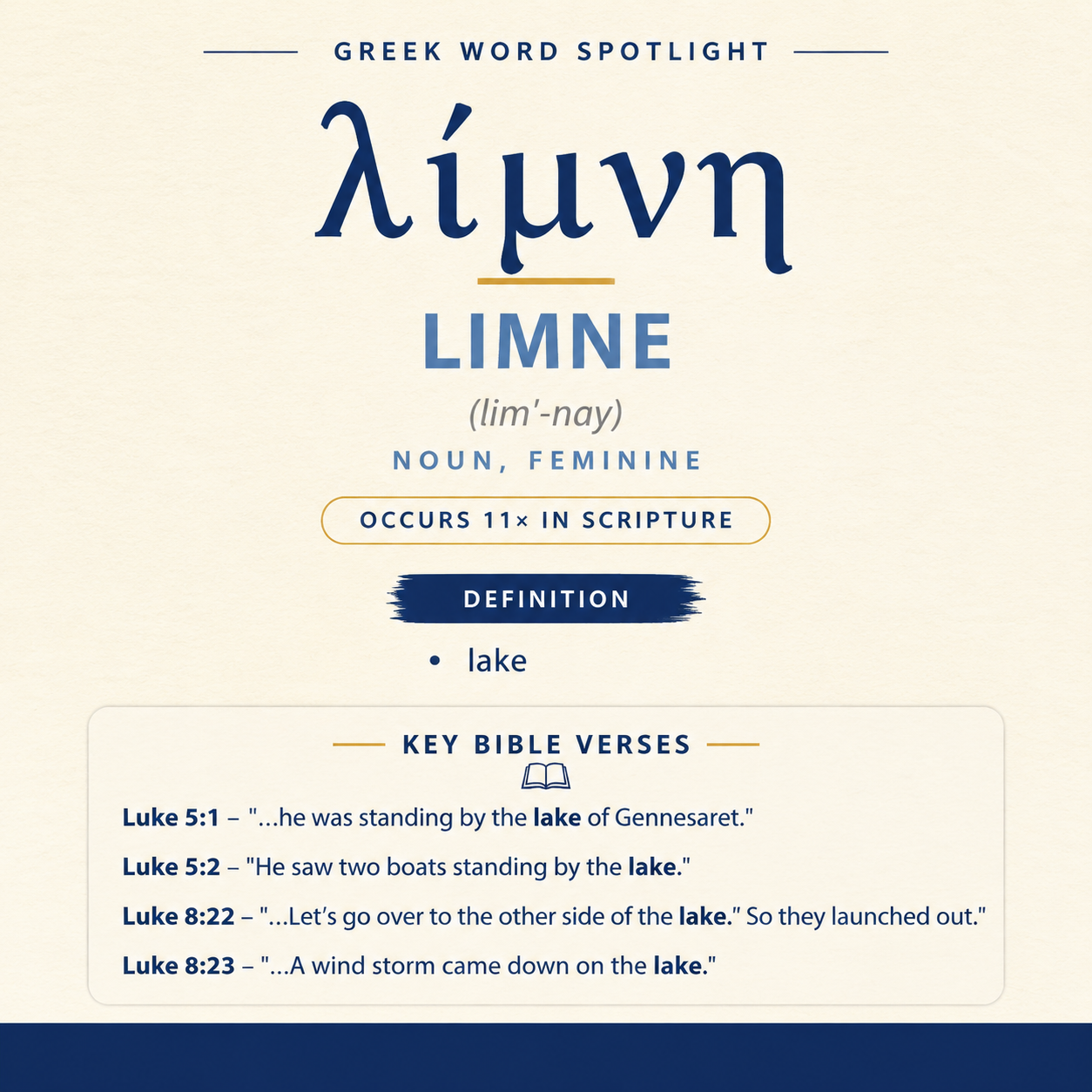
Occurrences
Luke 5:1: “Now while the multitude pressed on him and heard the word of God, he was standing by the lake of Gennesaret.”
Here λίμνη locates the scene at the edge of a particular lake. The crowd’s pressure and the hearing of “the word of God” are set against a public, open shoreline setting: Jesus is not indoors or in a secluded place, but “standing by” the lake, with the lake functioning as the immediate physical boundary of the gathering.
Luke 5:2: “He saw two boats standing by the lake, but the fishermen had gone out of them, and were washing their nets.”
In this continuation, λίμνη anchors a working waterfront: boats are “standing by the lake,” and fishermen are engaged in the ordinary labor of “washing their nets.” The lake is the reason boats and nets are present at all, and it frames the scene as one where livelihood and daily practice take place at the water’s edge.
Luke 8:22: “Now on one of those days, he entered into a boat, himself and his disciples, and he said to them, “Let’s go over to the other side of the lake.” So they launched out.”
Here λίμνη is something with “another side,” implying breadth that requires a deliberate crossing. The word gives the narrative a clear direction and destination—travel is not along the shore but across open water. The launching of the boat is a direct response to the lake’s spatial reality: it is a traversable expanse that separates two sides.
Luke 8:23: “But as they sailed, he fell asleep. A wind storm came down on the lake, and they were taking on dangerous amounts of water.”
In this scene λίμνη is the surface upon which a storm descends. The lake is not merely a setting but the medium through which danger arrives: the storm “came down on the lake,” and the result is that the boat takes on “dangerous amounts of water.” The lake is thus depicted as capable of sudden peril when winds transform it from a route of travel into a threatening environment.
Luke 8:33: “The demons came out of the man, and entered into the pigs, and the herd rushed down the steep bank into the lake, and were drowned.”
Here λίμνη marks the endpoint of a rapid, uncontrolled movement: the herd “rushed down the steep bank into the lake.” The lake is the place of drowning, so it functions as a lethal depth into which living creatures can plunge. The steep bank emphasizes the lake’s physical adjacency to land while highlighting the abrupt transition from solid ground to engulfing water.
Revelation 19:20: “The beast was taken, and with him the false prophet who worked the signs in his sight, with which he deceived those who had received the mark of the beast and those who worshiped his image. These two were thrown alive into the lake of fire that burns with sulfur.”
In Revelation, λίμνη appears with a defining phrase, “of fire,” portraying a lake characterized by burning. The lake is not approached or crossed; it is the receptacle into which opponents are “thrown alive.” The mention that it “burns with sulfur” sharpens the lake’s depiction as a punitive environment—still called a lake, but described through fiery properties rather than water.
Revelation 20:10: “The devil who deceived them was thrown into the lake of fire and sulfur, where the beast and the false prophet are also. They will be tormented day and night forever and ever.”
Here λίμνη again is the destination of being “thrown,” and it is linked with ongoing condition: it is the place “where the beast and the false prophet are also.” The lake is presented as a continuing locale rather than a momentary event, since it is associated with torment “day and night forever and ever.” In this usage, the lake gathers together those previously active in deception and opposition and holds them there.
Revelation 20:14: “Death and Hades were thrown into the lake of fire. This is the second death, the lake of fire.”
In this verse λίμνη is the place into which “Death and Hades” are thrown, expanding the range of what can be cast into it beyond individual figures. The lake is explicitly identified with “the second death,” and the repetition, “the lake of fire,” gives the term a fixed, formal weight within the passage. The lake functions as a definitive end-point: what is thrown there is no longer portrayed as operating in its former role.
Revelation 20:15: “If anyone was not found written in the book of life, he was cast into the lake of fire.”
Here λίμνη appears in a conditional judgment statement. The lake is the destination for a person who does not meet the criterion “found written in the book of life.” The lake’s role is judicial and final in tone: it is the place to which one is “cast,” emphasizing removal from the standing implied by being recorded in the “book of life.”
Revelation 21:8: “But for the cowardly, unbelieving, sinners, abominable, murderers, sexually immoral, sorcerers, idolaters, and all liars, their part is in the lake that burns with fire and sulfur, which is the second death.”
In this statement λίμνη is assigned as the allotted “part” for a catalog of people characterized by specified patterns of life. The lake is again described as burning “with fire and sulfur,” and again equated with “the second death.” Unlike scenes where someone is thrown in, this verse speaks of belonging or portion—“their part is in the lake”—so the lake is framed as the outcome assigned to these categories.
Sense and Usage
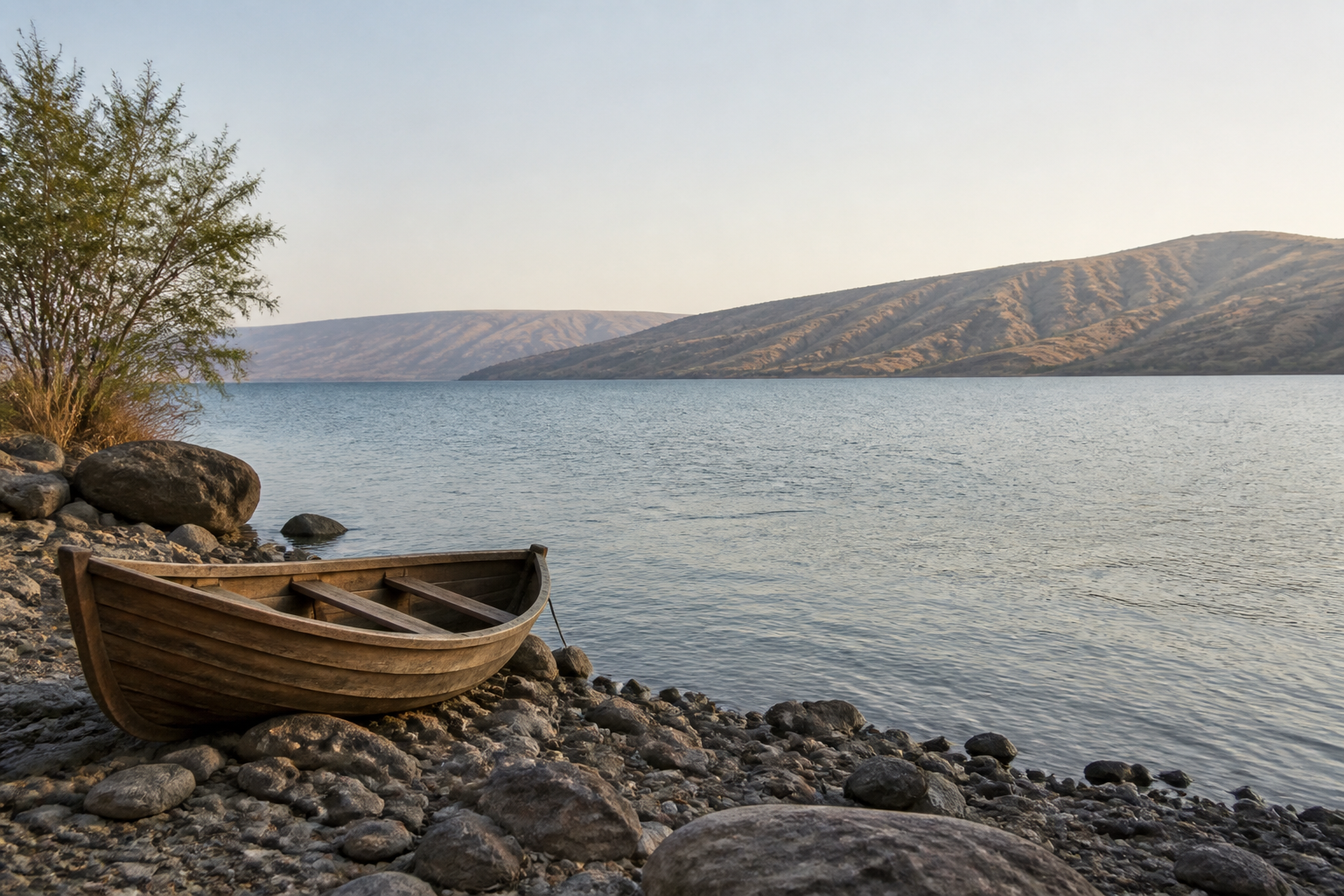
Across these passages, λίμνη consistently denotes a “lake,” but the way it functions in each book differs markedly. In Luke, the lake is a geographic feature that organizes movement, work, and risk. People can stand beside it (Luke 5:1), keep boats by it and work nets near it (Luke 5:2), and plan to cross it as a route to “the other side” (Luke 8:22). The same lake can become hazardous when weather “came down on the lake” and a vessel begins taking on water (Luke 8:23). It can also be deadly by drowning when a herd rushes from a “steep bank” into it (Luke 8:33). In these scenes, the lake is a normal part of the landscape, sometimes calm and useful, sometimes suddenly dangerous, always materially present.
In Revelation, λίμνη is used with a defining qualifier—“of fire”—and the lake becomes a set destination in judgment scenes. The lake is not portrayed as a place of travel or labor, but as a receptacle into which beings and realities are “thrown” or in which a “part” is assigned (Revelation 19:20; 20:10; 20:14; 20:15; 21:8). The repeated description “burns with sulfur” frames the lake as an environment with ongoing, consuming conditions rather than the watery properties associated with a typical lake. Yet the noun remains the same: the imagery continues to rely on the idea of a bounded basin or expanse that can receive what is cast into it, now transposed into a fiery setting and used to convey irreversible outcome (“the second death”).
These two clusters show how λίμνη can carry straightforward physical reference and also serve as a stable picture for a defined place in apocalyptic depiction. In Luke, the lake is encountered from the outside—by its shore, on its surface, and at its boundary with land. In Revelation, the lake is chiefly encountered as a destination; the verbs and descriptions emphasize entry by being thrown or cast, and the lake’s defining characteristic is its burning nature, giving the term a severe, final tone within those scenes.
Imagery
Luke’s lake imagery is tactile and immediate: shoreline crowds, boats at rest, launching out, a storm-driven surface, and a steep bank ending in drowning water. Revelation’s lake imagery is stark and judicial: a “lake of fire” that “burns with sulfur,” receiving the beast and false prophet, the devil, “Death and Hades,” and those whose “part is in the lake,” and being named “the second death.” In both, λίμνη gathers the scene around a single, concentrated place—either a real expanse of water shaping daily life and danger, or a fixed basin of fiery judgment that functions as the narrative’s terminus.
Sources: Lexical data from Strong’s Exhaustive Concordance and the Translators Brief Lexicon of Extended Strongs for Greek (STEPBible, CC BY). Occurrence data from the Translators Amalgamated Greek New Testament (STEPBible, CC BY). Scripture quotations from the World English Bible (public domain).