Understanding the Meaning of Brabeion in Greek
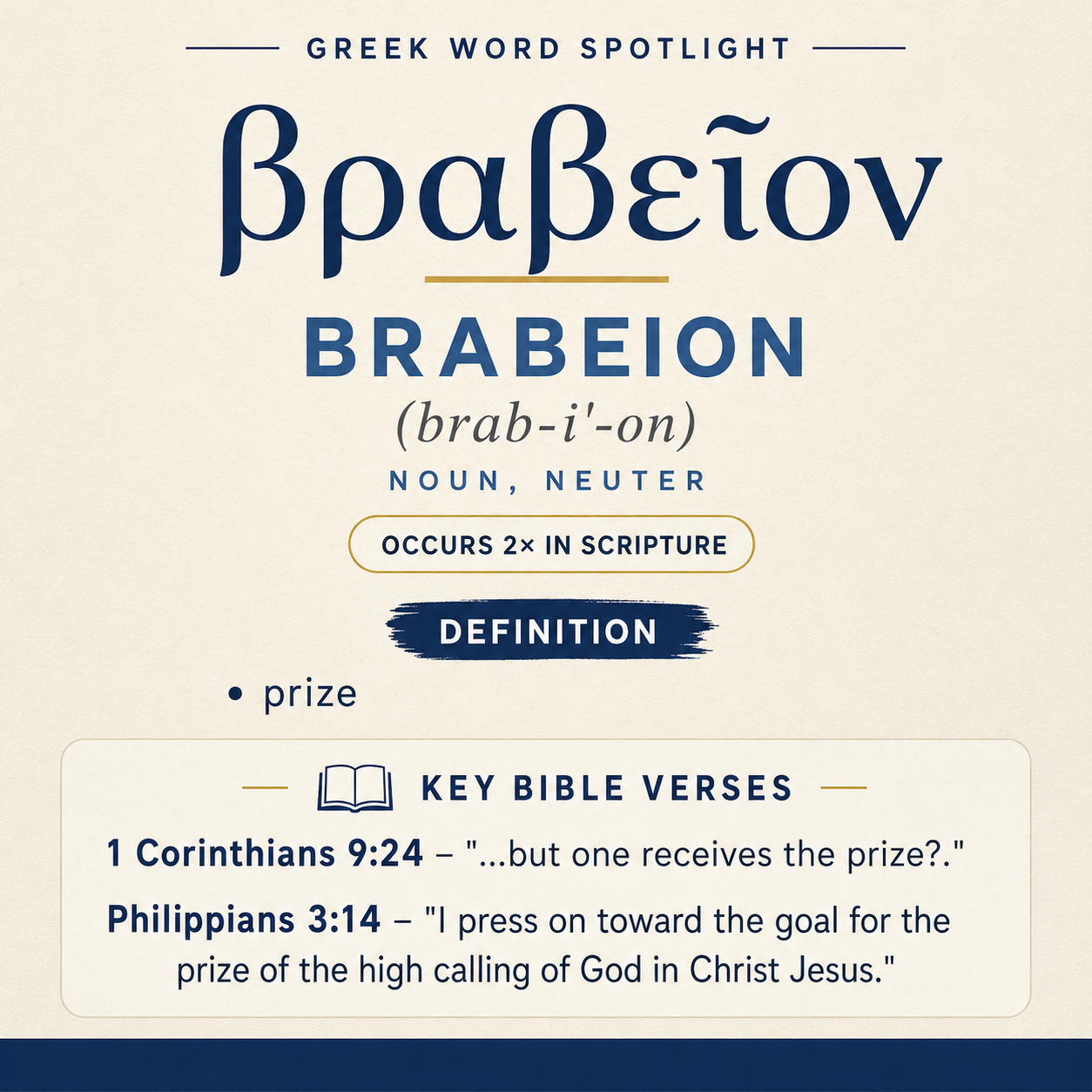
βραβεῖον (Brabeion) means “prize” and appears in 1 Corinthians 9:24 and Philippians 3:14.
Scripture Occurrences
It occurs 2 times in Scripture: 1 Corinthians 9:24 and Philippians 3:14.
Learn More →Verse Contexts
In 1 Corinthians 9:24, it is the prize a runner seeks to win. In Philippians 3:14, it is the prize linked to God’s high calling in Christ Jesus.
Learn More →βραβεῖον refers to a “prize,” and it appears in two New Testament passages that frame Christian effort with the imagery of pursuit and reward: 1 Corinthians 9:24 and Philippians 3:14. In both, the word marks the object sought—what lies at the end of sustained exertion.
Occurrences
“Don’t you know that those who run in a race all run, but one receives the prize? Run like that, that you may win.” (1 Corinthians 9:24)
Here βραβεῖον stands at the focal point of an athletic comparison: a race in which “all run,” yet “one receives the prize.” The verse uses the prize as a way to clarify the kind of running envisioned—purposeful, directed, and shaped by the reality that only one takes the award in the race as described. The second sentence, “Run like that, that you may win,” leans on the presence of βραβεῖον to supply the race with stakes: the act of running is not pictured as casual motion or mere participation but as an effort oriented to receiving what is awarded at the end.
Within the logic of the verse, βραβεῖον functions as the decisive outcome that distinguishes the runners. Because the verse sets a contrast between the many who run and the single recipient, the word carries the force of exclusivity and finality in this scene: it is the concrete thing that can be “received.” That receiving is not described as gradual; it is depicted as a single result that answers the whole course of running. The exhortation “Run like that” depends on βραβεῖον to define “like that”—with the same kind of intention and competitive seriousness implied by a race whose endpoint includes a prize awarded to a winner.
“I press on toward the goal for the prize of the high calling of God in Christ Jesus.” (Philippians 3:14)
In Philippians, βραβεῖον appears in a sentence of forward motion and sustained effort: “I press on toward the goal for the prize…” The word again designates what is sought, but the imagery is broadened from a race with multiple runners to a personal pursuit that is explicitly directional: pressing “toward the goal.” The phrase “for the prize” presents βραβεῖον as the motivating objective that stands beyond the goal line, shaping the pressing on. The verse’s structure places the “goal” and the “prize” in close relation, so that the goal is not an end in itself; it is the line of aim along which the prize is pursued.
This occurrence also specifies the prize in a distinctive way: it is “the prize of the high calling of God in Christ Jesus.” βραβεῖον remains “prize,” but it is tied by a genitive relationship to “the high calling of God in Christ Jesus,” identifying the prize as belonging to that calling and characterizing it as connected with God’s call as framed “in Christ Jesus.” The result is that βραβεῖον retains the concrete clarity of an awarded prize while being placed within explicitly theological language. The athletic imagery (“press on,” “goal”) is not discarded; rather, βραβεῖον anchors it by naming the pursued outcome, while the accompanying phrase situates that outcome within the calling that comes from God.
Sense and Usage
Across these two passages, βραβεῖον consistently names a prize as the object received or sought after a course of effort. In 1 Corinthians 9:24, the prize is something “one receives,” and the verse uses that fact to sharpen an exhortation about how to run. The prize defines the race as a contest with a determinate end, and it supplies the logic for running in a way that aims at winning. The word therefore functions not simply as a reward in the abstract, but as the end-point outcome that gives shape to the whole activity leading up to it.
In Philippians 3:14, βραβεῖον likewise marks the end-point of pursuit, but the pursuit is described with the language of determination: “I press on toward the goal for the prize.” Here the prize is not described as something already in hand; it stands ahead, drawing the runner forward. The presence of “goal” alongside “prize” allows the verse to present exertion as both directional (toward a defined aim) and purposeful (for the sake of the prize). βραβεῖον, then, is the named reason for sustained forward motion: it is what the pressing on is “for.”
These uses together show βραβεῖον operating within athletic imagery where exertion, direction, and outcome are tightly linked. The word is concrete enough to be “received” (1 Corinthians 9:24) and definite enough to be pursued as the reason for pressing forward (Philippians 3:14). Yet it can also bear theological specification without changing its core reference: in Philippians, the prize is explicitly connected to “the high calling of God in Christ Jesus.” The prize remains a prize, but the verse frames its character and context through that calling, so that βραβεῖον serves as the reward-term that carries the athletic metaphor into explicitly Christian vocabulary.
Because βραβεῖον appears in exhortational and testimonial settings—“Run like that, that you may win” and “I press on”—it consistently functions as a term that clarifies what kind of action is being urged or modeled. The prize is not introduced for curiosity; it is the controlling endpoint that organizes the verbs: running in a certain way, pressing on toward a goal. In both, βραβεῖον is the named outcome that makes the present effort intelligible as purposeful striving rather than aimless activity.
Imagery and Emphasis
The imagery carried by βραβεῖον in these verses is the imagery of a finish and an award—something that stands beyond the exertion and answers it. In 1 Corinthians 9:24, the scene is a race where many run but the prize goes to one, giving the word a sharp edge that intensifies the call to run to win. In Philippians 3:14, the scene is a determined press toward a goal, with the prize set ahead as the reason to keep moving. Together, the passages use βραβεῖον to depict Christian life and effort in terms of forward motion toward an outcome that is not incidental but defining.
Sources: Lexical data from Strong’s Exhaustive Concordance and the Translators Brief Lexicon of Extended Strongs for Greek (STEPBible, CC BY). Occurrence data from the Translators Amalgamated Greek New Testament (STEPBible, CC BY). Scripture quotations from the World English Bible (public domain).