
Exploring the Meaning of Bia in Greek
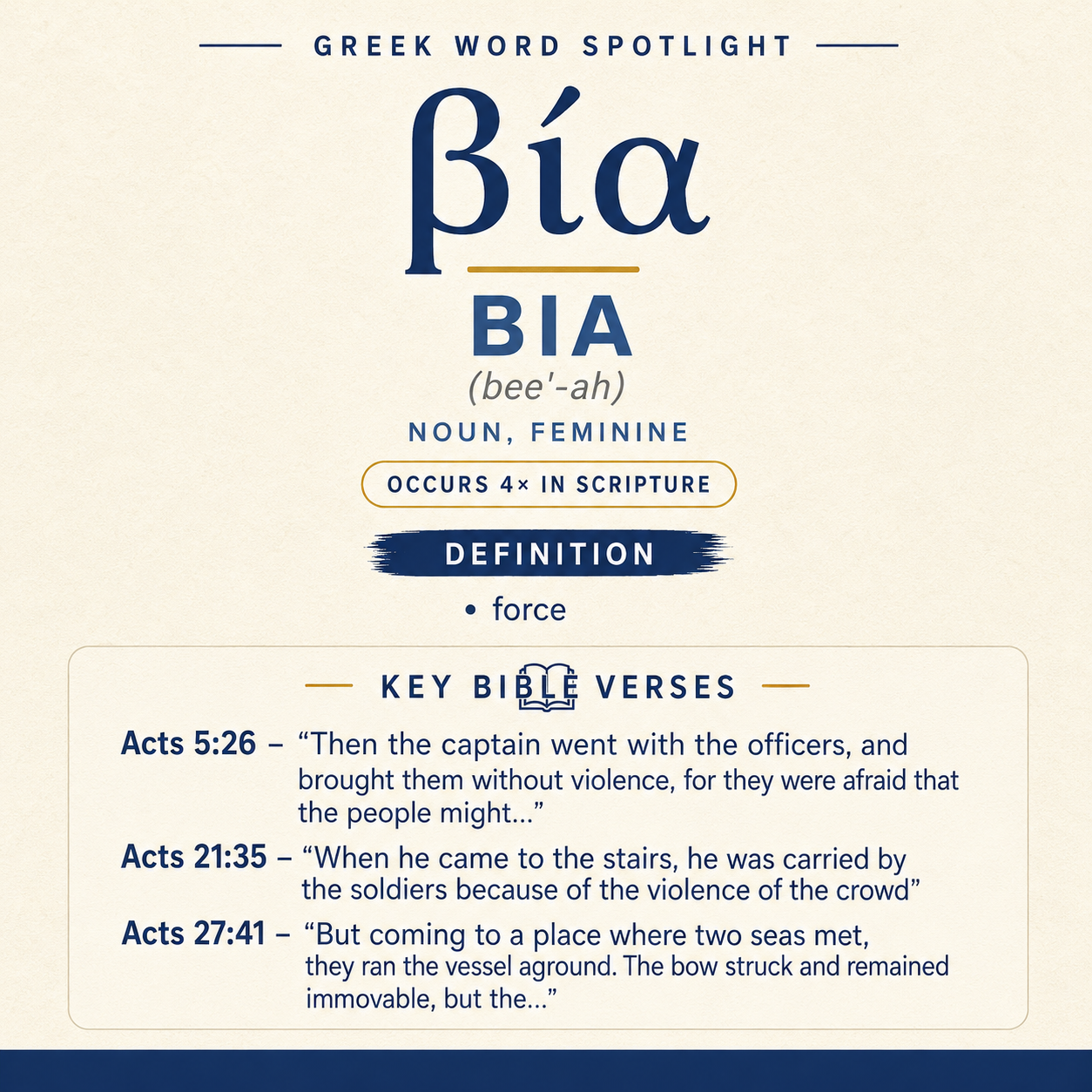
βία (Bia) means “force” and appears four times in Scripture, including Acts 5:26, Acts 21:35, and Acts 27:41.
Core Meaning
βία means “force.” It is used in contexts where violence or forceful pressure is in view.
Learn More →Acts References
In Acts 5:26, the officers bring them “without violence.” In Acts 21:35, soldiers carry him because of the crowd’s violence.
Learn More →Other Occurrence
Acts 27:41 uses βία in the account of a ship running aground. Scripture records a total of four occurrences.
Learn More →βία refers to “force,” and in Acts it appears in scenes where action is pressed forward by physical compulsion or overpowering pressure. The word is used both for human force in tense public moments and for the sheer force exerted by the sea.
Root and Related Words
βία is connected with βίος (bios), “life” (Strong’s G979).

Occurrences
“Then the captain went with the officers, and brought them without violence, for they were afraid that the people might stone them.” (Acts 5:26)
Here βία is framed by a deliberate restraint: the captain and officers “brought them without violence.” The word marks the kind of coercive force that could have been used in making arrests, but is consciously avoided. The reason given is the volatility of the crowd—“they were afraid that the people might stone them”—so the absence of force is not softness or hesitation, but a tactical choice shaped by the danger of provoking a worse eruption of force from the people. In this scene, βία sits at the intersection of official authority and public threat: the officers have the capacity to compel, yet the crowd’s potential to escalate the situation governs how that capacity is exercised. The word therefore helps the reader feel the tension of the moment: restraint is not calm, but controlled action under pressure.
“When he came to the stairs, he was carried by the soldiers because of the violence of the crowd;” (Acts 21:35)
In Acts 21:35 βία is attached directly to the crowd: it is “the violence of the crowd” that drives the soldiers’ response. The verb “was carried” depicts a removal that becomes necessary not merely because the crowd is loud or persistent, but because its force is dangerous and pressing. βία here describes more than opposition; it is an aggressive pressure that prevents normal movement and requires extraordinary handling. The word makes the crowd’s hostility tangible—strong enough that a person cannot simply walk, but must be borne along by soldiers to get him out of reach. The stairs become a narrow space where force concentrates: the crowd’s push turns an ordinary ascent into an extraction under threat. βία supplies the causal explanation for the soldiers’ actions and communicates that the situation has crossed a threshold into physical peril.
“But coming to a place where two seas met, they ran the vessel aground. The bow struck and remained immovable, but the stern began to break up by the violence of the waves.” (Acts 27:41)
Acts 27:41 moves βία from human conflict to the natural world. The ship is trapped: “The bow struck and remained immovable,” pinned fast, while the “stern began to break up by the violence of the waves.” The word attributes the ship’s destruction not to gradual wear but to the waves’ forceful pounding. The narrative details intensify what βία conveys. Because the bow is stuck, the ship cannot yield or adjust; it is held in place while the waves batter the rear, so the sea’s force has repeated impact on a vulnerable part of the vessel. βία thus paints the waves as an overpowering agent that acts upon the ship with damaging pressure, strong enough to tear it apart. The phrase “by the violence of the waves” makes the sea an adversary whose force is inexorable and mechanical, an impersonal power that breaks what cannot move.
Sense and Usage
Across these passages, βία consistently portrays force as something that pushes bodies and events beyond ordinary control. In Acts 5:26 it is the kind of force authorities might apply in seizing and transporting someone; the verse highlights its absence (“without violence”) to show purposeful restraint under threat. In Acts 21:35 the same kind of force is located in the crowd, not in the officials, and it functions as the reason normal procedures fail: the soldiers must carry the person because the crowd’s force makes walking unsafe. In Acts 27:41 βία shifts from social conflict to physical environment, describing the sea’s force acting on a ship with destructive results.
These contexts show that βία can be associated with different agents—officers who could use it, crowds who unleash it, waves that embody it—while keeping a stable core idea: force that compels, presses, or breaks. The word’s contribution is often explanatory: it clarifies why an action is taken (bringing someone “without violence” to avoid being stoned; carrying someone because of crowd violence; a ship breaking up because of wave violence). In each case, βία supplies the missing physical reality behind decisions and outcomes. It turns a narrative from merely reporting movement (bringing, carrying, breaking) into showing the pressures that make that movement hazardous or destructive.
βία also highlights contrasts. Acts 5:26 gains its edge from negation: force is present as a possibility and deliberately withheld. Acts 21:35 presents force as uncontrolled human aggression that overrides normal mobility. Acts 27:41 presents force as relentless natural impact that overwhelms human planning. Together, the uses trace a spectrum of force: restrained force, threatening force, and crushing force. Yet even as the agents change, βία keeps attention on physical compulsion—force as something felt, feared, and endured.
Imagery
The scenes attached to βία in Acts carry vivid, concrete imagery. In one, officers move through a charged crowd, choosing to bring people “without violence” because stones could fly (Acts 5:26). In another, a person is lifted and borne up stairs because the crowd’s force has made the ground unsafe (Acts 21:35). In the last, a ship’s immovable bow and a collapsing stern display the sea’s force as repeated blows that splinter wood (Acts 27:41). βία ties these images together by portraying force as pressure that can be withheld, erupted, or endured—always with real weight upon bodies, crowds, and vessels.
Sources: Lexical data from Strong’s Exhaustive Concordance and the Translators Brief Lexicon of Extended Strongs for Greek (STEPBible, CC BY). Occurrence data from the Translators Amalgamated Greek New Testament (STEPBible, CC BY). Scripture quotations from the World English Bible (public domain).




