
Exploring the Meaning of Bebaios in Greek
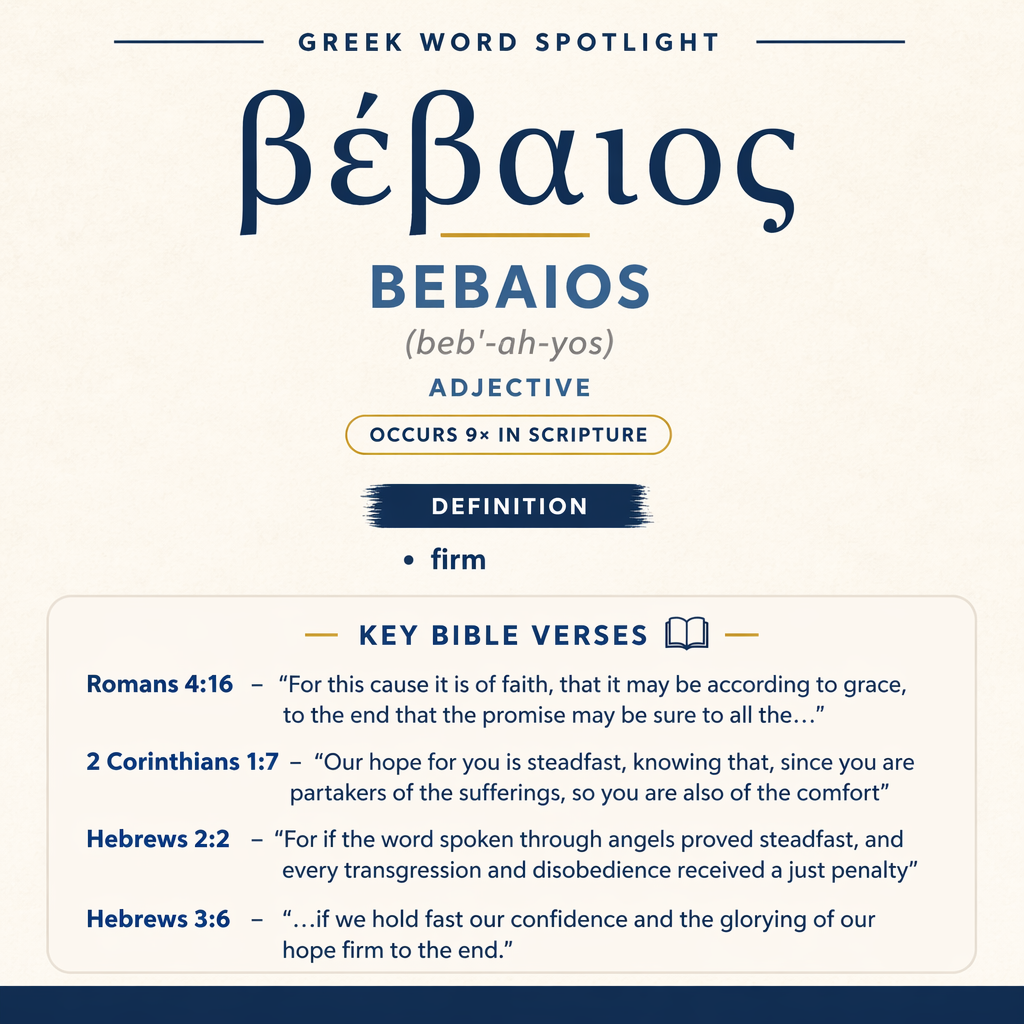
βέβαιος means “firm” and appears 9 times in Scripture, including Romans 4:16, 2 Corinthians 1:7, Hebrews, and 2 Peter 1:10.
Core Meaning
βέβαιος is defined as “firm.” In context it describes what is sure, steadfast, or in force.
Learn More →Where It Appears
It occurs in Romans 4:16; 2 Corinthians 1:7; Hebrews 2:2; 3:6; 3:14; 6:19; 9:17; and 2 Peter 1:10.
Learn More →Usage Snapshots
It modifies hope, confidence, and the promise as sure or steadfast (2 Corinthians 1:7; Hebrews 6:19; Romans 4:16). It also describes the word as steadfast and a will as in force (Hebrews 2:2; 9:17).
Learn More →βέβαιος describes what is firm—what can be relied on as stable, in force, or securely held. In the New Testament it appears in contexts of promise, hope, divine speech, covenantal validity, and the believer’s settled confidence.
Occurrences
“For this cause it is of faith, that it may be according to grace, to the end that the promise may be sure to all the offspring, not to that only which is of the law, but to that also which is of the faith of Abraham, who is the father of us all.” (Romans 4:16)
Here βέβαιος qualifies “the promise” as something firm in its reach and stability. The verse ties that firmness to the way the promise operates: “of faith… according to grace,” with the stated goal “that the promise may be sure to all the offspring.” The word underscores that what is promised does not wobble or narrow depending on whether one is “of the law” or “of the faith of Abraham.” Within this sentence, firmness is the property that allows the promise to extend securely to “all the offspring.”
“Our hope for you is steadfast, knowing that, since you are partakers of the sufferings, so you are also of the comfort.” (2 Corinthians 1:7)
βέβαιος marks “hope” as firm in the midst of shared experience. The sentence grounds the firmness of hope in an observed pattern: participation in “the sufferings” is paired with participation “of the comfort.” The adjective therefore functions to present hope as something settled and stable, not a fragile wish, because it rests on the known connection between suffering and comfort described in the verse.
“For if the word spoken through angels proved steadfast, and every transgression and disobedience received a just penalty,” (Hebrews 2:2)
The term is used of “the word spoken through angels,” characterizing it as firm in its effectiveness and outcome. The verse immediately illustrates that firmness by its consequences: “every transgression and disobedience received a just penalty.” In this setting βέβαιος highlights the dependable solidity of that spoken word—what it declares stands, and its sanctions follow through reliably.
“but Christ is faithful as a Son over his house. We are his house, if we hold fast our confidence and the glorying of our hope firm to the end.” (Hebrews 3:6)
Firmness here is the required character of the community’s “confidence” and “the glorying of our hope,” held “to the end.” The verse places this firmness alongside Christ’s own faithfulness as Son “over his house,” then describes the readers as that house on the condition that they “hold fast.” βέβαιος thus emphasizes a stability that persists over time: confidence and hope are to be held in a firm way, not loosening before the goal is reached.
“For we have become partakers of Christ, if we hold the beginning of our confidence firm to the end,” (Hebrews 3:14)
This occurrence parallels the previous one, but focuses on “the beginning of our confidence.” βέβαιος frames that initial confidence as something to be maintained in firm condition “to the end.” The word contributes the idea of staying fixed and stable: what began as confidence is not to erode, shift, or be surrendered along the way, because continuing participation (“we have become partakers of Christ”) is tied to holding it firmly.
“This hope we have as an anchor of the soul, a hope both sure and steadfast and entering into that which is within the veil;” (Hebrews 6:19)
Here firmness is expressed through a dense cluster of images and descriptions. Hope is called “an anchor of the soul,” and then described as “both sure and steadfast.” βέβαιος strengthens the anchor imagery: hope is presented as something that holds fast rather than slipping. The verse also says this hope is “entering into that which is within the veil,” so the firmness is not merely internal resolve; it is a stable hope with an orientation beyond what is immediately visible, portrayed as reaching into a secured realm.
“For a will is in force where there has been death, for it is never in force while he who made it lives.” (Hebrews 9:17)
βέβαιος is applied to a “will” with the sense of being firm in the specific way a will becomes established: “in force where there has been death.” The repetition “in force… never in force” sets up a clear contrast of conditions, and βέβαιος supports the legal-like point that a will’s firmness is tied to a decisive event. In this verse, what is “firm” is what is valid and established as operative.
“Therefore, brothers, be more diligent to make your calling and election sure. For if you do these things, you will never stumble.” (2 Peter 1:10)
The adjective describes “calling and election” as something to be made firm. The command “be more diligent” connects firmness with purposeful effort, and the resulting effect is practical steadiness: “you will never stumble.” In this setting βέβαιος carries the idea of securing what is already named—calling and election—so that one’s path is stable rather than marked by falling.
“We have the more sure word of prophecy; and you do well that you heed it, as to a lamp shining in a dark place, until the day dawns, and the morning star arises in your hearts:” (2 Peter 1:19)
βέβαιος qualifies “the word of prophecy” as firm, and the verse then depicts how a firm word functions: it is something to “heed,” compared to “a lamp shining in a dark place.” The time horizon “until the day dawns” extends the picture of reliance across a period of darkness. The word’s firmness supports sustained attention: because it is stable, it can guide like a lamp over time, not flickering into unreliability before dawn.

Sense and Usage
Across these passages βέβαιος consistently marks something as stable and dependable under pressure, over time, or with respect to validity. In Romans 4:16 the firmness belongs to a “promise” designed to reach broadly—its stability supports its inclusive scope (“sure to all the offspring”). In 2 Corinthians 1:7 the firmness of hope is tethered to an experienced correspondence between suffering and comfort, so steadiness is not portrayed as naive confidence but as settled expectation rooted in what is “knowing.”
Hebrews uses the adjective to connect firmness with endurance (“to the end”), with enforceability (“proved steadfast… received a just penalty”), and with established status (“a will is in force”). These uses show that firmness can describe both the unshakable character of a message and the lasting grip of a person’s confidence. The same quality can apply to what comes from outside the hearer (“the word spoken through angels”) and to what the hearer is responsible to hold (“our confidence… firm to the end”).
In 2 Peter, firmness relates to practical stability in life (“you will never stumble”) and to guiding reliability in darkness (“a lamp shining in a dark place”). The adjective’s force is not merely abstract; it is directional and stabilizing. When applied to calling and election, firmness is something to be “made,” suggesting a secured condition that prevents stumbling. When applied to prophetic word, firmness is the basis for heeding it as steady illumination until a promised change of situation (“until the day dawns”).
Imagery in Context
Several occurrences attach βέβαιος to vivid stabilizing images and concrete tests. Hebrews 6:19 presents firmness through the picture of an “anchor of the soul,” emphasizing holding power in a setting where drifting would otherwise be expected. 2 Peter 1:19 pairs firmness with a “lamp shining in a dark place,” emphasizing guidance that can be trusted through obscurity and waiting. Taken together with the legal phrasing of Hebrews 9:17 (“in force”) and the moral steadiness of 2 Peter 1:10 (“never stumble”), βέβαιος repeatedly signals what stands firm when conditions might tempt movement—whether the condition is darkness, delay, suffering, judgment, or the long course “to the end.”
Sources: Lexical data from Strong’s Exhaustive Concordance and the Translators Brief Lexicon of Extended Strongs for Greek (STEPBible, CC BY). Occurrence data from the Translators Amalgamated Greek New Testament (STEPBible, CC BY). Scripture quotations from the World English Bible (public domain).




