
Exploring the Meaning of Basis in Greek
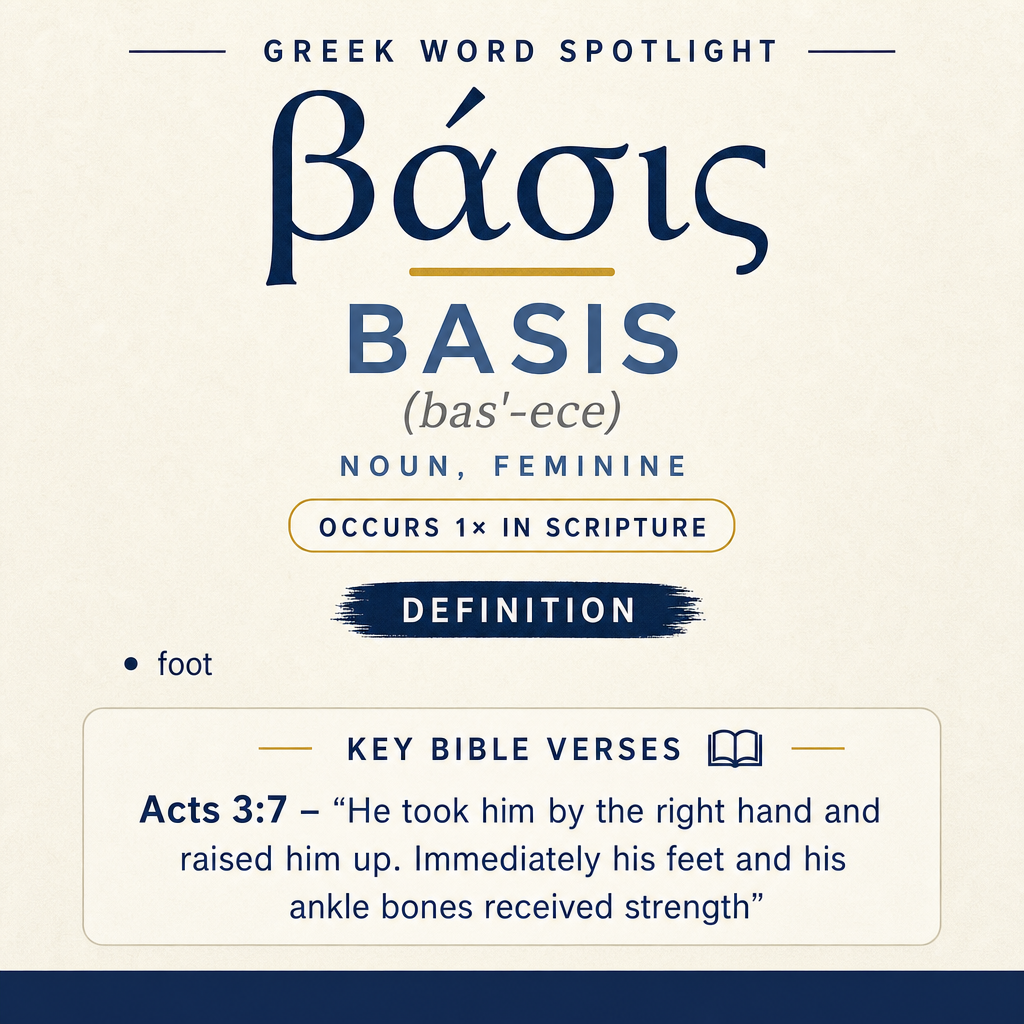
βάσις means “foot” and appears once in Scripture, in Acts 3:7.
Verse Context
In Acts 3:7, the man is raised up, and immediately his feet and ankle bones receive strength.
Learn More →βάσις denotes a “foot” and is attested in the account of the healing of a man who is lifted up by the hand. In its single New Testament appearance, the word belongs to a brief, concrete description of physical strengthening.
Occurrences
“He took him by the right hand and raised him up. Immediately his feet and his ankle bones received strength.” (Acts 3:7)
In Acts 3:7 the narrative turns on a sudden change in the man’s ability to stand: he is “raised… up,” and at once “his feet and his ankle bones received strength.” βάσις contributes to the paired description of the lower body by naming the foot in the same breath as the “ankle bones.” The emphasis is on immediacy (“Immediately”) and on bodily capacity rather than mere sensation: the parts that bear weight and enable standing are depicted as receiving “strength,” fitting the action that has just been performed—someone taking him “by the right hand” and lifting him. Within the verse, the foot is not an isolated anatomical detail; it is one element in a coordinated picture of support and movement, framed by the upward motion of being raised and the result of strengthened joints.

Sense and Usage
The sense “foot” is expressed in Acts 3:7 in a straightforward, physical way. The verse places the foot alongside the “ankle bones,” giving the term a practical orientation: it is the part of the body that, together with the joint above it, must be strengthened for a person to rise and remain upright. Because the strengthening is narrated as something received (“received strength”), the foot is portrayed as a functional member that can lack strength and then suddenly possess it. The immediate context supplies the implied purpose of that strength: the preceding act of being raised up by another person’s hand calls for stability at the lowest point of the body, where contact with the ground and the bearing of weight occur.
By pairing “feet” with “ankle bones,” the verse invites the reader to see the foot not merely as an extremity but as part of the body’s supportive structure. The foot is pictured as involved in standing and movement without the narration needing to spell those actions out; the simple report that these parts “received strength” after he was lifted establishes that these are the relevant parts for a successful rising. The term therefore participates in the verse’s concrete realism: the healing is not described in abstract terms but in the language of bodily members that can be grasped, lifted, strengthened, and used.
Imagery
The imagery attached to βάσις in Acts 3:7 is tactile and grounded. A hand takes hold, a body is raised, and the feet—together with the ankles—are depicted as gaining strength at once. The scene is anchored at the point where a human body meets the ground and either can or cannot support itself; the word “foot” helps the verse paint that moment of restored bodily firmness in the simplest terms.
Sources: Lexical data from Strong’s Exhaustive Concordance and the Translators Brief Lexicon of Extended Strongs for Greek (STEPBible, CC BY). Occurrence data from the Translators Amalgamated Greek New Testament (STEPBible, CC BY). Scripture quotations from the World English Bible (public domain).




