Exploring the Meaning of Barutimos in Greek
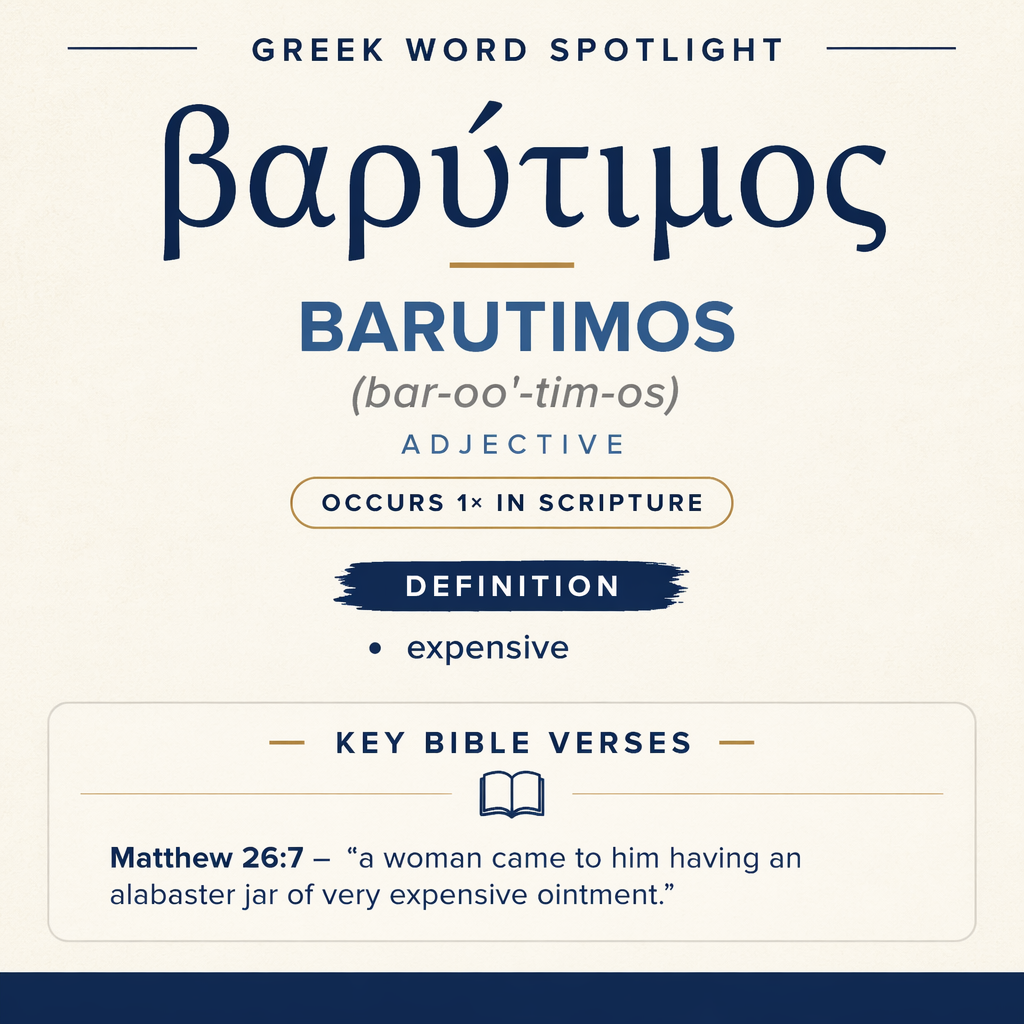
βαρύτιμος means “expensive” and appears once in Scripture, in Matthew 26:7.
Matthew Context
In Matthew 26:7, it describes very expensive ointment poured on Jesus’ head from an alabaster jar.
Learn More →βαρύτιμος describes something “expensive,” highlighting its high cost in a concrete moment of lavish giving. It appears in the scene where a woman brings an alabaster jar of ointment and pours it out at a meal in Matthew 26:7.
Root and Related Words
βαρύτιμος is connected with two Greek words: τιμή (time), “honor” (Strong’s G5092), and βαρύς (barys), “weighty” (Strong’s G926). Together these related terms frame the adjective’s sense of costly value as something that carries “weight” and is bound up with what is regarded as honorable.

Occurrences
“a woman came to him having an alabaster jar of very expensive ointment, and she poured it on his head as he sat at the table.” (Matthew 26:7)
Here βαρύτιμος intensifies the description of the ointment by marking it as costly, not ordinary. The narrative detail does more than inventory what she carried; it shapes how the act of pouring is understood. A jar of ointment could be a small courtesy at a meal, but “very expensive” identifies the substance as valuable and therefore the action as materially significant: the woman is not merely applying fragrance; she is dispensing something of high cost in a single, irreversible gesture.
The adjective works alongside the physical concreteness of “an alabaster jar,” a container associated in the sentence with holding a precious liquid. Within the verse’s movement—she comes, she has the jar, she pours—βαρύτιμος belongs to the “having” clause, so that what she possesses is characterized before it is used. That placement makes the costliness a deliberate feature of what she brings to the table; the reader is invited to register the value of the ointment prior to seeing it emptied.
Because the ointment is described as “very expensive,” the pouring “on his head” is framed as lavish in proportion to the value of the contents. The phrase does not merely say the ointment was pleasant or fragrant; it calls attention to its costliness at the very moment it is given away. In the scene, then, βαρύτιμος functions as an evaluative description that heightens the perceived magnitude of the offering and the generosity implied by pouring it out during the meal.
Sense and Usage
In its single New Testament attestation here, βαρύτιμος is used for a tangible commodity—ointment—whose value can be conceived in terms of expense. The adjective’s force lies in how it lets “cost” become part of the story’s meaning: what happens at the table is not only an anointing but an expenditure. By qualifying the ointment rather than the woman or the act, βαρύτιμος focuses the reader’s attention on the objective worth of what is poured out, anchoring the interpretation in the material reality of what is being given.
The immediate context also shows how “expensive” functions in narrative description. The verse presents a straightforward sequence of actions, but βαρύτιμος introduces a scale: this is not just ointment, but ointment at the high end of cost. That scale matters because the action described—pouring—implies consumption and loss of what is contained. When a cheap substance is poured, little is at stake; when a “very expensive” substance is poured, the same physical motion carries greater economic weight. In this way, the adjective supplies an evaluative dimension without changing the concrete referent: it remains ointment in a jar, but the adjective alters how that ointment is perceived within the scene.
The related words help frame the nuance that expense carries in this verse. τιμή (“honor”) provides a conceptual association between value and what is honored, fitting the setting in which an honored guest is present at the table and receives the ointment. βαρύς (“weighty”) supplies a metaphorical orientation toward heaviness: the expense is not light or trivial. Without expanding beyond “expensive,” these connections help explain why the adjective suits a moment where the costliness of the gift gives the action added seriousness and prominence in the narrative flow.
Imagery
Matthew 26:7 ties βαρύτιμος to vivid, sensory imagery: a sealed jar opened and its contents poured. The word attaches the idea of high cost to that sensory act, so that the fragrance implied by “ointment” is paired with the implied loss of something valuable. The scene’s imagery therefore carries a double emphasis: what is poured is materially precious, and it is poured out completely enough for its expense to be felt as part of the moment.
Sources: Lexical data from Strong’s Exhaustive Concordance and the Translators Brief Lexicon of Extended Strongs for Greek (STEPBible, CC BY). Occurrence data from the Translators Amalgamated Greek New Testament (STEPBible, CC BY). Scripture quotations from the World English Bible (public domain).