Understanding the Meaning of Barus in Greek
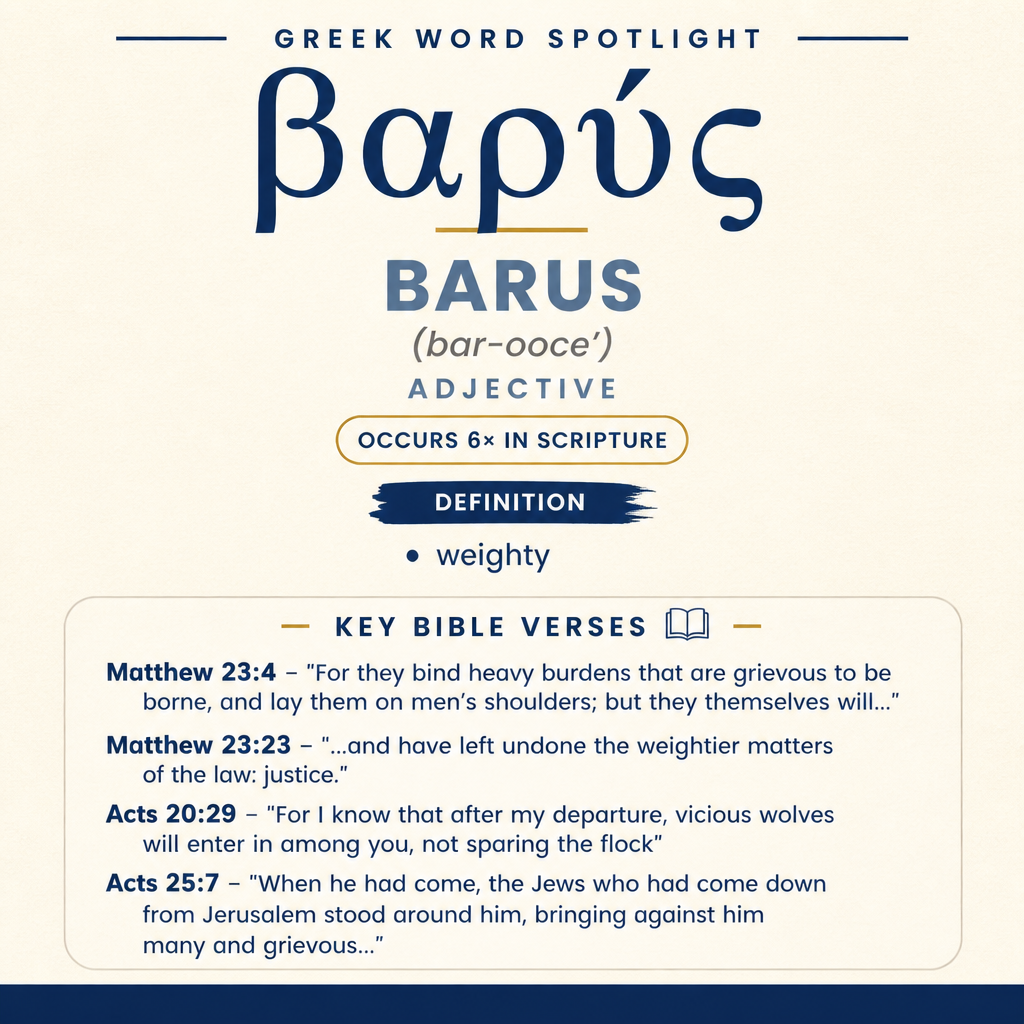
βαρύς (Barus) means “weighty” and occurs six times in Scripture: Matthew 23:4, 23:23; Acts 20:29, 25:7; 2 Corinthians 10:10; 1 John 5:3.
Core Meaning
βαρύς means “weighty.” In the cited passages it describes burdens, matters, charges, letters, and commandments.
Learn More →Gospel Context
In Matthew 23:4 it describes heavy burdens laid on others. In Matthew 23:23 it refers to the weightier matters neglected.
Learn More →Other Uses
In Acts 25:7 it modifies grievous charges brought against Paul, and in 2 Corinthians 10:10 it describes letters as weighty and strong. In 1 John 5:3, God’s commandments are not grievous.
Learn More →βαρύς describes what is “weighty,” whether as a literal load, a serious matter, or an oppressive demand. In the New Testament it appears in teaching about religious practice, in courtroom accusation, in comments about written correspondence, and in an assurance about God’s commandments.
Root and Related Words
βαρύς is related to βάρος (baros, “burden”; Strong’s G922).

Occurrences
“For they bind heavy burdens that are grievous to be borne, and lay them on men’s shoulders; but they themselves will not lift a finger to help them.” (Matthew 23:4)
Here βαρύς frames the burdens as genuinely weighty: they are not light obligations but loads that press down and exhaust. The picture is physical—“lay them on men’s shoulders”—and the adjective sharpens the contrast between those who impose the burdens and their refusal to “lift a finger” to help. The weightiness is part of the criticism: the heaviness of the demands intensifies the injustice of placing them on others without sharing the strain.
“Woe to you, scribes and Pharisees, hypocrites! For you tithe mint, dill, and cumin, and have left undone the weightier matters of the law: justice, mercy, and faith. But you ought to have done these, and not to have left the other undone.” (Matthew 23:23)
In this setting βαρύς shifts from physical burden to moral seriousness. “Weightier matters of the law” presents certain concerns as carrying more weight—greater moral substance—than meticulous attention to “mint, dill, and cumin.” The adjective strengthens the charge that their practice is imbalanced: they are diligent in small calculations while neglecting what has heavier moral force, named as “justice, mercy, and faith.” Weightiness here marks what should set the priorities of obedience.
“For I know that after my departure, vicious wolves will enter in among you, not sparing the flock.” (Acts 20:29)
Within this warning, βαρύς characterizes the “wolves” as harsh and destructive in their approach to the community. The description “not sparing the flock” matches the idea of weightiness as something that presses hard: the coming threat is not mild or manageable. The adjective contributes to the sense of severity in the forecast—an impending pressure that will fall on the believers like a heavy force moving through a vulnerable group.
“When he had come, the Jews who had come down from Jerusalem stood around him, bringing against him many and grievous charges which they could not prove,” (Acts 25:7)
Here βαρύς qualifies “charges” in a legal confrontation. The accusations are presented as “many,” and the adjective adds that they are weighty—serious allegations with the potential to condemn. Yet the verse immediately places their weightiness alongside their emptiness: they “could not prove” them. The effect is a portrait of pressure through accusation: heavy-sounding claims piled up around the defendant, intended to overwhelm even when unsupported.
“For, “His letters”, they say, “are weighty and strong, but his bodily presence is weak, and his speech is despised.”” (2 Corinthians 10:10)
In this criticism, βαρύς describes the perceived impact of “letters.” They are “weighty and strong,” conveying force and seriousness in written form, while the speaker contrasts that with the writer’s “weak” presence and “despised” speech. The adjective thus functions rhetorically: it highlights an imbalance between the authority felt in writing and the dismissive evaluation of the person when present. Weightiness becomes a quality attributed to communication—words that land with force.
“For this is loving God, that we keep his commandments. His commandments are not grievous.” (1 John 5:3)
Here βαρύς appears in a direct negation: the commandments “are not grievous.” The adjective evokes the idea of commands as a potential heavy load, but the statement denies that God’s commandments function as crushing weight. In the immediate context, keeping the commandments is tied to “loving God,” and the denial of grievousness presents obedience not as oppressive strain but as something that, in this framing, does not bear down in a burdensome way.
Sense and Usage
Across these passages, βαρύς consistently marks the felt heaviness of something placed upon someone—whether physically, socially, morally, or rhetorically. In Matthew 23:4, the heaviness is pictured on shoulders: demands that weigh down the people. In Matthew 23:23, the same adjective supplies a scale for evaluation: some matters carry more weight than others, so neglecting them exposes a distorted sense of what truly matters. Acts uses the term to intensify situations of danger and hostility: the threat to the “flock” is severe (Acts 20:29), and the accusations are serious in tone and aim even when unproven (Acts 25:7). In 2 Corinthians 10:10, weightiness becomes a perceived trait of letters—communication that comes with force—showing how heaviness can be experienced through words as well as through actions. Finally, 1 John 5:3 uses the adjective to address an expectation: commandments could be experienced as crushing burdens, but the author insists that this is not their character.
The occurrences also show how βαρύς can operate either as a critique of oppressive weight (burdens and grievous charges), as a call to recognize genuine moral seriousness (“weightier matters”), as a warning of severe pressure (wolves who do not spare), or as an assessment of forcefulness (letters that are weighty). The negative form in 1 John 5:3 is especially pointed against the background of the other uses: where human systems and human hostility can load people down with what is heavy, God’s commandments are presented as not bearing that same oppressive weight.
Imagery
The word’s imagery repeatedly evokes weight that can be placed, felt, and compared. In Matthew, heavy burdens sit on shoulders, and weightier matters tip the scales of what deserves attention. In Acts, weight is sensed as pressure—predators entering and accusations surrounding. In 2 Corinthians, weightiness is heard in letters, as though written words can press on a reader with strength. And in 1 John, the same field of imagery is reversed: commandments are explicitly denied the status of a heavy load.
Sources: Lexical data from Strong’s Exhaustive Concordance and the Translators Brief Lexicon of Extended Strongs for Greek (STEPBible, CC BY). Occurrence data from the Translators Amalgamated Greek New Testament (STEPBible, CC BY). Scripture quotations from the World English Bible (public domain).