
Exploring the Meaning of Authenteo in Greek
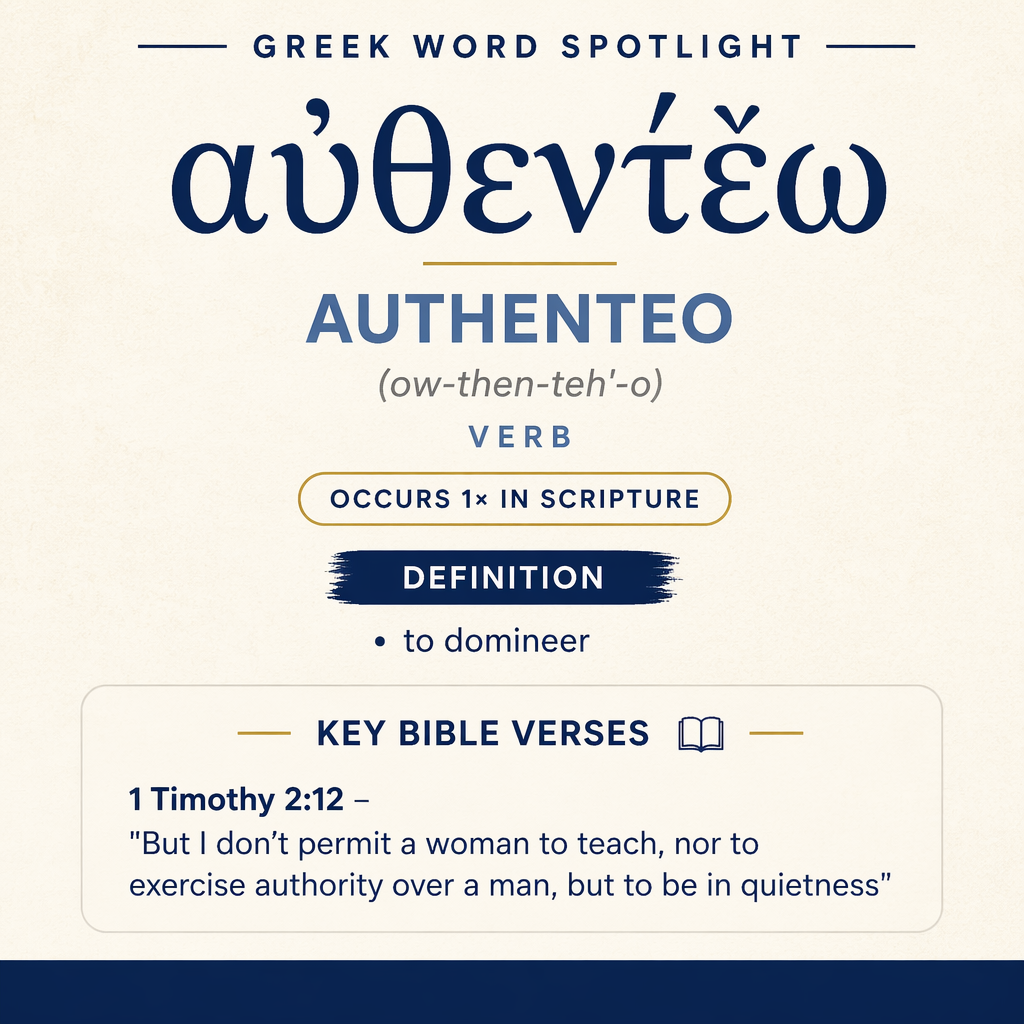
αὐθεντέω (Authenteo) means “to domineer” and appears once in Scripture, in 1 Timothy 2:12.
Verse Context
In 1 Timothy 2:12 it appears in the statement, “nor to exercise authority over a man.”
Learn More →αὐθεντέω means “to domineer,” and it appears once in the New Testament, in Paul’s instructions for conduct in the gathered life of the church. In its single context it is set alongside teaching and contrasted with quietness.
Root and Related Words
αὐθεντέω is connected (in Strong’s) with autos (αὐτός), meaning “it/s/he” (Strong’s G846). In the verse where αὐθεντέω occurs, the action is explicitly directed “over a man,” so the verb is framed as an exercised relation between persons rather than an impersonal force.

Occurrences
“But I don’t permit a woman to teach, nor to exercise authority over a man, but to be in quietness.” (1 Timothy 2:12)
Here αὐθεντέω is placed in a coordinated prohibition with “to teach,” joined by “nor,” so that it names a second kind of action prohibited in the same breath. The direct object is expressed as a relational target: “over a man.” That wording situates the verb in an interpersonal hierarchy, not merely in the presence of influence or initiative, but in a posture taken “over” someone else. Because the same sentence ends with “but to be in quietness,” the verse itself supplies a contrastive pairing: the forbidden actions (teaching and the exercise of authority “over a man”) are opposed to the demeanor or posture described as “quietness.”
The immediate effect of αὐθεντέω in this clause is to define a boundary for what is “permit[ted]” in this setting. The prohibition does not float as an abstract statement about power; it is embedded in instruction about what a woman is and is not permitted to do. As used here, the verb contributes the notion of a controlling or overbearing exercise of authority in relation to a man, and the grammar of the sentence frames that kind of action as incompatible with the quietness Paul calls for in the same line.
Sense and Usage
The given sense, “to domineer,” gains its color in 1 Timothy 2:12 from three features that are explicit in the wording: (1) it is coordinated with teaching (“nor”); (2) it is directed “over a man”; and (3) it is contrasted with “quietness.” Together these features show how the verb functions in context: it is not a generic term for having responsibility, but a term that, in this sentence, marks a mode of exercising authority that places one person above another in a way the instruction rejects.
First, the pairing with teaching matters for how αὐθεντέω is heard in the verse. The statement is not simply, “I don’t permit… to exercise authority,” but “I don’t permit… to teach, nor to exercise authority.” The coordination signals that αὐθεντέω is one item in a short list of activities Paul is restricting. The verse does not define a technical distinction between the two actions; it simply places them side by side as behaviors governed by the same rule of permission. The reader therefore encounters “to domineer” as part of a pattern of conduct—something that can be done in a community context and something that can be forbidden there.
Second, the phrase “over a man” specifies the directional force of the verb. “Domineer” is inherently relational, and the verse expresses that relationality overtly: it is something done “over” someone. This supports reading αὐθεντέω in the line as an exertion of control in a vertical relationship. The prepositional wording signals a posture taken toward another person: it is not described as authority exercised within oneself, or as an inner disposition, but as an outward act in which one party positions herself “over” another.
Third, “but to be in quietness” provides the immediate contrast that helps the sense of αὐθεντέω land with the reader. The structure “nor… but…” places “quietness” as the alternative posture to the two prohibited actions. In that contrast, αὐθεντέω belongs on the side of assertive, directive behavior, rather than the side of restraint. Without importing additional meanings, the verse itself frames domineering authority as the opposite of quietness in the setting Paul is addressing.
Because αὐθεντέω appears only here, its usable semantic profile in Scripture must be drawn from this single line. The verse presents it as an enacted stance in community life, something a person may attempt, something that can be permitted or refused permission, and something that has a clear interpersonal direction (“over a man”). Within that single scene, “to domineer” names a kind of authority exercise that is not merely present but actively imposed, since the imagery of being “over” another person communicates a top-down relation rather than mutuality or parallel standing.
The wording also shows that αὐθεντέω is treated as a behavior that can be regulated, not an inborn status. The speaker says, “I don’t permit,” which casts the verb’s action as something that might otherwise occur in the community and therefore must be addressed by instruction. In that way, αὐθεντέω functions as a term of conduct within an ordered setting: it is one of the practices that are either allowed or disallowed, alongside teaching, with quietness held out as the instructed alternative.
Imagery and Force
The verse’s own language supplies a concrete directional picture for αὐθεντέω: being “over” someone. That spatial metaphor fits the sense “to domineer” by evoking a posture of elevation or dominance within a relationship. Set against “quietness,” the verb carries the force of an assertive taking of the upper position, not merely holding a role, but acting in a way that places oneself above another in the communal setting Paul is regulating.
Sources: Lexical data from Strong’s Exhaustive Concordance and the Translators Brief Lexicon of Extended Strongs for Greek (STEPBible, CC BY). Occurrence data from the Translators Amalgamated Greek New Testament (STEPBible, CC BY). Scripture quotations from the World English Bible (public domain).




