Exploring the Meaning of Authades in Greek
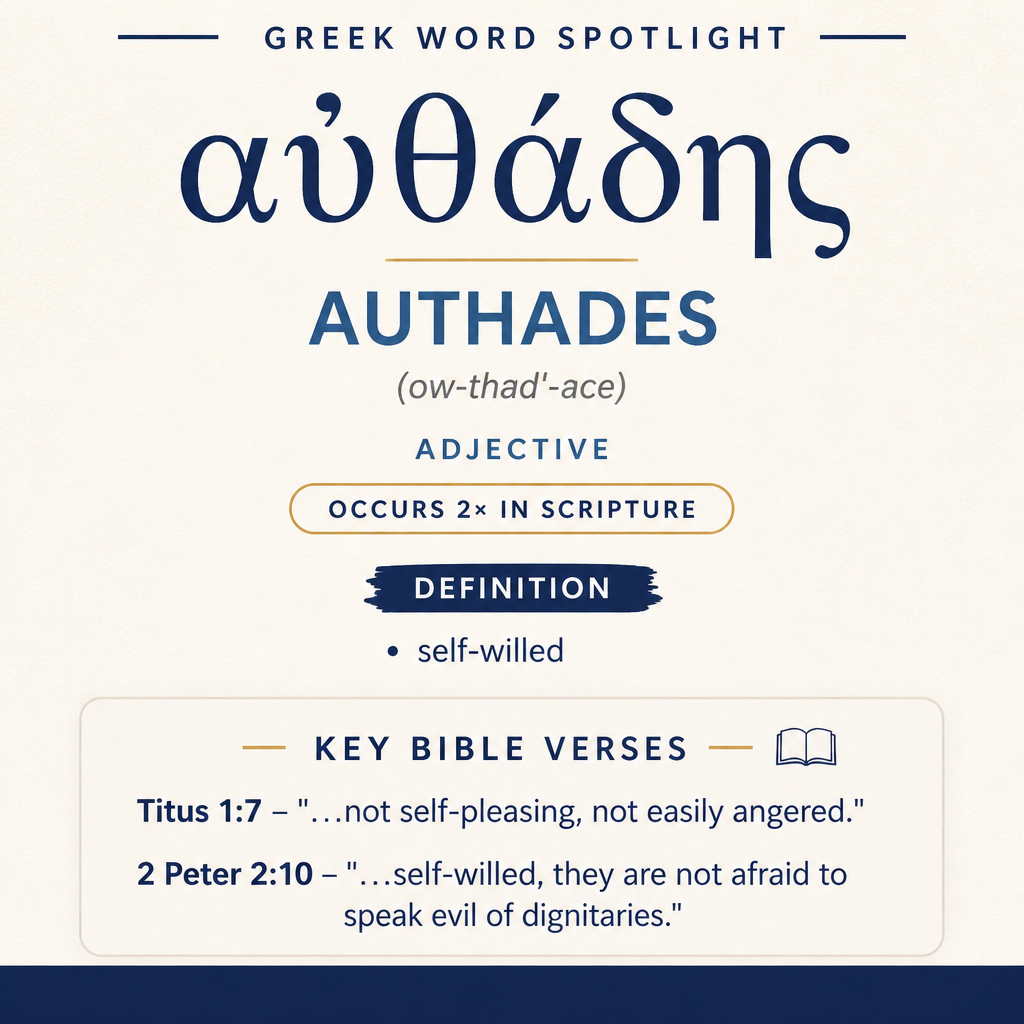
αὐθάδης means “self-willed” and appears twice in Scripture: Titus 1:7 and 2 Peter 2:10.
Scripture Occurrences
It occurs 2 times in Scripture. The references are Titus 1:7 and 2 Peter 2:10.
Learn More →Context Snapshot
In Titus 1:7 it is rendered “not self-pleasing” as a qualification for an overseer. In 2 Peter 2:10 it appears in “Daring, self-willed.”
Learn More →αὐθάδης describes a person who is “self-willed,” and it appears in two New Testament passages: one setting expectations for an overseer, and one describing the character of corrupt intruders who despise authority. In both places it marks a posture of stubborn self-direction that clashes with proper accountability.
Root and Related Words
αὐθάδης is connected with αὐτός (autos), meaning “it/s/he” (Strong’s G846), and ἡδονή (hedone), meaning “pleasure” (Strong’s G2237). These related elements point the term toward the sphere of the self and what satisfies the self.

Occurrences
Titus 1:7 — “For the overseer must be blameless, as God’s steward, not self-pleasing, not easily angered, not given to wine, not violent, not greedy for dishonest gain;”
In Titus, the word functions as a disqualifier in a compact list of traits that must not characterize “the overseer.” The verse frames the overseer as “God’s steward,” a role that carries delegated responsibility: stewardship is exercised on behalf of another, under another’s interest. Within that frame, “not self-pleasing” places αὐθάδης alongside other disruptive behaviors—quick temper (“not easily angered”), lack of restraint (“not given to wine”), coerciveness (“not violent”), and compromised motives (“not greedy for dishonest gain”). The placement suggests that self-willedness is not a private quirk but a leadership hazard: a steward who insists on his own way will tend to set his own agenda, and that self-directed posture easily travels with anger, excess, force, or greed. The word therefore contributes a pointed contrast between being answerable to God as steward and being driven by one’s own will.
2 Peter 2:10 — “but chiefly those who walk after the flesh in the lust of defilement and despise authority. Daring, self-willed, they are not afraid to speak evil of dignitaries;”
In 2 Peter, αὐθάδης appears in a rapid string of descriptions that paint a bolder, more aggressive portrait. The verse first identifies the targets as those who “walk after the flesh in the lust of defilement,” then adds that they “despise authority.” Against that backdrop, “Daring, self-willed” marks how they carry themselves: they act with audacity and with a will set on itself. The next clause shows the social effect of this stance—“they are not afraid to speak evil of dignitaries.” Here self-willedness is not merely inward obstinacy; it spills into speech and behavior, breaking the normal restraints of respect and fear. The immediate pairing with “despise authority” shows the direction of the term in this context: self-will expresses itself as contempt for legitimate oversight, and it emboldens reckless talk against those regarded as dignitaries.
Sense and Usage
Across its two New Testament uses, αὐθάδης consistently marks a fixed insistence on one’s own will. The two contexts set this insistence in sharp contrast with two different kinds of accountability: in Titus, accountability to God as steward; in 2 Peter, accountability to recognized authority (“despise authority”) and to the social restraint that would normally govern speech about “dignitaries.” The word therefore helps characterize not only what a person wants, but how that wanting relates to order: it presses against being governed, corrected, or constrained.
The Titus occurrence shows αὐθάδης as a leadership disqualification because leadership in the church is portrayed as stewardship. The overseer is not free to be self-directed, since his office is defined by trust and responsibility. Within the vice-list, self-willedness sits near relational volatility (“not easily angered”) and coercive or exploitative tendencies (“not violent,” “not greedy for dishonest gain”). This arrangement presents αὐθάδης as a seedbed disposition: when the self must be satisfied and the will must prevail, other behaviors that harm the community can follow readily. Titus does not describe the overseer’s tasks here; instead, it gives a moral profile, and αὐθάδης names a central distortion of motive—governance of the self by the self.
The 2 Peter occurrence, by contrast, depicts αὐθάδης as part of an already active pattern: “walk after the flesh,” “lust of defilement,” and contempt for authority. In that environment, self-will does not remain hidden. The verse’s punctuation-like sequence—“Daring, self-willed”—reads like character labels that explain the behavior that follows: fearlessness in slanderous speech. αὐθάδης therefore contributes a psychological and moral explanation for social transgression. The self-willed person will not be held back by reverence, caution, or respect; the self’s will becomes the controlling measure, and authority becomes something to be scorned rather than recognized.
Taken together, these uses show αὐθάδης operating in both preventative and diagnostic ways. Titus uses it preventatively: it names a trait that must not be present in someone entrusted with oversight. 2 Peter uses it diagnostically: it names a trait that accompanies and helps explain a broader corrupt trajectory. In both cases, the word’s force is interpersonal and communal. It is not simply a preference for independence; it is a self-assertion that strains stewardship and ruptures proper submission, whether in the orderly life of church leadership or in the unruly conduct of those who despise authority.
Implied Imagery
Both passages evoke a picture of a person set against being guided. In Titus, the “steward” image places the self-willed impulse in tension with entrusted care: the steward is meant to manage what belongs to another, but self-will pushes management toward self-pleasing. In 2 Peter, the description of speaking evil of “dignitaries” gives self-will a public face: an unrestrained boldness that refuses the boundaries normally honored in speech and conduct.
Sources: Lexical data from Strong’s Exhaustive Concordance and the Translators Brief Lexicon of Extended Strongs for Greek (STEPBible, CC BY). Occurrence data from the Translators Amalgamated Greek New Testament (STEPBible, CC BY). Scripture quotations from the World English Bible (public domain).