Understanding the Significance of Arimathaia in Greek
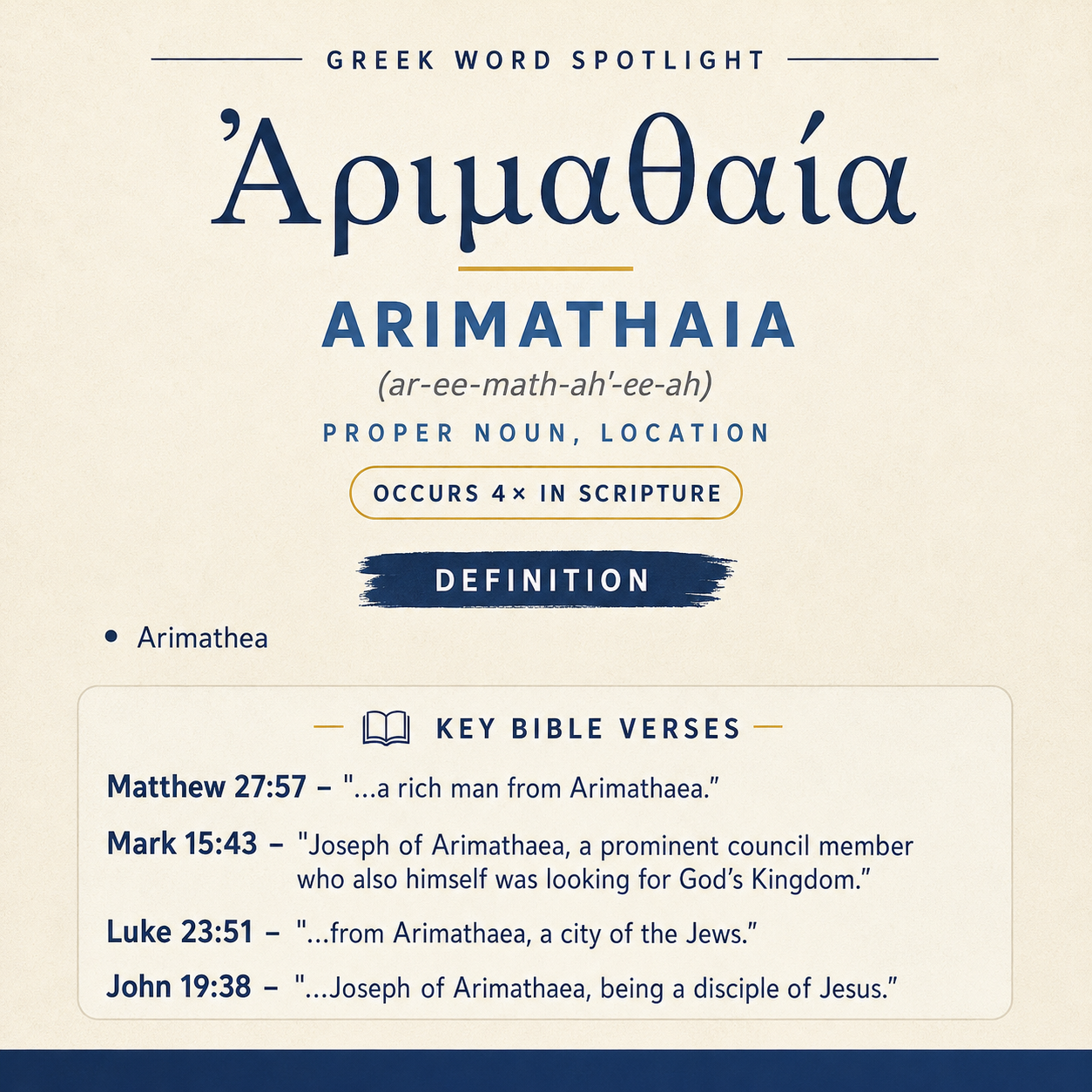
Ἀριμαθαία means Arimathea and appears four times in the Gospels in connection with Joseph of Arimathaea.
Gospel Occurrences
The word occurs in Matthew 27:57, Mark 15:43, Luke 23:51, and John 19:38.
Learn More →Narrative Setting
In each occurrence it identifies Joseph as being from Arimathaea in the burial narrative of Jesus.
Learn More →Ἀριμαθαία denotes “Arimathea,” named in the Passion narratives as the place associated with Joseph, the man who approaches Pilate for Jesus’ body. The word appears across all four Gospels in close connection with burial actions and with Joseph’s identity.
Occurrences
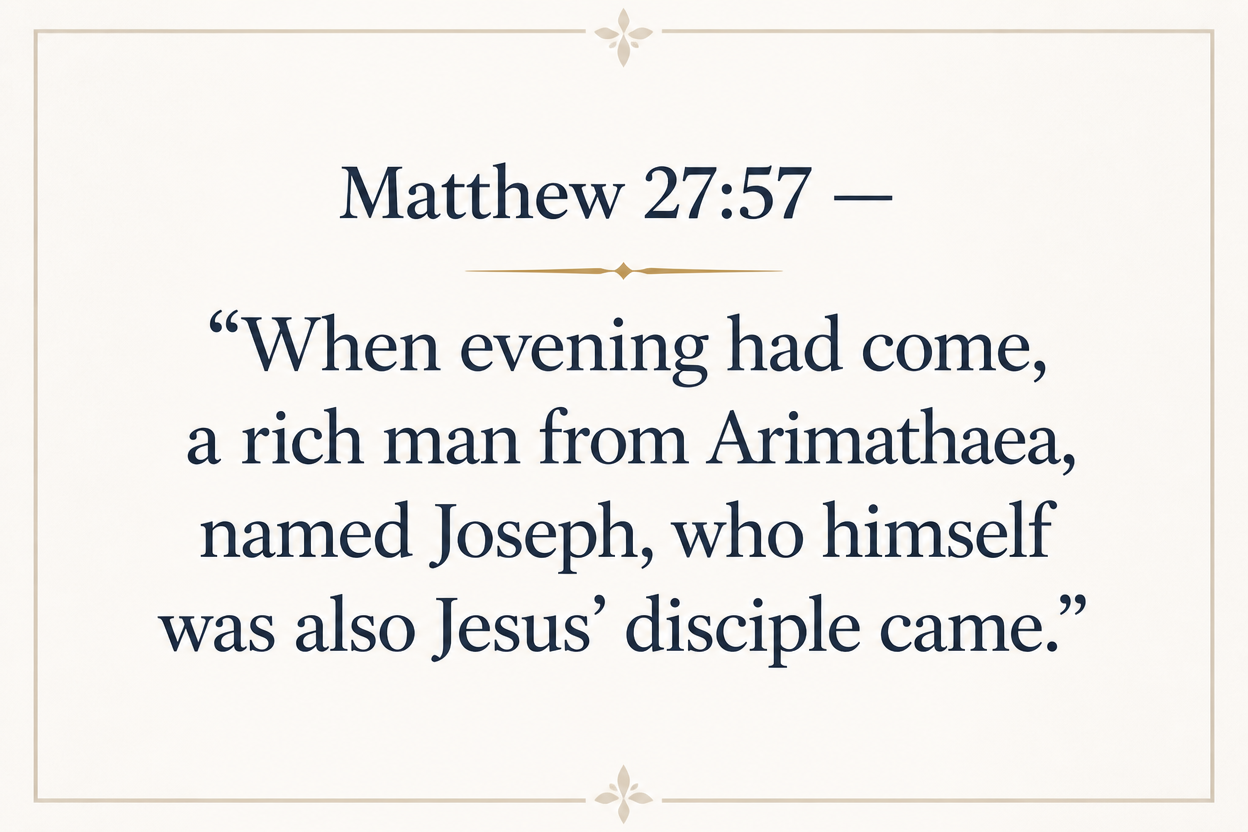
Matthew 27:57 — “When evening had come, a rich man from Arimathaea, named Joseph, who himself was also Jesus’ disciple came.”
Here Ἀριμαθαία functions as a locator for Joseph: he is “from Arimathaea.” The place-name helps frame Joseph as a particular individual entering the scene at a specific moment (“When evening had come”), and it anchors his identity alongside two additional descriptors in the same sentence: his wealth (“a rich man”) and his allegiance (“Jesus’ disciple”). Arimathea is not described in itself; its role is to mark Joseph’s origin and so to distinguish him within the narrative as he steps forward at the close of the day.
Mark 15:43 — “Joseph of Arimathaea, a prominent council member who also himself was looking for God’s Kingdom, came. He boldly went in to Pilate, and asked for Jesus’ body.”
In Mark, Ἀριμαθαία is incorporated into Joseph’s name as a fixed designation (“Joseph of Arimathaea”), and it accompanies a fuller public profile: he is “a prominent council member” and one “looking for God’s Kingdom.” The place-name thus sits within a line of identifiers that situate Joseph socially and spiritually before recounting his decisive action. After the identification, the narrative moves quickly: he “came,” “boldly went in to Pilate,” and “asked for Jesus’ body.” Arimathea, as the geographic tag attached to Joseph, travels with him into the political setting of Pilate’s presence, serving as part of how the Gospel introduces the agent who initiates the request.
Luke 23:51 — “(he had not consented to their counsel and deed), from Arimathaea, a city of the Jews, who was also waiting for God’s Kingdom:”
Luke likewise uses Ἀριμαθαία to specify where this man is “from,” but expands the geographic reference by apposition: “Arimathaea, a city of the Jews.” The phrase makes the location explicit as a city and places it within a Jewish setting, which complements the surrounding comment about his stance toward the decision of others (“he had not consented to their counsel and deed”). The place-name works here with the characterization: he is both geographically situated and morally distinguished. As in Mark, Luke pairs the identification with an eschatological posture—he is “waiting for God’s Kingdom”—so that Arimathea becomes part of the portrait of a man whose origin, community context (“a city of the Jews”), and expectations cohere within the Passion account.
John 19:38 — “After these things, Joseph of Arimathaea, being a disciple of Jesus, but secretly for fear of the Jews, asked of Pilate that he might take away Jesus’ body. Pilate gave him permission. He came therefore and took away his body.”
In John, Ἀριμαθαία again appears as part of Joseph’s designation (“Joseph of Arimathaea”), but the narrative concentrates on his relationship to Jesus and the risk he perceives: he is “a disciple of Jesus,” yet “secretly for fear of the Jews.” The place-name is the stable identifier in a sentence otherwise filled with tension and action—request, permission, removal of the body. John’s account sets Joseph’s origin alongside his hidden discipleship, and then traces a chain of concrete steps: he “asked of Pilate,” Pilate “gave him permission,” and Joseph “came therefore and took away his body.” Arimathea thus appears at the point where Joseph enters the burial process, functioning as the geographic element in a densely narrated moment.
Sense and Usage
Across these passages, Ἀριμαθαία operates strictly as a place-name, and its consistent narrative use is to identify Joseph through origin or association. Two Gospels employ the “from Arimathaea” construction (Matthew, Luke), emphasizing provenance; two use the gentilic-like label “of Arimathaea” (Mark, John), presenting it as an identifying tag attached to his name. In either case, the word does not carry descriptive content beyond naming the location; it contributes by grounding a person in a recognizable place and by giving the narrative a concrete point of reference for the man who steps into the events surrounding Jesus’ death.
The settings in which Arimathea is mentioned are notably concentrated: the word occurs when Joseph enters the scene during the period immediately following Jesus’ death. The place-name therefore becomes closely tied, in these Gospels, to the practical realities of burial and to the figure who makes the decisive request. Yet each Evangelist places that stable geographic label within a slightly different cluster of descriptors. Matthew pairs Arimathea with Joseph’s wealth and discipleship. Mark pairs it with council prominence and hope for God’s Kingdom, highlighting the boldness of approaching Pilate. Luke adds the explicit note that Arimathea is “a city of the Jews” and situates Joseph as dissenting from a particular “counsel and deed,” again coupled with waiting for God’s Kingdom. John frames the label within the tension of secret discipleship “for fear of the Jews” and then narrates the permission and removal of Jesus’ body. In this way, the same toponym helps each Gospel introduce the same actor while allowing the surrounding characterization to differ in emphasis.
Because the word appears only in these Joseph-related identifications, its usage is tightly focused: it functions less as a setting the narrative enters and more as a coordinate attached to a named individual. Even so, by specifying Joseph’s origin, the Gospels give a sense that the burial initiative is undertaken by a distinct person with a particular background, rather than by an anonymous bystander. The place-name supplies that specificity in a compact form, enabling the narrative to move quickly from identification to action: “came,” “went in,” “asked,” “permission,” “took away.”
Imagery
In these four scenes, Arimathea is heard every time Joseph is introduced at the point where he steps forward to secure Jesus’ body. The recurring place-name becomes part of the sound and rhythm of the burial narrative: a man is named, his origin is stated, and he enters into the final acts described—coming, requesting, receiving permission, and taking the body away.
Sources: Lexical data from Strong’s Exhaustive Concordance and the Translators Brief Lexicon of Extended Strongs for Greek (STEPBible, CC BY). Occurrence data from the Translators Amalgamated Greek New Testament (STEPBible, CC BY). Scripture quotations from the World English Bible (public domain).