Understanding the Meaning of Archipoimen in Greek
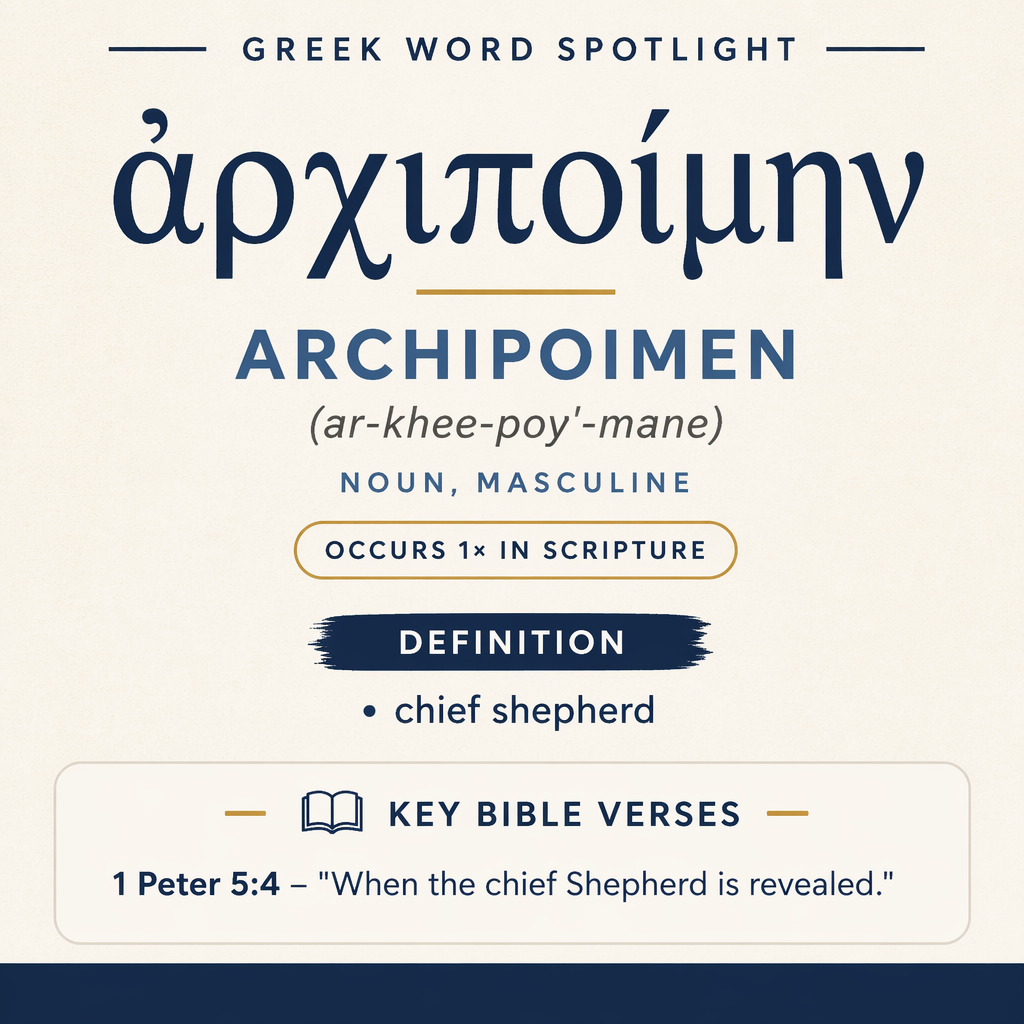
ἀρχιποίμην means “chief shepherd” and appears once in Scripture, in 1 Peter 5:4.
Verse Context
1 Peter 5:4 says the chief Shepherd will be revealed, and a crown of glory will be received.
Learn More →ἀρχιποίμην means “chief shepherd” and appears once in the New Testament, in 1 Peter 5:4. In that verse it frames the hope and motivation connected to the public revealing of this Shepherd and the reward promised to those addressed.
Root and Related Words
ἀρχιποίμην (Archipoimen) is built from ἀρχή (arche), meaning “beginning” (Strong’s G746), and ποιμήν (poimen), meaning “shepherd” (Strong’s G4166). The compound formation brings together a term of precedence with the ordinary word for a shepherd, producing a single title that points to primacy within the shepherding imagery.

Occurrences
“When the chief Shepherd is revealed, you will receive the crown of glory that doesn’t fade away.” (1 Peter 5:4)
Here ἀρχιποίμην functions as a title tied to a decisive moment: “When the chief Shepherd is revealed.” The sentence is structured around that future disclosure, so the word does more than name a figure; it anchors the timing and certainty of what follows. The promised outcome—“you will receive the crown of glory that doesn’t fade away”—is connected to the revealing of the chief Shepherd, portraying him as the one whose appearing marks the occasion for bestowal of an enduring reward.

The title also shapes the logic of accountability and honor in the verse. A “chief Shepherd” implies a shepherding order in which others may serve under, or in relation to, the one who stands foremost. Without needing to add details beyond the line itself, the verse uses the title to present the revealer as authoritative enough to confer a “crown of glory,” and stable enough that what he gives “doesn’t fade away.” The enduring quality of the crown matches the weight of the title: the Shepherd named here is not a passing or local figure but the chief one whose revealing is decisive for the recipients’ reward.
Sense and Usage
Because ἀρχιποίμην occurs in a single, highly concentrated statement, its sense is expressed through its placement and its links to “revealed” and “crown.” The word’s force lies in how it orders the imagery: shepherding is not presented as an undefined pastoral picture, but as a framework with a clear head. By choosing a title that names a “chief” among shepherds, the verse situates the audience’s expected reward under the supervision of a supreme pastoral figure.
The immediate context in the verse highlights two key associations. First, ἀρχιποίμην is tied to revelation: the chief Shepherd is not merely present but will be “revealed,” a verb that points to disclosure or manifestation rather than ordinary appearance. This makes the title function eschatologically within the verse’s own wording: the chief Shepherd’s identity and role will be shown openly, and that moment carries consequences for the recipients. Second, the title is tied to remuneration: “you will receive the crown of glory.” The chief Shepherd is therefore depicted as the one whose unveiling corresponds with the giving of honor. The title supports a sense of legitimate, recognized authority in the act of awarding a crown.
The phrase “that doesn’t fade away” further colors the usage of ἀρχιποίμην by contrasting the permanence of the promised crown with anything subject to decline. In this line, the chief Shepherd stands as the guarantor of something unfading. The verse does not explain the mechanics of the crown, but it uses the title to strengthen the promise: the giver is the chief Shepherd, and the gift is enduring.
As a compound, ἀρχιποίμην compresses hierarchy and care into a single designation. Even when the verse speaks only one sentence, the title quietly suggests that shepherding is not only about tending but also about recognized precedence—one who stands at the head of shepherds. The word thereby supports the tone of assurance in the promise: the recipients’ future reception of glory is set under the horizon of a chief Shepherd’s revealing, not under uncertain circumstances.
Imagery
The lone occurrence of ἀρχιποίμην carries the concrete imagery of shepherding into a scene of unveiling and reward. A shepherd is an immediately graspable figure of oversight and care, and the title “chief Shepherd” intensifies that image by placing him at the forefront. In 1 Peter 5:4, that shepherding picture is joined to a ceremonial moment—receiving “the crown of glory that doesn’t fade away”—so the word evokes both pastoral authority and the honor bestowed at the time of revelation.
Sources: Lexical data from Strong’s Exhaustive Concordance and the Translators Brief Lexicon of Extended Strongs for Greek (STEPBible, CC BY). Occurrence data from the Translators Amalgamated Greek New Testament (STEPBible, CC BY). Scripture quotations from the World English Bible (public domain).