
Exploring the Meaning of Apotheomai in Greek
ἀπωθέω means “to reject” and occurs six times in Scripture: Acts 7; Acts 13; Romans 11; and 1 Timothy 1.
Core Meaning
ἀπωθέω is defined as “to reject.” In Acts 7:27 it is pictured as pushing someone away.
Learn More →Scripture Occurrences
This verb appears 6 times in Scripture. It occurs in Acts 7:27, Acts 7:39, Acts 13:46, Romans 11:1–2, and 1 Timothy 1:19.
Learn More →Usage Snapshots
Romans 11:1–2 uses ἀπωθέω in the question of whether God rejected his people. 1 Timothy 1:19 uses it for thrusting away faith and a good conscience.
Learn More →ἀπωθέω means “to reject,” and it appears in narrative speech (Acts), apostolic argument (Romans), and pastoral warning (1 Timothy). In these settings it describes a decisive turning-away that can be enacted with the body (“pushed him away”), with the will (“rejected him”), or with settled judgment (“God reject his people?”).

Root and Related Words
ἀπωθέω is related to the preposition ἀπό (apo), “away from” (Strong’s G575), which supplies the directional force felt in several contexts where rejection is pictured as a thrusting or pushing away.

Occurrences
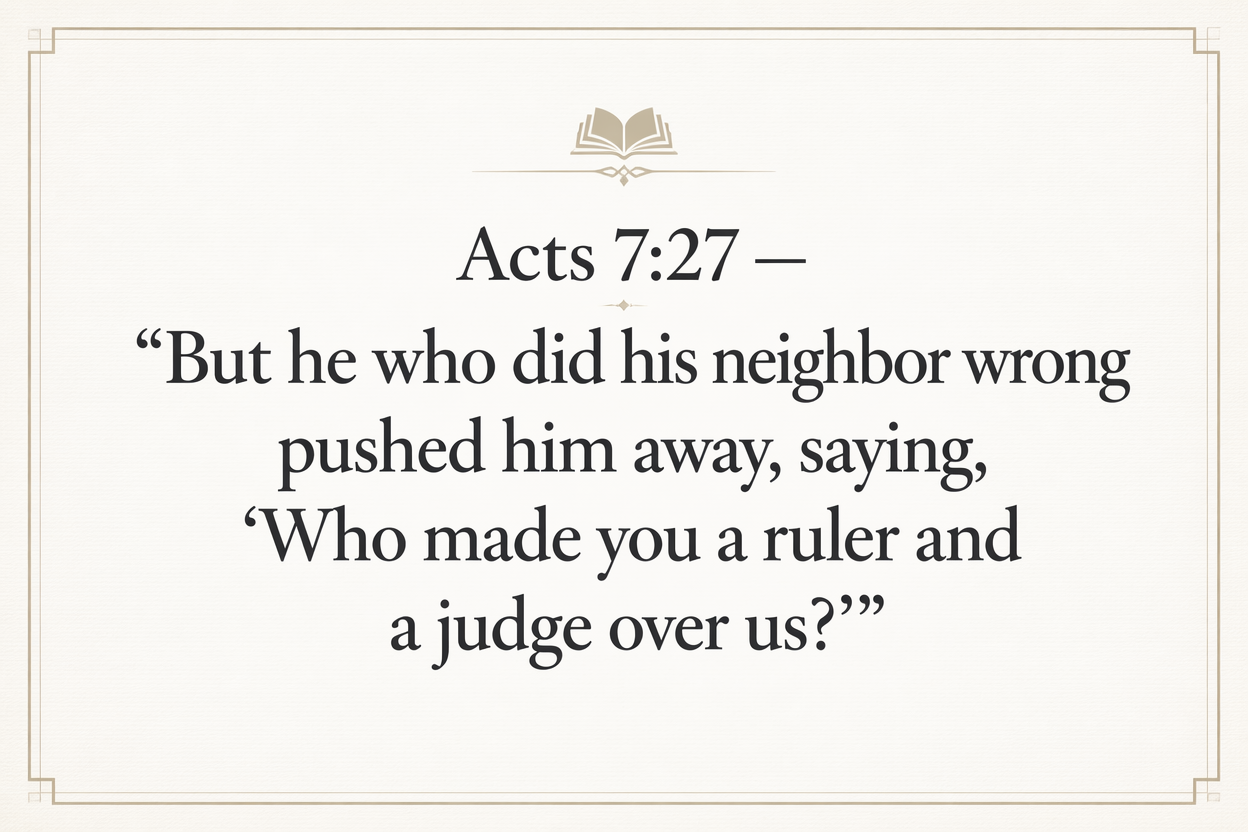
Acts 7:27 — “But he who did his neighbor wrong pushed him away, saying, ‘Who made you a ruler and a judge over us?”
Here rejection is acted out as physical removal. The wrongdoer does not merely disagree; he “pushed him away,” refusing the other man’s intervention and verbally challenging any claim to authority (“Who made you a ruler and a judge over us?”). The word frames rejection as an expulsion from proximity—an attempt to end the encounter by force and to deny the legitimacy of the would-be mediator.
Acts 7:39 — “to whom our fathers wouldn’t be obedient, but rejected him, and turned back in their hearts to Egypt,”
In this retelling, rejection is the opposite of obedience: “wouldn’t be obedient, but rejected him.” The clause that follows—“turned back in their hearts to Egypt”—shows rejection as a chosen reversal. The action is inward (“in their hearts”) but has a clear direction: they refuse the person set before them and reorient themselves toward a former place of attachment. The word therefore carries the weight of deliberate refusal, not mere failure or neglect.
Acts 13:46 — “Paul and Barnabas spoke out boldly, and said, “It was necessary that God’s word should be spoken to you first. Since indeed you thrust it from yourselves, and judge yourselves unworthy of eternal life, behold, we turn to the Gentiles.”
In this public declaration, rejection is expressed as an active “thrust” directed at “God’s word.” The verb portrays a self-directed motion: “you thrust it from yourselves,” implying that the hearers push away what came to them. Paul and Barnabas connect that rejection to a self-assessment—“judge yourselves unworthy of eternal life”—and then to a consequential change of mission focus (“behold, we turn to the Gentiles”). The word thus marks a pivotal decision point, where rejection functions as the stated reason for a relational and ministerial turning.
Romans 11:1 — “I ask then, did God reject his people? May it never be! For I also am an Israelite, a descendant of Abraham, of the tribe of Benjamin.”
Here the word is placed in a direct question about God’s stance toward “his people.” The immediate response—“May it never be!”—treats the idea as unacceptable. Paul then grounds his denial in his own identity (“I also am an Israelite… of the tribe of Benjamin”), using his continued inclusion as an argument against the claim that God has rejected that people as a whole. Rejection in this verse is not a momentary slight; it is a sweeping relational verdict, and Paul contests that such a verdict has occurred.
Romans 11:2 — “God didn’t reject his people, which he foreknew. Or don’t you know what the Scripture says about Elijah? How he pleads with God against Israel:”
The denial is repeated with expanded description: “God didn’t reject his people, which he foreknew.” The added phrase locates the discussion in God’s prior knowledge of that people, framing rejection as something incompatible with that relationship. Paul immediately appeals to “the Scripture” and introduces Elijah’s pleading “against Israel,” setting rejection in a context where accusation and intercession are imaginable, yet God’s stance is still described as non-rejection. The word therefore functions as a boundary term in Paul’s argument: whatever the situation addressed by Elijah’s complaint, it does not amount to God casting off his people.
1 Timothy 1:19 — “holding faith and a good conscience, which some having thrust away made a shipwreck concerning the faith,”
In this warning, rejection is again pictured as “thrust away,” this time with “faith and a good conscience” as the objects. The image of “shipwreck” interprets the action’s outcome: pushing away what should be “held” leads to disastrous collapse “concerning the faith.” The word therefore describes a willful discarding that precedes ruin; it is not portrayed as accidental drifting but as a decisive repudiation of what formerly could have been maintained.
Sense and Usage
Across these passages, “to reject” ranges from bodily expulsion to moral and theological repudiation, yet the same basic dynamic holds: something or someone is pushed away and treated as unwelcome. Acts 7:27 presents the most concrete form, where the rejection is enacted with a shove and reinforced by speech that denies the other’s standing. Acts 7:39 and Acts 13:46 extend the action into communal and religious life—refusal to obey, reversal of the heart’s direction, and the thrusting away of “God’s word.” In Romans 11:1–2, the term becomes a crucial category for understanding God’s relationship to “his people”: Paul frames the question in absolute terms and insists that such rejection has not occurred, supporting his claim with his own continued identity and with appeal to Scripture. In 1 Timothy 1:19, the word targets personal perseverance: what is meant to be “held” can be rejected, and the result is portrayed as catastrophic damage.
Two recurring features sharpen the sense in these contexts. First, rejection is portrayed as active rather than passive: people “pushed,” “rejected,” and “thrust… away.” Even when the sphere is internal (“in their hearts”), the verb depicts a decisive motion away from what stands before them. Second, rejection carries consequences that are relational and directional: it breaks attempted mediation (Acts 7:27), redirects loyalties (Acts 7:39), triggers a turning of outreach (Acts 13:46), defines the contours of God’s covenantal dealings as Paul argues them (Romans 11:1–2), and results in moral and spiritual collapse (1 Timothy 1:19). The word thus fits settings where a refusal is not merely an opinion but a turning-point act with visible outcomes.
Imagery
The verb’s repeated association with “pushed” and “thrust away” gives rejection a tactile feel in these verses. Whether it is a man shoved back from intervening (Acts 7:27), a people turning back in their hearts (Acts 7:39), hearers thrusting away God’s word (Acts 13:46), or some thrusting away faith and conscience into shipwreck (1 Timothy 1:19), rejection is pictured as a forceful distancing—creating space between the rejecter and what is refused.
Sources: Lexical data from Strong’s Exhaustive Concordance and the Translators Brief Lexicon of Extended Strongs for Greek (STEPBible, CC BY). Occurrence data from the Translators Amalgamated Greek New Testament (STEPBible, CC BY). Scripture quotations from the World English Bible (public domain).




