
Understanding the Meaning of Aporrhipto in Greek
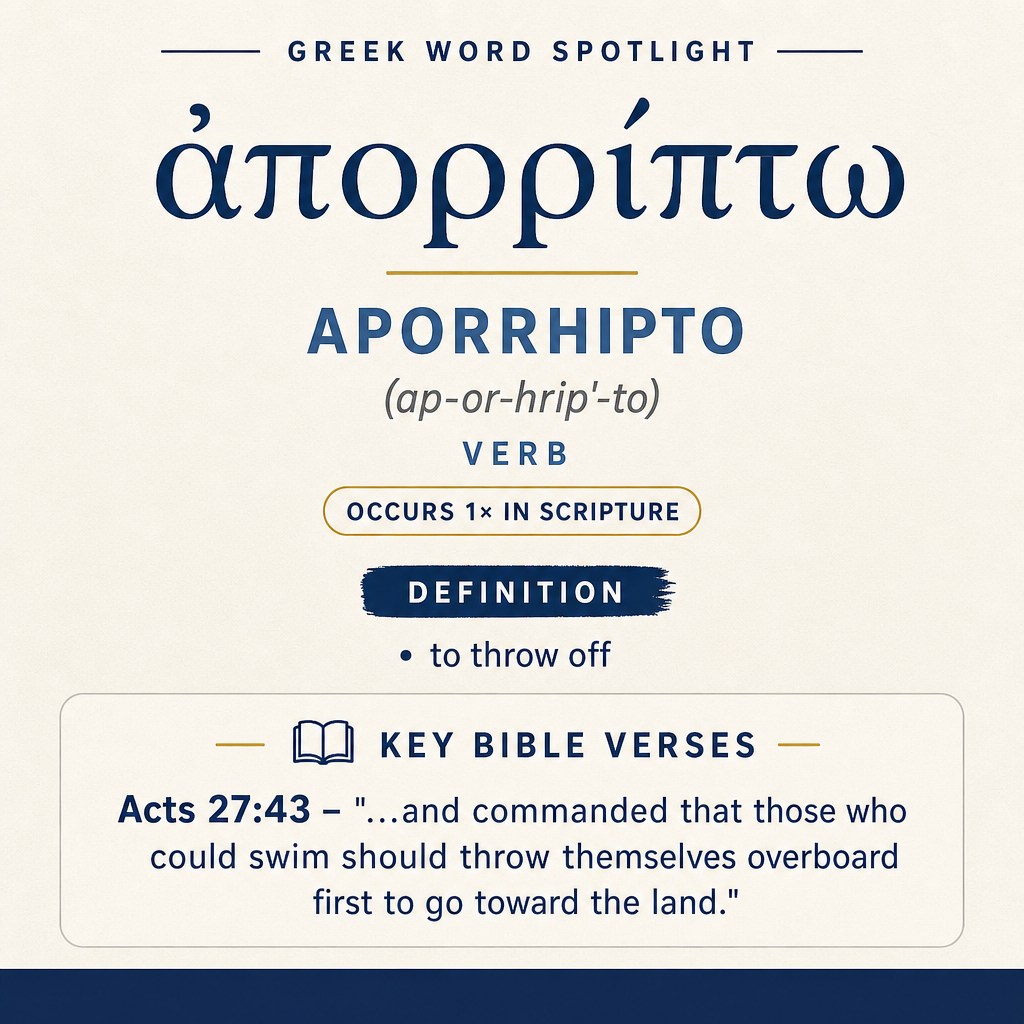
ἀπορρίπτω means “to throw off” and appears once in Scripture, in Acts 27:43.
Scripture Occurrence
This word occurs 1 time in Scripture. Its single occurrence is in Acts 27:43.
Learn More →Verse Context
In Acts 27:43, it appears within the narrative involving the centurion’s command about those who could swim.
Learn More →ἀπορρίπτω means “to throw off.” It appears once, in the narrative of Paul’s voyage and shipwreck, where it names a decisive physical action taken in the emergency at sea.
Root and Related Words
ἀπορρίπτω is connected with two Greek elements reflected in its related words: rhipto (ῥίπτω), “to throw/lay down” (Strong’s G4496), and apo (ἀπό), “away from” (Strong’s G575). Together they frame a verb of throwing with an away-from orientation.

Occurrences
“But the centurion, desiring to save Paul, stopped them from their purpose, and commanded that those who could swim should throw themselves overboard first to go toward the land;” (Acts 27:43)
In Acts 27:43 the word belongs to a set of urgent, controlled commands issued by a centurion at a critical moment. The ship is in danger, and the soldiers have formed “their purpose,” a plan the centurion blocks because he wants to preserve Paul’s life. Against that tension, ἀπορρίπτω expresses the practical, bodily means by which survival will begin: the swimmers are ordered to separate themselves from the ship by forceful action—“throw themselves overboard”—and in doing so initiate the movement “to go toward the land.” The wording links two directions: away from the doomed vessel and toward the shore. The verb thus marks the turning point from remaining with the ship to leaving it behind, and it does so with language that emphasizes decisive motion rather than careful descent. It is not a passive falling into the sea but an instructed, deliberate casting-off of one’s position on the ship.
Sense and Usage
Within its single attested scene, “to throw off” is not an abstract idea but an embodied response to danger. The command targets “those who could swim,” so the action presupposes ability and aims at rescue. The verb’s force is heightened by the reflexive sense in the translation (“throw themselves”), which depicts the swimmer as both agent and object of the throwing: they actively propel their own bodies away from the ship’s deck into the water. That self-directed casting is the first step in a sequence (“first to go toward the land”), making the action function like a launch—an intentional severing from one setting so that forward progress toward safety can begin.
The immediate context also gives the verb a social and military coloration. The centurion “commanded,” and the act of throwing oneself overboard becomes obedience under authority, performed in a structured order: swimmers first, others implicitly after. ἀπορρίπτω therefore carries, in this passage, the sense of a decisive release enacted under command, where the goal is not abandonment for its own sake but preservation of life. The contrast between the soldiers’ earlier purpose (stopped by the centurion) and the centurion’s life-saving command sets the throwing-off as the approved alternative to a fatal course of action. In that way the verb is framed not as reckless risk-taking but as the practical way to survive when remaining on board is no longer viable.
The directionality suggested by the related element apo (ἀπό), “away from,” also resonates with the scene’s movement. The swimmers’ act is explicitly oriented: away from the ship and toward land. The text joins the separation and the destination in one breath—“throw themselves overboard first to go toward the land”—so the throwing-off is not an end but a means of passage from one domain to another. The sea becomes the transitional space; the land is the aim. Even without additional occurrences to broaden the picture, this single usage shows that the verb can present “throwing off” as a controlled, purposeful step within a larger plan of escape.
Imagery
Acts 27:43 gives ἀπορρίπτω vivid physical imagery: bodies leaving a ship under urgent command, plunging into open water, then striking out toward shore. The word evokes the moment of release—the instant when safety requires letting go of the vessel and committing oneself to the sea as the route to land.
Sources: Lexical data from Strong’s Exhaustive Concordance and the Translators Brief Lexicon of Extended Strongs for Greek (STEPBible, CC BY). Occurrence data from the Translators Amalgamated Greek New Testament (STEPBible, CC BY). Scripture quotations from the World English Bible (public domain).




