
Exploring the Meaning of Rhipto in Greek
ῥίπτω means “to throw/lay down” and occurs 8 times in Scripture, including Matthew, Luke, and Acts.
Core Meaning
ῥίπτω means “to throw/lay down.” Its occurrences show actions of throwing, casting down, or putting down.
Learn More →Gospel Scenes
In Matthew and Luke it describes people being scattered, being put down, Judas throwing down silver, and a demon throwing someone down. It also appears in Jesus’ warning about being thrown into the sea.
Learn More →Acts Narratives
In Acts it describes throwing off cloaks and throwing dust into the air. It also describes sailors throwing out ship’s tackle and letting go anchors.
Learn More →ῥίπτω expresses the action of throwing or laying something down. In the passages where it appears, it marks forceful casting, deliberate depositing at someone’s feet, being flung down by another power, and urgent jettisoning in danger.
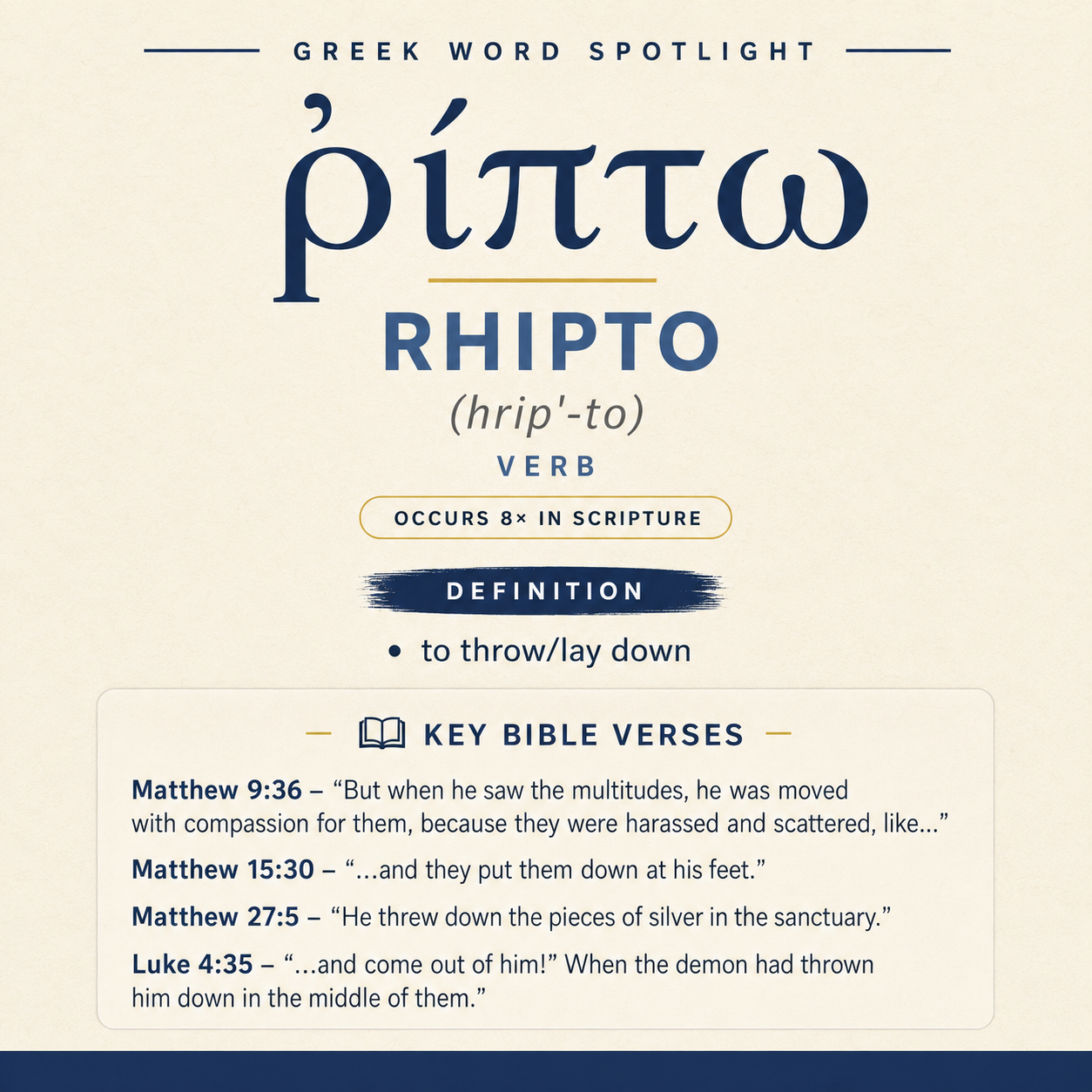
Occurrences
“But when he saw the multitudes, he was moved with compassion for them, because they were harassed and scattered, like sheep without a shepherd.” (Matthew 9:36)
Here the scene centers on a crowd described as “harassed and scattered.” ῥίπτω contributes the picture behind “scattered”: people are not simply dispersed at random but are portrayed as having been thrown about—left in a condition like sheep without guidance or protection. The verb sharpens the pathos of the comparison by framing their state as something that has happened to them, not as a chosen arrangement.

“Great multitudes came to him, having with them the lame, blind, mute, maimed, and many others, and they put them down at his feet. He healed them,” (Matthew 15:30)
In this gathering of need, ῥίπτω depicts the act of bringing the afflicted and laying them down “at his feet.” The wording points to purposeful placement: the needy are set where help is expected, and the healer’s feet become the focal point of access. The action is direct and concrete—bodies are deposited in front of him—so the verb helps the reader feel the immediacy and urgency of the crowd’s approach.
“He threw down the pieces of silver in the sanctuary, and departed. He went away and hanged himself.” (Matthew 27:5)
In this terse account, ῥίπτω marks a decisive gesture: the “pieces of silver” are thrown down “in the sanctuary.” The setting (“in the sanctuary”) frames the action as public and abrupt rather than private and careful. The verb conveys not merely setting something aside but casting it away, with the thrown coins functioning as a final act before “departed.”
“Jesus rebuked him, saying, “Be silent, and come out of him!” When the demon had thrown him down in the middle of them, he came out of him, having done him no harm.” (Luke 4:35)
Here ῥίπτω describes what the demon does to the afflicted person: it “had thrown him down in the middle of them.” The verb heightens the confrontation by showing a violent, visible effect in the presence of the crowd (“in the middle of them”). At the same time, the sentence closes with “having done him no harm,” so the throwing-down is portrayed as real and disruptive, yet bounded by the outcome of Jesus’ rebuke.
“It would be better for him if a millstone were hung around his neck, and he were thrown into the sea, rather than that he should cause one of these little ones to stumble.” (Luke 17:2)
In this warning, ῥίπτω belongs to a stark conditional image: a person with a millstone “hung around his neck” and then “thrown into the sea.” The verb indicates a completed, irreversible casting—an act that ends in submersion. The force of the saying comes from pairing the weight (“millstone”) with the motion (“thrown”), producing an image of being cast away with no recovery implied by the scene.
“As they cried out, threw off their cloaks, and threw dust into the air,” (Acts 22:23)
In this burst of agitation, ῥίπτω describes two coordinated actions: they “threw off their cloaks” and “threw dust into the air.” The verb captures quick, demonstrative movements that match their crying out. Casting dust upward is especially vivid: the action makes their uproar visible, turning anger into a physical display that fills the air around them.
“On the third day, they threw out the ship’s tackle with their own hands.” (Acts 27:19)
Here ῥίπτω is the sailors’ hard decision in crisis: “they threw out the ship’s tackle with their own hands.” The phrase “with their own hands” stresses personal effort and urgency; this is not accidental loss but intentional jettisoning. Throwing “the ship’s tackle” overboard shows the extremity of the situation—valuable equipment is cast away to meet the demands of survival at sea.
“Fearing that we would run aground on rocky ground, they let go four anchors from the stern, and wished for daylight.” (Acts 27:29)
In this nautical moment, ῥίπτω underlies the action rendered “they let go four anchors from the stern.” The movement is downward and away—anchors are released into the sea to check the ship’s drift as the crew fears “rocky ground.” The verb’s contribution is the sense of a decisive casting from the stern: they relinquish what is in hand to gain stability, then wait in anxious hope (“wished for daylight”).

Sense and Usage
Across these passages, ῥίπτω consistently portrays an action that is more abrupt than simple placement and more active than mere movement. It can describe people being “scattered” in a way that suggests they have been flung about (Matthew 9:36), or the intentional laying-down of the needy in a place of anticipated help (Matthew 15:30). It can also mark an expressive casting-away of objects—silver in a sacred space (Matthew 27:5), cloaks cast off and dust cast upward in public protest (Acts 22:23), and maritime equipment cast out in the face of danger (Acts 27:19).
The verb’s range in these scenes includes both voluntary and involuntary throwing. In Luke 4:35 the afflicted person is thrown down by a demon, an act done to him and witnessed by others; in Luke 17:2 the person is imagined as being thrown into the sea, a passive outcome within a warning. Conversely, the crowd in Matthew 15:30 actively lays sufferers at Jesus’ feet, and the crew in Acts 27 actively casts out gear or releases anchors. In each case, the motion implied by ῥίπτω creates a clear before-and-after: something is in one place (or state) and is then abruptly put down, cast away, or forced down into another.
Several occurrences highlight direction and setting, which shape how the throwing is heard. Things can be thrown down “in the sanctuary” (Matthew 27:5), thrown down “in the middle of them” (Luke 4:35), thrown “into the sea” (Luke 17:2), thrown “into the air” (Acts 22:23), or thrown out from a ship (Acts 27:19) and from “the stern” (Acts 27:29). These locational notes show ῥίπτω operating not as an abstract idea but as a concrete transfer into a defined space—before witnesses, into depths, upward into the air, or outward from a vessel.
Imagery
The imagery of ῥίπτω in these verses often joins physical motion to human need or danger. A crowd is pictured as thrown about like shepherdless sheep (Matthew 9:36), sufferers are laid down at a healer’s feet (Matthew 15:30), and a man is thrown down in a public clash with a demon (Luke 4:35). Elsewhere the verb marks moments when people cast things away under pressure—coins flung down before departure (Matthew 27:5), dust hurled into the air amid shouting (Acts 22:23), and equipment cast into the sea as rocky ground threatens (Acts 27:19, 27:29). The repeated pattern is sudden, visible action that makes an internal crisis—compassion, remorse, rage, fear—plainly seen in what is thrown and where it lands.
Sources: Lexical data from Strong’s Exhaustive Concordance and the Translators Brief Lexicon of Extended Strongs for Greek (STEPBible, CC BY). Occurrence data from the Translators Amalgamated Greek New Testament (STEPBible, CC BY). Scripture quotations from the World English Bible (public domain).




