
Understanding the Meaning of Apobletos in Greek
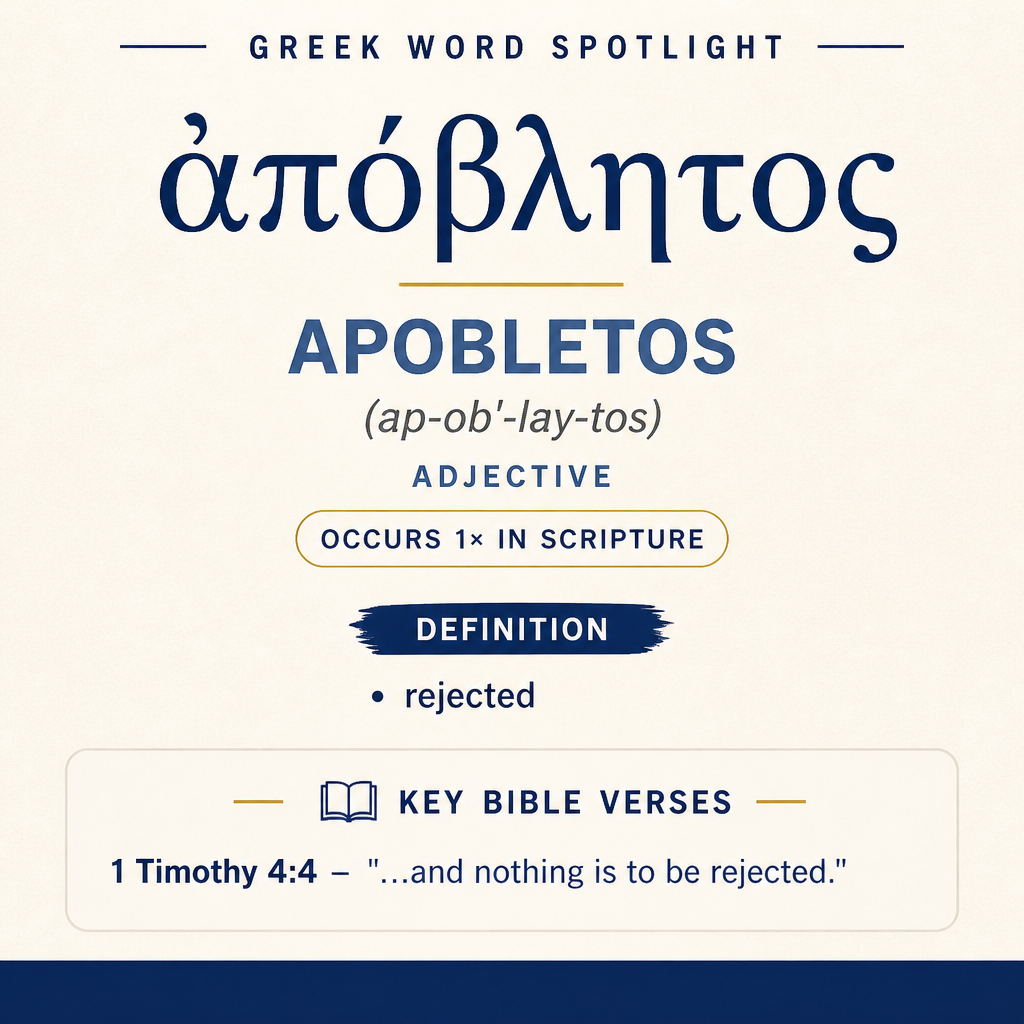
ἀπόβλητος means “rejected” and appears once in Scripture, in 1 Timothy 4:4.
Scripture Occurrence
This word occurs 1 time in Scripture. Its single occurrence is in 1 Timothy 4:4.
Learn More →Verse Context
In 1 Timothy 4:4, it states that nothing is to be rejected if received with thanksgiving.
Learn More →ἀπόβλητος means “rejected,” and it appears in the instruction about receiving God’s creatures with thanksgiving in 1 Timothy 4:4. In that setting it frames what the passage denies should happen to something God has made and called good.
Root and Related Words
ἀπόβλητος derives from the verb apoballo (ἀποβάλλω), “to throw away” (Strong’s G577). The relationship places ἀπόβλητος in the orbit of removal or disposal language: what is “rejected” is treated as something to be cast off, set aside, or dismissed from use.

Occurrences
“For every creature of God is good, and nothing is to be rejected, if it is received with thanksgiving.” (1 Timothy 4:4)
In this sentence, ἀπόβλητος functions as a firm boundary on the response permitted toward “every creature of God.” The verse opens with a broad affirmation—“every creature of God is good”—and then turns that affirmation into a practical conclusion: “nothing is to be rejected.” The word therefore serves the verse’s moral logic by naming the action that is ruled out. Instead of allowing a posture of refusal toward what God has made, the line explicitly disallows that outcome.

The immediate context within the verse sets ἀπόβλητος alongside reception and gratitude: the negative (“nothing is to be rejected”) is paired with a positive condition (“if it is received with thanksgiving”). Within the verse’s own terms, rejection is the opposite of receiving; it is what someone might do with a “creature of God” if they treat it as unfit, unwelcome, or inappropriate for acceptance. The phrase “received with thanksgiving” portrays an act of welcome that is not merely practical but explicitly grateful; ἀπόβλητος marks the contrary stance—turning something away rather than welcoming it as a good gift.
Because the statement is cast in universal terms (“every,” “nothing”), ἀπόβλητος helps carry the comprehensiveness of the claim. The verse does not address a single item by name; rather, it makes a sweeping judgment about God’s creatures as a class and, on that basis, excludes a sweeping practice of rejection. The word thus supports a general rule: where the creature is received with thanksgiving, “rejected” is not an acceptable verdict.
Sense and Usage
Within its lone attested setting, “rejected” has the force of a disqualifying label placed on something that could otherwise be taken up and enjoyed. The verse sets up a contrast between an evaluative stance (calling something good) and a practical response (receiving it). ἀπόβλητος belongs to that practical response: it describes what it would mean, in action, to refuse what one has judged—or has been told—to be good. In that way the word bridges belief and behavior: if “every creature of God is good,” then the fitting response is not to treat any of it as refuse.
The conditional clause, “if it is received with thanksgiving,” locates the refusal/reception contrast inside a posture toward God. Thanksgiving is the acknowledged frame for receiving; it implies recognition of God as giver (“creature of God”) and sets the act of receiving within worshipful gratitude. ἀπόβλητος, by contrast, would represent the practical denial of that posture: to “reject” would be to act as though the creature were not to be welcomed as a good gift. The verse’s wording does not merely forbid rejection in the abstract; it forbids rejection in the very circumstance where the creature is being received rightly—namely, with thanksgiving.
Because ἀπόβλητος is related to “to throw away,” the word’s sense carries an implied picture of disposal: what is rejected is treated as something to be discarded rather than taken in. In 1 Timothy 4:4, that picture sharpens the verse’s claim by showing what is at stake. The question is not only whether one approves of a creature in theory, but whether one handles it as something to keep and receive, or as something to cast off. The verse’s logic places rejection in the category of an improper handling of God’s good creation when gratitude governs the reception.
The scope of “nothing” also shapes how “rejected” is heard: ἀπόβλητος is not reserved for exceptional cases in this line but is excluded as a general practice. The sentence is constructed so that the goodness of “every creature of God” is matched by the categorical prohibition of treating any such creature as disposable. Thus “rejected” functions as the negated alternative to thankful reception, and the verse’s flow makes that negation part of the instruction’s central emphasis.
Imagery
Even in a straightforward ethical statement, ἀπόβλητος carries concrete imagery. Joined to its verb family’s notion of “throwing away,” it evokes the act of casting something aside as unwanted. In 1 Timothy 4:4 that imagined action is set against the act of taking something up and receiving it—an image of open-handed acceptance—so that the verse’s teaching can be felt not only as an idea but as a practical contrast between discarding and welcoming what God has made.
Sources: Lexical data from Strong’s Exhaustive Concordance and the Translators Brief Lexicon of Extended Strongs for Greek (STEPBible, CC BY). Occurrence data from the Translators Amalgamated Greek New Testament (STEPBible, CC BY). Scripture quotations from the World English Bible (public domain).





