
Exploring the Meaning of Agorazo in Greek
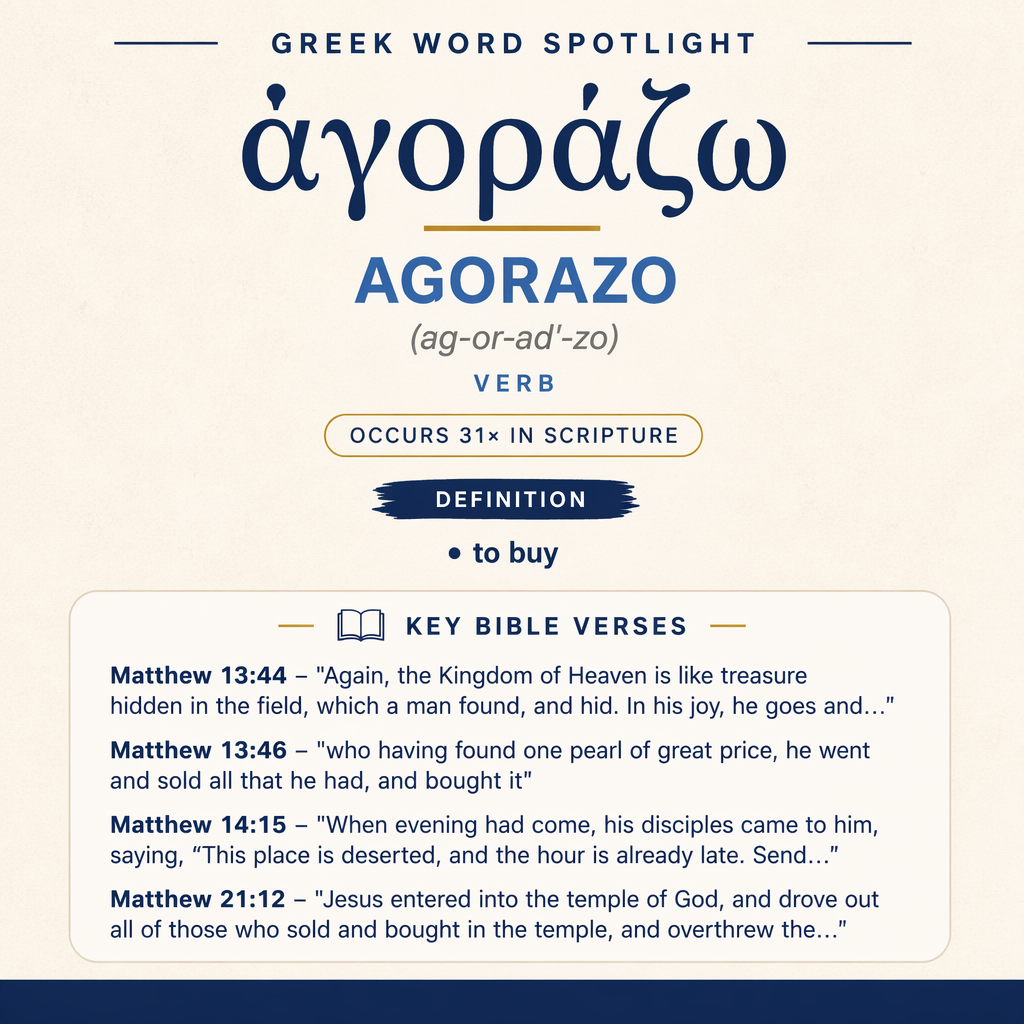
ἀγοράζω (Agorazo) means “to buy” and occurs 31 times in Scripture, including in Matthew and Mark.
Core Meaning
ἀγοράζω means “to buy.” In the listed passages, it describes purchasing items such as a pearl or bread.
Learn More →Gospel Examples
In Matthew 13:46, someone sells all he has and buys a pearl of great price. In Mark 6:36, the disciples suggest buying bread.
Learn More →Temple & Field
In Matthew 21:12, Jesus drives out those buying and selling in the temple. In Matthew 27:7, money is used to buy the potter’s field.
Learn More →ἀγοράζω expresses the act of buying, pictured in the Gospels in everyday needs, commercial spaces, and purposeful purchases that drive the plot of parables and passion narratives. In these passages it marks concrete transactions—food, land, cloth, spices—often highlighting urgency, value, or propriety in the setting where buying occurs.
Occurrences
“Again, the Kingdom of Heaven is like treasure hidden in the field, which a man found, and hid. In his joy, he goes and sells all that he has, and buys that field.” (Matthew 13:44)
Here buying is the decisive final step of a sequence: finding, hiding, selling, and then purchasing. The purchase of “that field” legally secures what has been discovered within it, and the verse stresses the buyer’s total liquidation (“sells all that he has”) and the emotional tone (“In his joy”) that accompanies the transaction.
“who having found one pearl of great price, he went and sold all that he had, and bought it.” (Matthew 13:46)
Buying is paired with evaluation: the pearl is “of great price,” and the purchase follows the same totalizing sale of prior holdings. The verb focuses attention on the choice to convert all assets into one acquisition, framing buying as an act that concentrates value rather than distributes it.
“When evening had come, his disciples came to him, saying, “This place is deserted, and the hour is already late. Send the multitudes away, that they may go into the villages, and buy themselves food.”” (Matthew 14:15)
Buying is suggested as the practical solution to a logistical problem: a late hour and a deserted location. The disciples envision many people dispersing to “the villages” in order to obtain “food,” so the verb anchors the scene in ordinary market behavior and a need that must be met quickly.
“Jesus entered into the temple of God, and drove out all of those who sold and bought in the temple, and overthrew the money changers’ tables and the seats of those who sold the doves.” (Matthew 21:12)
Buying is placed inside the temple precincts, alongside selling, money changing, and the sale of doves. The verb identifies buyers as active participants in a commercial environment that Jesus disrupts; his action is directed not only at vendors but also at the transactional activity itself in that location.
“But the wise answered, saying, ‘What if there isn’t enough for us and you? You go rather to those who sell, and buy for yourselves.’” (Matthew 25:9)
Buying is presented as a responsibility each person must undertake individually: “buy for yourselves.” The wise distinguish between shared supply and what must be procured from “those who sell,” making buying the proposed remedy for shortage and the test of preparedness within the story’s tension.
“While they went away to buy, the bridegroom came, and those who were ready went in with him to the wedding feast, and the door was shut.” (Matthew 25:10)
Buying becomes a time-consuming errand with consequences. The phrase “went away to buy” explains absence at the critical moment; the arrival of the bridegroom and the shutting of the door happen during that interval, so the act of buying functions as the narrative hinge between readiness and exclusion.
“They took counsel, and bought the potter’s field with them, to bury strangers in.” (Matthew 27:7)
Buying is attached to deliberation (“took counsel”) and to a communal purpose. The object purchased, “the potter’s field,” is acquired “to bury strangers in,” so the verb signals an official transaction aimed at securing a practical public use rather than personal enjoyment.
“Send them away, that they may go into the surrounding country and villages, and buy themselves bread, for they have nothing to eat.” (Mark 6:36)
As in Matthew’s feeding context, buying is invoked to address hunger, here specifically “bread.” The proposed buyers are the crowd, who would travel to “the surrounding country and villages,” and the verb underscores the normal expectation that food is obtained by purchase when supplies run out.
“But he answered them, “You give them something to eat.” They asked him, “Shall we go and buy two hundred denarii worth of bread, and give them something to eat?” (Mark 6:37)
Buying is measured and costed: “two hundred denarii worth of bread.” The disciples frame buying as a possible but expensive solution, and the verb draws attention to the scale of the need by attaching a striking sum to the proposed purchase.
“They came to Jerusalem, and Jesus entered into the temple, and began to throw out those who sold and those who bought in the temple, and overthrew the money changers’ tables, and the seats of those who sold the doves.” (Mark 11:15)
This parallels Matthew’s temple scene, again identifying buyers as integral to the commerce being expelled. Buying is not a neutral background action here; it is one side of an economic exchange that is taking place “in the temple,” and the verb helps define the activity Jesus forcibly halts.
“He bought a linen cloth, and taking him down, wound him in the linen cloth, and laid him in a tomb which had been cut out of a rock. He rolled a stone against the door of the tomb.” (Mark 15:46)
Buying supplies the necessary material for burial action. The linen cloth is obtained first, then used immediately: “wound him in the linen cloth” and laid him in a tomb. The verb therefore marks a purposeful purchase made for an urgent, reverent task carried out step by step in the same verse.
“When the Sabbath was past, Mary Magdalene, and Mary the mother of James, and Salome, bought spices, that they might come and anoint him.” (Mark 16:1)
Buying is motivated by intent: the women purchase “spices” in order to “come and anoint him.” The timing (“When the Sabbath was past”) places the purchase at the first opportunity after a pause, and the verb presents the acquisition as preparation for a specific act of care.
Sense and Usage
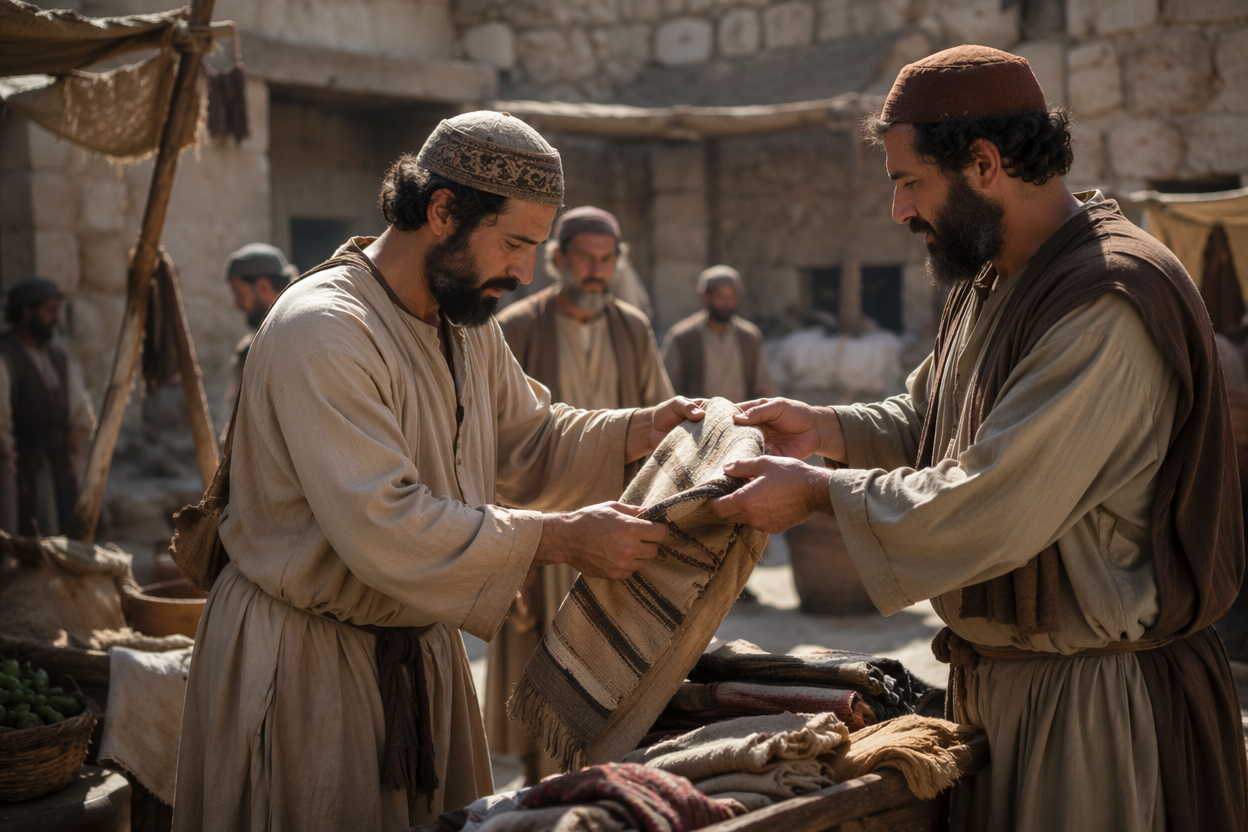
Across these scenes, ἀγοράζω consistently denotes acquisition by purchase, but the narrative contexts color what buying accomplishes. In Matthew 13:44 and 13:46, buying stands at the end of a deliberate conversion of resources—“sells all that he has”—so the transaction is portrayed as comprehensive and single-minded, shaped by discovery (“treasure hidden,” “one pearl of great price”) and by the buyer’s response (“In his joy”). The purchase is not casual; it finalizes a choice to secure something valued above all else.
In the feeding settings (Matthew 14:15; Mark 6:36–37), buying is everyday and practical, yet the verses heighten its realism by emphasizing constraints: time (“evening,” “already late”), place (“deserted,” “surrounding country and villages”), and cost (“two hundred denarii worth of bread”). Buying is what ordinary reasoning reaches for when faced with hunger and distance. The verb thus conveys not only procurement but also the implied process—traveling to villages, paying, returning—so that the scale of the need becomes tangible.
In the temple episodes (Matthew 21:12; Mark 11:15), buying is embedded in a contested space. The text places buyers alongside sellers, money changers, and dove vendors, and Jesus’ action targets the entire commercial dynamic. Here ἀγοράζω identifies participation in an exchange taking place within the temple precincts, and its inclusion shows that demand (buying) as well as supply (selling) belongs to the activity being driven out.
In Matthew 25:9–10, buying becomes bound up with preparedness and timing. The wise counsel others to “buy for yourselves,” making purchase the appropriate way to remedy lack, but the subsequent line shows that the attempt “to buy” creates absence at the decisive moment. The verb therefore carries an implicit delay: buying takes time, and in this story time is the scarce resource once the bridegroom arrives and “the door was shut.”
Finally, in Matthew 27:7 and Mark 15:46; 16:1, buying is tied to burial-related actions and communal decisions. The purchase of “the potter’s field” follows counsel and serves a public purpose (“to bury strangers in”), whereas the purchase of a “linen cloth” and “spices” directly equips immediate acts surrounding a body: wrapping, entombing, and anointing. In these verses the verb highlights that certain duties require material provision obtained through purchase, and it links intent to concrete preparation.
Imagery and Emphasis
The occurrences of ἀγοράζω move through recognizable places: a field, villages, the temple, and a tomb. The word’s imagery is often transactional—selling, money changing, purchasing—but the verses repeatedly frame buying as a decisive act that exposes what matters most: a man’s joy in securing a field (Matthew 13:44), the costly scale of feeding a crowd (Mark 6:37), the propriety of activity within the temple (Mark 11:15), the consequences of leaving to procure what is lacking (Matthew 25:10), and the practical preparations made for burial (Mark 15:46; Mark 16:1).
Sources: Lexical data from Strong’s Exhaustive Concordance and the Translators Brief Lexicon of Extended Strongs for Greek (STEPBible, CC BY). Occurrence data from the Translators Amalgamated Greek New Testament (STEPBible, CC BY). Scripture quotations from the World English Bible (public domain).




