Exploring the Meaning of Apoblepo in Greek
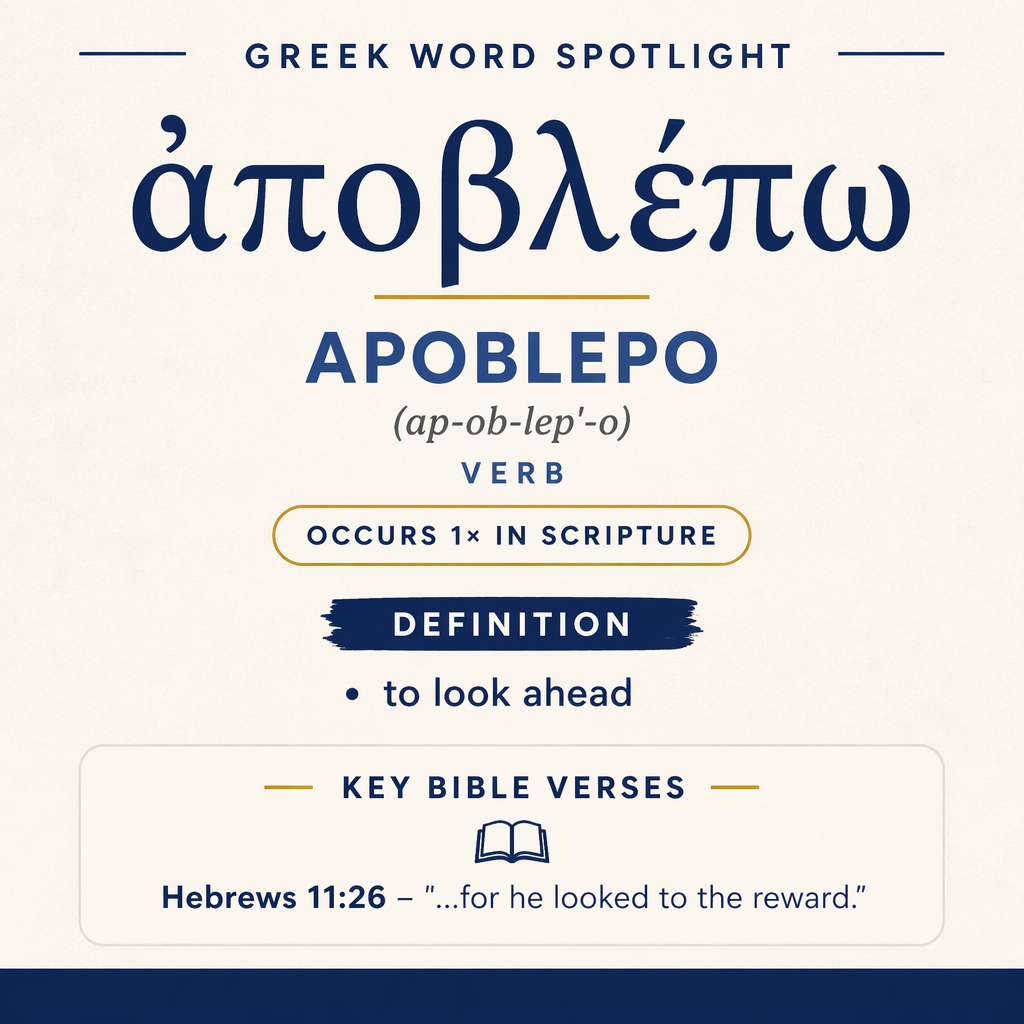
ἀποβλέπω means “to look ahead” and appears once in Scripture, in Hebrews 11:26.
Scripture Occurrence
This word occurs one time in Scripture. Its single occurrence is in Hebrews 11:26.
Learn More →Hebrews Context
In Hebrews 11:26, it describes looking to the reward. The verse contrasts Christ’s reproach with Egypt’s treasures.
Learn More →ἀποβλέπω means “to look ahead,” and it appears once in the Greek Scriptures at Hebrews 11:26. In that setting it describes a forward-directed gaze that shapes how present wealth and present reproach are evaluated.
Root and Related Words
ἀποβλέπω is formed from ἀπό (apo), “away from” (Strong’s G575), and βλέπω (blepo), “to see” (Strong’s G991). The compound draws these ideas together to express a kind of seeing that is oriented beyond what is immediately in view.

Occurrences
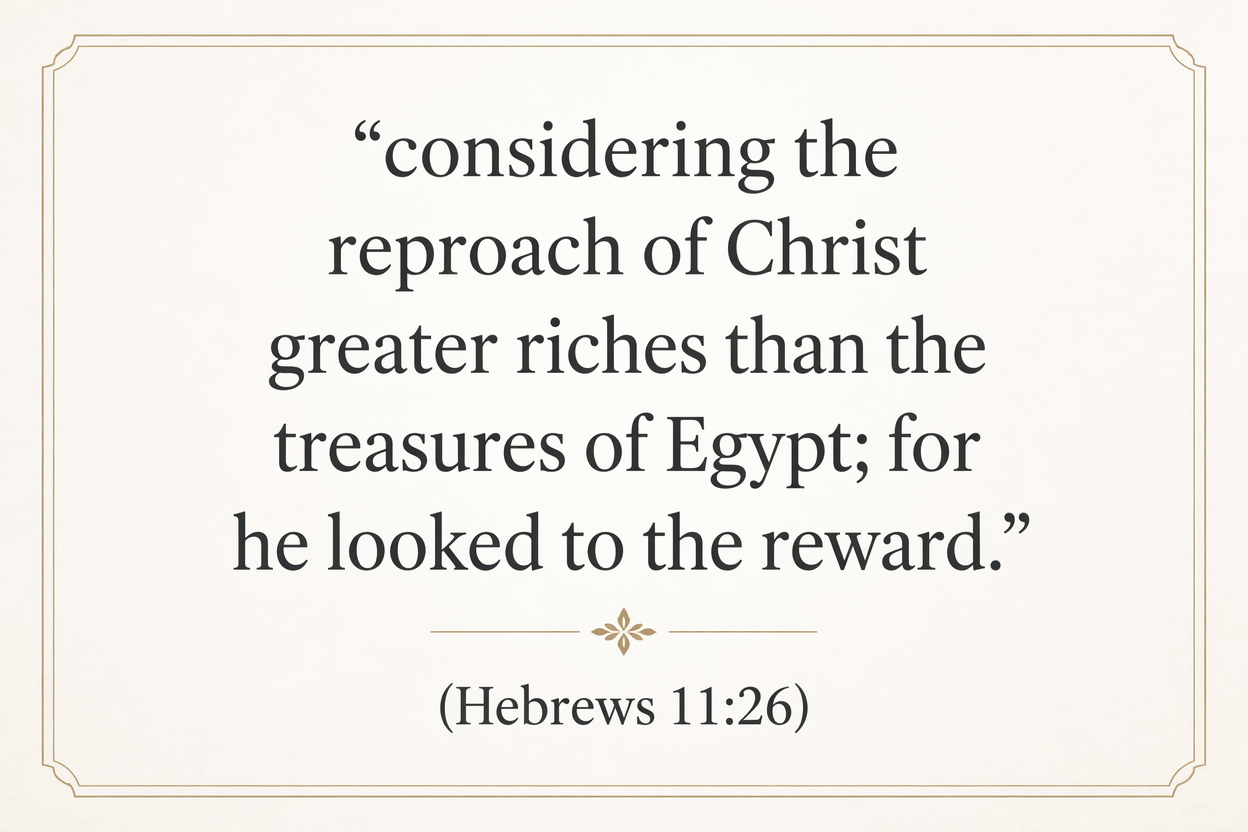
“considering the reproach of Christ greater riches than the treasures of Egypt; for he looked to the reward.” (Hebrews 11:26)
Here ἀποβλέπω explains the inner logic behind a striking valuation: “the reproach of Christ” is counted “greater riches than the treasures of Egypt.” The verse sets two kinds of “riches” side by side—one bound up with “treasures of Egypt,” the other bound up with “reproach”—and the verb supplies the reason this comparison can be made at all: “for he looked to the reward.” The forward look does not float as a vague optimism; it functions as the stated ground (“for…”) of the decision described in the first clause.
The word’s contribution is felt in the way it organizes time and attention within the sentence. The “treasures of Egypt” represent something tangible and present, while “the reward” is presented as the object of a directed look. By describing him as one who “looked to the reward,” Hebrews frames his appraisal of present options as governed by a future reference point. The verb therefore marks a deliberate orientation: his regard is set toward what lies ahead, and that orientation reorders what counts as “greater riches” in the present.
Just as importantly, the verb connects the two halves of the verse without changing the topic. The first half is about “considering” (an evaluative judgment), and ἀποβλέπω supplies the basis for that judgment. The action of “looking ahead” is not a separate spiritual exercise alongside moral reasoning; it is the reason his reasoning lands where it does. In the scene the word suggests sustained attention rather than a passing glance: the gaze toward “the reward” is strong enough to outweigh “the treasures of Egypt” as the competing object of desire.
Sense and Usage
The definition “to look ahead” fits Hebrews 11:26 in a concrete, decision-shaping way. The verse portrays a choice about what is truly valuable, and the forward look is what makes the choice coherent. The “ahead” aspect is carried by the contrast between what can be possessed now (“treasures of Egypt”) and what is held out as the goal (“the reward”). In this usage, the verb describes a posture of mind and will: attention is directed beyond immediate circumstances so that present loss (“reproach”) can be assessed in relation to a coming outcome (“reward”).
Because the look is explicitly tied to “the reward,” the verb’s forward direction is not merely chronological; it is evaluative. The verse does not present “looking ahead” as a neutral act of forecasting. Rather, the gaze functions as a chosen point of reference that assigns comparative weight: “reproach” can be treated as “greater riches” precisely because the reward, lying ahead, is treated as real and determinative. The verb thus serves as a bridge between belief about what is coming and behavior in the present, without requiring the reader to supply any additional mechanism beyond what the sentence itself states.
In this context, “looking ahead” also implies selectivity in attention. The sentence names two powerful attractors—honor and wealth on one side (“treasures of Egypt”), and shame on the other (“reproach of Christ”). ἀποβλέπω depicts the decisive direction of sight that governs which attractor wins. The word does not describe the content of the reward, but it does describe the direction of regard: the look is turned toward the reward in such a way that other visible “treasures” are relativized.
Imagery
Even in a single occurrence, ἀποβλέπω carries vivid imagery: a person standing between immediate wealth and future recompense, with the eyes set forward. Hebrews 11:26 places that imagery in a context of comparison—“greater riches than the treasures of Egypt”—so that the act of looking ahead becomes the quiet, interior movement that explains an outwardly paradoxical valuation.
Sources: Lexical data from Strong’s Exhaustive Concordance and the Translators Brief Lexicon of Extended Strongs for Greek (STEPBible, CC BY). Occurrence data from the Translators Amalgamated Greek New Testament (STEPBible, CC BY). Scripture quotations from the World English Bible (public domain).