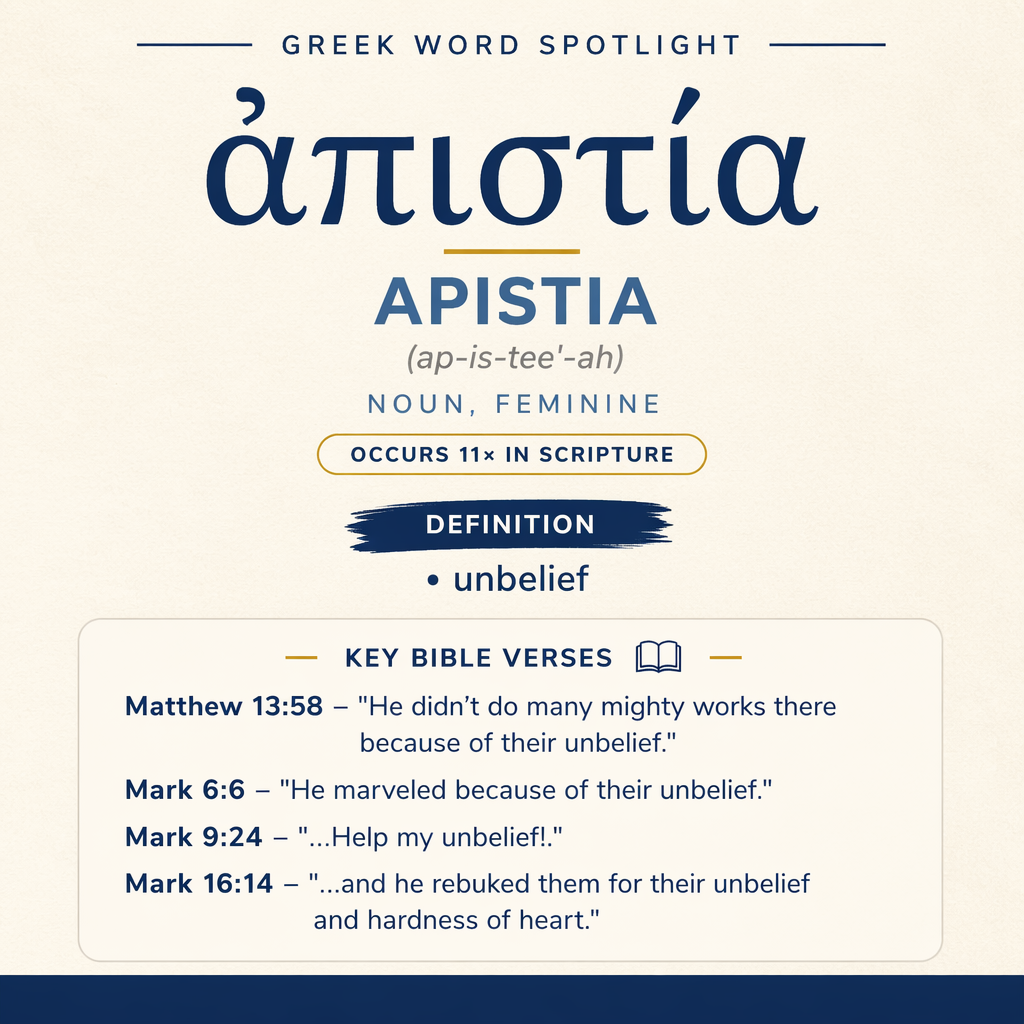
In the Gospels, unbelief is linked with Jesus doing fewer mighty works (Matthew 13:58) and with his marveling and rebuke (Mark 6:6; Mark 16:14). It also appears in a personal plea: “Help my unbelief!” (Mark 9:24).
Romans uses ἀπιστία in discussions of faith and God’s faithfulness (Romans 3:3; Romans 4:20). It also describes being “broken off” and the possibility of being “grafted in again” (Romans 11:20, 23).
ἀπιστία means “unbelief,” a term used for the stance or condition that resists trusting what is presented as true. In the New Testament it appears in Gospel scenes where Jesus confronts skepticism and in epistolary arguments where unbelief is treated as a decisive spiritual posture with concrete consequences.
Occurrences
“He didn’t do many mighty works there because of their unbelief.” (Matthew 13:58)
Here ἀπιστία is the stated reason for the scarcity of “mighty works.” The sentence makes unbelief the operative condition in that setting: what is (not) done is explained “because of” it. The word frames the community’s response as more than mere uncertainty; it is a settled disposition that shapes what takes place there.
“He marveled because of their unbelief. He went around the villages teaching.” (Mark 6:6)
ἀπιστία is again presented as the cause (“because of”), but the focus falls on Jesus’ reaction: “He marveled.” The word characterizes what prompts astonishment and, in the same breath, leads into continued instruction: “He went around the villages teaching.” Unbelief is thus set within a scene where teaching answers it, suggesting it is encountered publicly and addressed through proclamation.
“Immediately the father of the child cried out with tears, “I believe. Help my unbelief!”” (Mark 9:24)
In this cry, ἀπιστία is owned by the speaker and placed alongside an explicit confession of belief: “I believe. Help my unbelief!” The word functions as a frank name for an inner contradiction—belief present, yet unbelief still active and needing aid. The request “Help” portrays unbelief not merely as an opinion but as a hindrance that requires intervention.
“Afterward he was revealed to the eleven themselves as they sat at the table, and he rebuked them for their unbelief and hardness of heart, because they didn’t believe those who had seen him after he had risen.” (Mark 16:14)
Here ἀπιστία is paired with “hardness of heart” and becomes the direct object of rebuke. The verse itself explains what this unbelief looked like: “because they didn’t believe those who had seen him after he had risen.” Unbelief is therefore not abstract; it is refusal to accept testimony. The scene places it among insiders (“the eleven themselves”), locating unbelief even within the circle of disciples and showing it as culpable in this context.
“For what if some were without faith? Will their lack of faith nullify the faithfulness of God?” (Romans 3:3)
In Romans 3:3, ἀπιστία appears as “lack of faith” and is posed as a hypothetical (“what if some were without faith?”). The question that follows sets unbelief against “the faithfulness of God,” asking whether human lack of faith can “nullify” divine faithfulness. The word thus serves an argumentative role: it is the human variable introduced to clarify what does—and does not—affect God’s reliability.
“Yet, looking to the promise of God, he didn’t waver through unbelief, but grew strong through faith, giving glory to God,” (Romans 4:20)
Here ἀπιστία is the route not taken: “he didn’t waver through unbelief.” The verse contrasts two trajectories: wavering that would arise “through unbelief,” and strengthening that comes “through faith.” Unbelief is portrayed as a destabilizing force in relation to “the promise of God,” whereas faith results in resilience and worship (“giving glory to God”). The term is therefore placed within the dynamics of response to promise—either wavering or growing strong.
“True; by their unbelief they were broken off, and you stand by your faith. Don’t be conceited, but fear;” (Romans 11:20)
In this image of being “broken off,” ἀπιστία is the means: “by their unbelief they were broken off.” The word marks the reason for separation, set in direct contrast to the addressees’ stability: “you stand by your faith.” The admonition that follows (“Don’t be conceited, but fear;”) shows the practical force of the contrast: unbelief is not merely a label for “them,” but a warning sign that shapes how “you” ought to think and act.
“They also, if they don’t continue in their unbelief, will be grafted in, for God is able to graft them in again.” (Romans 11:23)
Here ἀπιστία is treated as a continuing state that can cease: “if they don’t continue in their unbelief.” The condition for being “grafted in” is defined negatively in relation to unbelief, and the statement grounds hope in divine ability: “for God is able to graft them in again.” The word thus functions within an argument about reversal—unbelief excludes, but not continuing in unbelief opens the way for restoration.
“although I used to be a blasphemer, a persecutor, and insolent. However, I obtained mercy, because I did it ignorantly in unbelief.” (1 Timothy 1:13)
In this personal recollection, ἀπιστία describes the sphere in which prior actions were committed: “I did it ignorantly in unbelief.” The word accompanies “ignorantly,” linking unbelief with a lack of understanding that characterized past conduct, even conduct described in strong terms (“blasphemer, a persecutor, and insolent”). The verse does not excuse the actions, but it frames unbelief as part of the moral and cognitive environment from which mercy was received.
“Beware, brothers, lest perhaps there might be in any one of you an evil heart of unbelief, in falling away from the living God;” (Hebrews 3:12)
Here ἀπιστία is embedded in a vivid internal description: “an evil heart of unbelief.” The phrase locates unbelief not only in the mind but in the “heart,” and it is qualified as “evil.” The warning connects this inner posture to a trajectory: “in falling away from the living God.” Unbelief is thus portrayed as a heart-condition that carries momentum toward apostasy, making the exhortation urgent and communal (“Beware, brothers”).
“We see that they weren’t able to enter in because of unbelief.” (Hebrews 3:19)
In this concluding observation, ἀπιστία is the explicit cause of exclusion: “they weren’t able to enter in because of unbelief.” The verb phrase “weren’t able” frames unbelief as determinative for capability and outcome; it explains why entry did not happen. The verse’s concise causal structure gives the word a weighty, final function: unbelief stands as the stated barrier.
Sense and Usage
Across these passages ἀπιστία consistently names a posture that stands over against believing response. In the Gospels it is publicly observable and relational: a community setting can be characterized by unbelief that shapes what occurs (“He didn’t do many mighty works there because of their unbelief,” Matthew 13:58), and Jesus can respond to it with amazement, rebuke, and continued teaching (Mark 6:6; Mark 16:14). The word also reaches inward, naming the conflicted experience of a person who both believes and recognizes remaining resistance (“I believe. Help my unbelief!” Mark 9:24). That plea shows ἀπιστία as something that can coexist with belief in the same speaker, not as a neat category for outsiders only.
In Paul’s letters the term becomes a tool for reasoning about standing and change. Romans 3:3 sets unbelief as a human condition that raises theological questions; the argument distinguishes human lack of faith from God’s faithfulness rather than merging them. Romans 4:20 places unbelief on the axis of wavering versus strength in relation to “the promise of God,” so that unbelief is associated with instability, while faith yields firmness and worship. Romans 11:20–23 uses unbelief to explain being “broken off” and to set the conditional pathway to being “grafted in” again, speaking of unbelief as something one can “continue” in—or cease to continue in. In that setting ἀπιστία is not only descriptive but admonitory: the contrast with standing “by your faith” is designed to cultivate humility and fear rather than conceit.
In the pastoral and homiletical material (1 Timothy; Hebrews), unbelief is portrayed with moral seriousness and communal urgency. In 1 Timothy 1:13 it is linked with ignorance in recounting a transformed life, marking unbelief as the prior framework within which destructive actions were carried out. Hebrews intensifies the interior portrayal: “an evil heart of unbelief” is not a passing doubt but a heart-condition that tends toward “falling away from the living God” (Hebrews 3:12). The chapter’s later statement that “they weren’t able to enter in because of unbelief” (Hebrews 3:19) shows unbelief operating not merely as an attitude but as an effective cause with irreversible-seeming outcome in that example.
Imagery and Weight
The passages attach ἀπιστία to concrete images of effect: mighty works not done (Matthew 13:58), a teacher moving village to village (Mark 6:6), a rebuke delivered at a table (Mark 16:14), branches “broken off” and “grafted in” (Romans 11:20, 11:23), and a prevented “enter[ing] in” (Hebrews 3:19). Even when the word points inward—tears and a cry for help (Mark 9:24), an “evil heart” (Hebrews 3:12), ignorance in prior conduct (1 Timothy 1:13)—it is never left as mere private feeling; it is tied to actions, warnings, and outcomes that shape communities and destinies.
Sources:
Lexical data from Strong’s Exhaustive Concordance and the Translators Brief Lexicon of Extended Strongs for Greek (STEPBible, CC BY). Occurrence data from the Translators Amalgamated Greek New Testament (STEPBible, CC BY). Scripture quotations from the World English Bible (public domain).