Exploring the Meaning of Apeileo in Greek
ἀπειλέω means “to threaten” and occurs in Acts 4:17 and 1 Peter 2:23.
Scripture Occurrences
This word occurs 2 times in Scripture: Acts 4:17 and 1 Peter 2:23.
Learn More →Context Examples
In Acts 4:17, leaders propose threatening others to stop them speaking. In 1 Peter 2:23, Jesus did not threaten while suffering.
Learn More →ἀπειλέω means “to threaten.” It appears in two New Testament contexts: one in a deliberation about silencing public speech, and one in a description of restrained conduct under suffering.

Occurrences
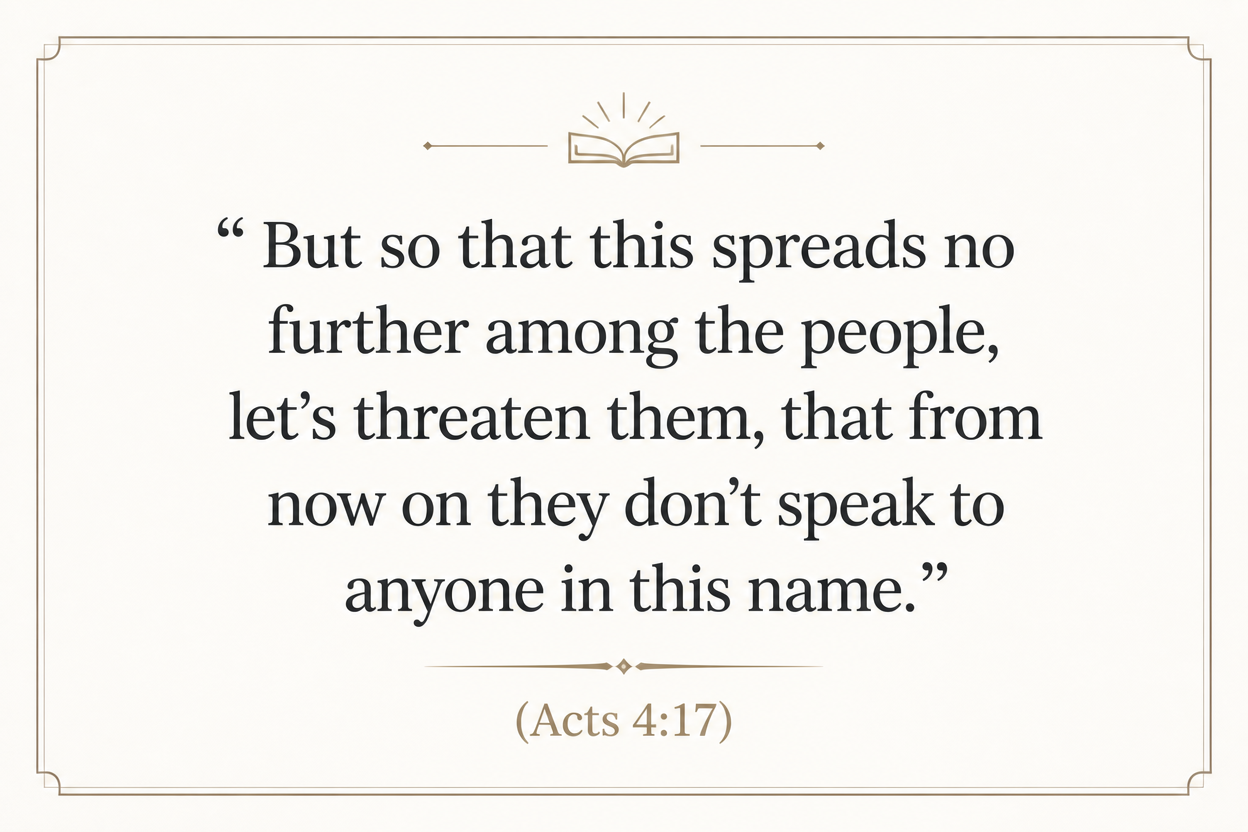
“But so that this spreads no further among the people, let’s threaten them, that from now on they don’t speak to anyone in this name.” (Acts 4:17)
Here ἀπειλέω functions as a proposed tool of control. The speakers frame the threat as a means to stop something from “spread[ing]… among the people,” and the desired outcome is explicitly verbal: “that from now on they don’t speak to anyone in this name.” The threat is not described in content (what punishment is promised), but it is presented as a pressure applied to the will, aiming to restrict speech. In this setting, threatening is treated as an action that can be decided upon (“let’s threaten them”) and directed toward a concrete behavioral boundary (“don’t speak”). The verse ties the threatening to social influence—containing a message so it “spreads no further”—so the threat is aimed at public communication and its ripple effects.
“When he was cursed, he didn’t curse back. When he suffered, he didn’t threaten, but committed himself to him who judges righteously.” (1 Peter 2:23)
In this verse ἀπειλέω names a response that is deliberately refused. The clause is tightly parallel: as cursing could be answered by counter-cursing, suffering could be answered by threatening; yet both retaliatory possibilities are denied (“he didn’t curse back… he didn’t threaten”). The word thus occupies the space of escalation: a threatened response would have been a way of pushing back against wrongdoing or pain, but it is replaced with a different action—“committed himself to him who judges righteously.” The scene places threatening alongside speech and moral posture. The contrast is not between silence and speech as such, but between a reaction that asserts pressure against others (threatening) and a response that entrusts judgment elsewhere. Within the verse’s rhythm, ἀπειλέω is presented as a kind of counterstroke under suffering that is intentionally withheld.

Sense and Usage
Across these two occurrences, ἀπειλέω names a performative act that seeks to influence another’s behavior by invoking impending consequences. In Acts 4:17 the emphasis falls on the social function of threatening: it is a chosen tactic to limit what others say and thereby prevent the wider dissemination of a message “among the people.” The threat is oriented toward prevention—stopping future speaking—so it is prospective by nature, aimed at what will or will not happen “from now on.”
In 1 Peter 2:23, by contrast, the emphasis falls on the personal restraint involved in not threatening. The verse pairs verbal injury (“cursed”) and physical or social injury (“suffered”) with the corresponding retaliatory options (“curse back… threaten”). Threatening here is treated as a natural-seeming reactive move under pressure, something that could be deployed to reassert control, intimidate, or warn of payback. Yet the passage frames the refusal to threaten as part of a broader pattern of non-retaliation, where the alternative to counterpressure is entrusting one’s case to “him who judges righteously.”
Placed side by side, these uses highlight two common arenas where threatening operates: institutional or group efforts to curb public speech, and interpersonal moments of provocation where retaliation is possible. The word can therefore be heard both as an outward strategy (a calculated step: “let’s threaten them”) and as an inwardly resisted impulse (a reaction withheld: “he didn’t threaten”). In both settings, ἀπειλέω is closely connected to speech: in Acts it is used to constrain speaking; in 1 Peter it is set in parallel with cursing and appears as the speech-act counterpart to suffering.
The verses also show that threatening is not defined by the exact content of the menace; neither text specifies the particular penalty threatened. Instead, the function is clear: threatening is pressure intended to shape what another person will do. Acts 4:17 makes that target explicit—silencing speech “in this name.” 1 Peter 2:23 makes the alternative explicit—rather than answer suffering with intimidation, the subject commits himself to a righteous judge. In this way, the two occurrences together situate ἀπειλέω along a spectrum from coercion (used to suppress) to restraint (refusing coercion even when provoked).
Imagery in Context
Acts 4:17 pictures a community setting where words can “spread… among the people,” and threatening enters as a barrier erected against that spread—an attempt to fence in public speech. 1 Peter 2:23 pictures the opposite movement: under cursing and suffering, the option to threaten is laid down, and the energy that could have become intimidation is redirected into committing oneself to righteous judgment.
Sources: Lexical data from Strong’s Exhaustive Concordance and the Translators Brief Lexicon of Extended Strongs for Greek (STEPBible, CC BY). Occurrence data from the Translators Amalgamated Greek New Testament (STEPBible, CC BY). Scripture quotations from the World English Bible (public domain).