Understanding the Significance of Apartismos in Greek
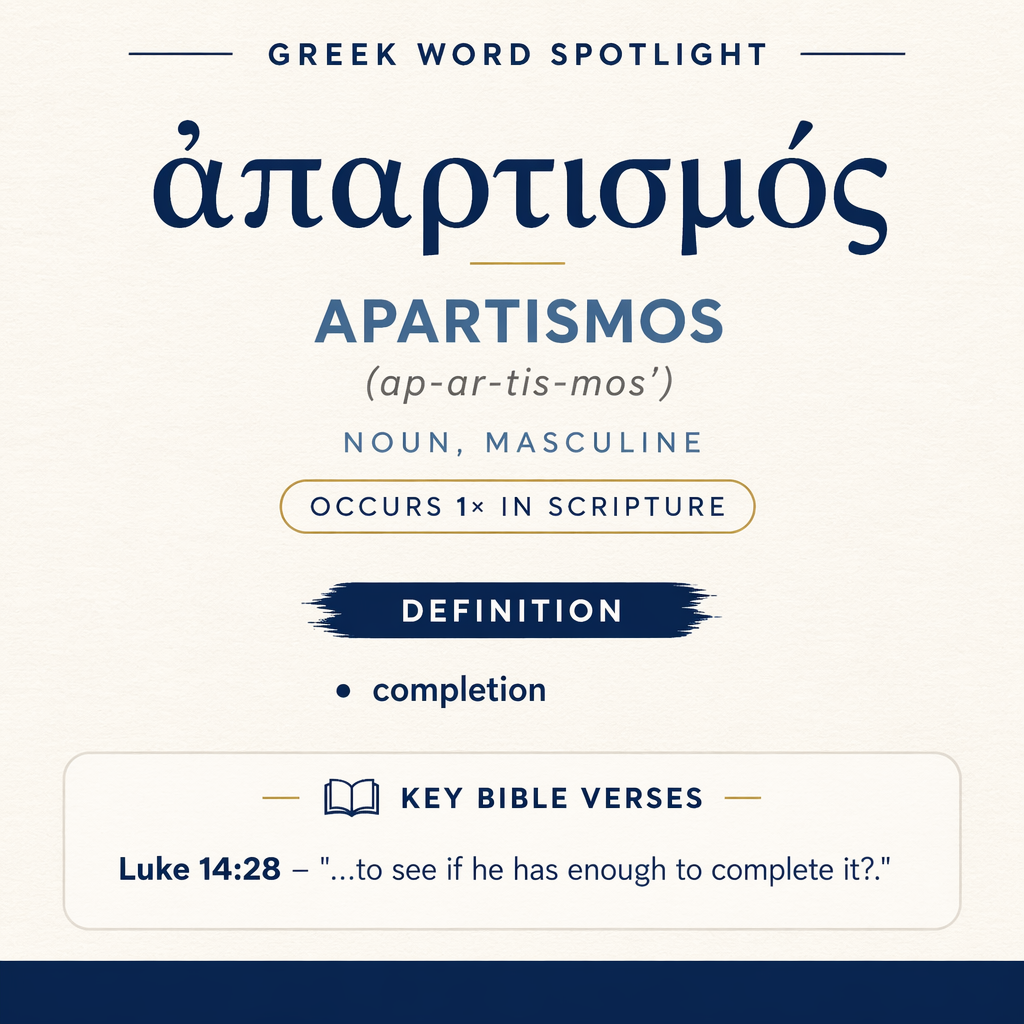
ἀπαρτισμός means “completion” and occurs once in Scripture, in Luke 14:28.
Biblical Occurrence
This noun occurs 1 time in Scripture. Its single occurrence is in Luke 14:28.
Learn More →Verse Context
In Luke 14:28, it appears in a saying about counting the cost before building a tower.
Learn More →ἀπαρτισμός expresses the idea of “completion,” and it appears in Jesus’ brief construction illustration about counting the cost before beginning a building project. In that setting the term points to bringing a planned work all the way to its intended finish.
Root and Related Words
ἀπαρτισμός is related to ἀπαρτί (apartí), “henceforth” (Strong’s G534). The related adverb frames a temporal boundary (“from now on”), while ἀπαρτισμός names the point at which a process reaches its endpoint.

Occurrences
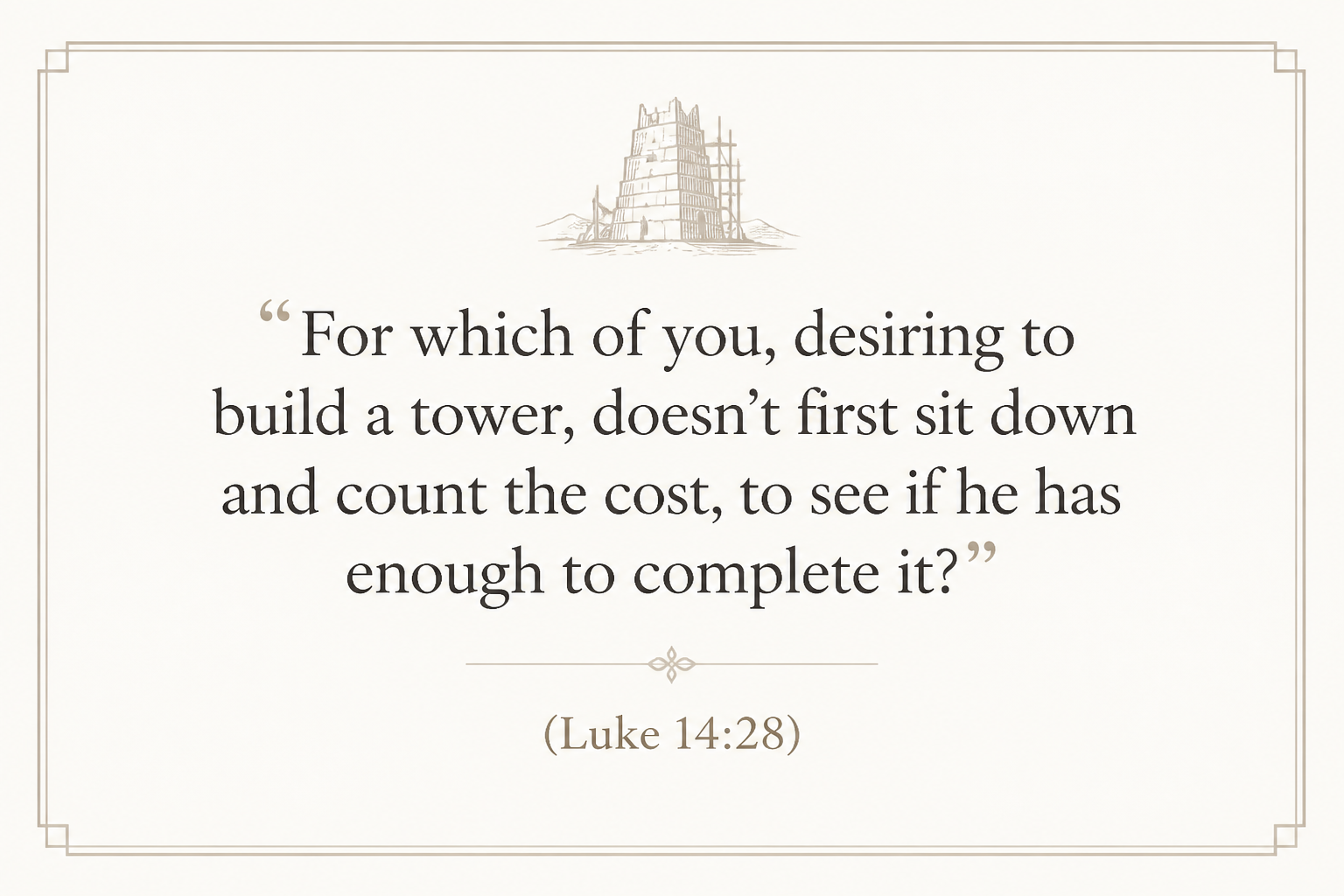
“For which of you, desiring to build a tower, doesn’t first sit down and count the cost, to see if he has enough to complete it?” (Luke 14:28)
In Luke 14:28, ἀπαρτισμός stands at the end of a chain of practical steps: the builder “desiring to build a tower” first “sit[s] down,” then “count[s] the cost,” with a specific purpose—“to see if he has enough.” The term “completion” names the decisive benchmark the cost-counting aims at: not merely starting, not merely purchasing materials, but possessing sufficient resources to carry the construction through to its finished state. In the logic of the sentence, “completion” functions as the measurable outcome that determines whether the initial desire is realistic; the builder’s calculation is judged against whether the project can be carried all the way to its endpoint.
The verse also places “completion” in close proximity to the builder’s resources (“if he has enough”), so the word’s force is concrete and evaluative. It identifies the finishing of the tower as something that requires adequacy—an adequate amount of cost covered, an adequate supply to reach the end. The rhetorical question presumes that sensible planning evaluates the whole span of the undertaking from intention to finished result, and ἀπαρτισμός names that finish as the goal against which the plan is tested.
Sense and Usage
Within its attested use, “completion” is not an abstract ideal detached from real-world constraints; it is the culmination of a process whose end can be anticipated and assessed beforehand. The building illustration contains an implicit contrast between beginning and finishing: the desire “to build” is only the first moment, but “completion” is the point that gives the project its integrity. The word therefore signals an end-state that is both intended (the builder aims at it) and demanding (the builder must “have enough” for it).
The immediate context also shapes how “completion” is heard. The sentence does not speak of completion as something that happens automatically with the passage of time; rather, it is tied to deliberate forethought: sitting down, counting, seeing. In that arrangement, ἀπαρτισμός functions like a planning criterion. It marks the finish line that should govern decisions at the starting line. The term thus carries a practical weight: it points to the kind of finish that can fail to occur if the costs exceed the resources. Even without describing the consequences, the verse’s structure makes “completion” the hinge of the builder’s judgment—either there is enough for it, or there is not.
Because the illustration uses a “tower,” the word’s sense takes on the flavor of a substantial project rather than a minor task. A tower suggests scale and visibility, and “completion” in such a context implies the full execution of a plan that was worth planning for. The term gathers up all intermediate stages—design, materials, labor, time—into a single end-point that can be named and evaluated. In this way, ἀπαρτισμός compresses the long arc of work into the concept of a finished whole.
Implied Imagery
Luke 14:28 sets “completion” against the image of a builder seated to calculate costs before a tower rises. The word evokes the difference between an envisioned structure and a structure brought to its end: a project not merely begun, but carried through until nothing necessary remains undone for it to stand as intended.
Sources: Lexical data from Strong’s Exhaustive Concordance and the Translators Brief Lexicon of Extended Strongs for Greek (STEPBible, CC BY). Occurrence data from the Translators Amalgamated Greek New Testament (STEPBible, CC BY). Scripture quotations from the World English Bible (public domain).